


The difference between playing against SB and BB 3-bets
After looking at single raised pots last week, what are the (very minor) differences between SB and BB 3-betting ranges?

In the self study series Barry Carter shows you how he tried to solve a poker problem then consults a coach or solver to get feedback on his method.
Last week I enjoyed writing about the difference between playing against SB defends and BB defends, so I thought it was only right to look at how the two spots differ when they 3-bet preflop.
Before looking at the specifics of each spot, my view was that the BB 3-bet was typically stronger than the SB 3-bet, though both strong. The reason for this is that the SB 3-bets in part to thin out the field, if they just call they incentivise the BB to call too. The BB, however, gets to close the action for a good price, so when they 3-bet they are likely to have a stronger range, because they could have seen a flop cheaply.
Similar ranges, small differences
First of all, let's look at the preflop ranges. These are the 3-betting ranges from GTO WIzard for the SB and BB, when it is folded to them at 40BBs effective, facing a CO open:
.png)
There is plenty to unpack here. First of all, the SB 3-bets 13.1% of hands whereas the BB 3-bets 12.8% of hands. So as I suggested, the SB 3-bets more to thin the field, but it is close.
Both positions value bet the same sorts of hands, which are pocket pairs 66 or better and strong Aces. The difference, it seems, is in the bluffs.
First of all, the BB occasionally shoves 44-22, which the SB never does. I consider this a semi-bluff, they don't want to get called. The reason for this is something I have explored before. Small pairs work well as shoves against late position opens. They usually get a fold and occasionally are in a flip when called. It's much more effective than set mining. The SB doesn't do this because they have two players to worry about, but the BB only is concerned about the CO.
The second big difference is that the SB bluffs with hands that play well multiway. They have all the suited wheel Ax hands, lots of suited broadway hands like Q9s and J8s, and the better offsuit hands like KJo. These are all hands that play well multiway when called because they can make straights and flushes, and often top pair is good enough.
The BB, by comparison, bluffs with junkier hands. More offsuit hands like Q8o and K5o and very little suited connected stuff. We saw in the last article that they flat with all their suited hands, because they get to do so cheaply.
Both are what I would call polarised ranges with bluffs and value, not much medium strength hands. The difference is the SB has more suited broadway in their bluffs, because they perform better multiway.
Similar post-flop pros and cons
We can explore further by looking at the aggregate reports on GTO Wizard. When the CO flat calls, the SB on average has 55.4% equity compared to 44.6% equity of the CO. The BB has 53.1% equity compared to 46.9%. So the SB is in a slightly more favourable position.
In the previous article, the SB and BB preferred different flop textures because they had very different flatting ranges. However, here the boards both players like to bet frequently are very similar. They both mostly favour Ax flops and/or paired boards. This is because their value is made of strong Aces and pocket pairs.
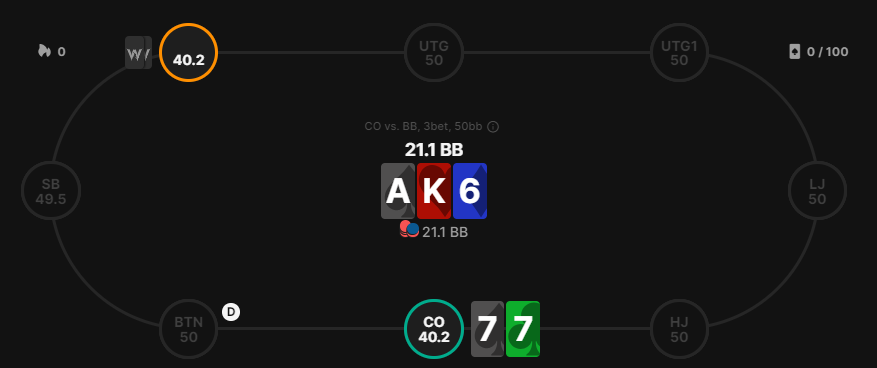
The SB performs worst on low-connected boards like 5♠4♠3♥. This is because they do not have much board coverage, given their range is mostly high cards and strong pocket pairs. The BB is in a similar predicament, however, they perform worst on Broadway flops with two or more cards of the same suit like K♥T♥9♦. This is because, as we pointed out above, their bluffs are made up of much weaker offsuit broadway, whereas the SB has hands like QJs and Q9s that hit these boards well.
The difference between SB and BB when they 3-bet is much smaller than when they flat. The main difference is that the SB has more suited broadway hands as bluffs, because they need to be able to play well against two opponents potentially. The BB does not have this worry because they get to close the action. The value portion of each range is nearly identical, however.
Previous self study articles
- Playing against disconnected players
- Overbetting with Ace King
- Why do we check back with Range Advantage?
- Why do I turn top pair into a bluff?
- How I use ICMIZER
- How wide can we go with Antes?
- Why can we bluff missed straight draws more than missed flush draws?
- How to play a strong underpair on a wet board
- How to play a 15BB stack
- How often does Villain have an Ace?
- Why do we not check/raise with the nut flush draw?
- Why do we bet small on the turn?
- When do we open shove the flop?
- The difference between SB and BB defends in single raised pots
How do you study away from the tables? Let us know in the comments:
