


Mathematical Concepts for No-Limit Holdem (1) - EV & Ranges
Introduction
In this article
- Why mathematics is important in poker
- What "equity" means
- How to calculate your expected value

In this series you will learn about basic and advanced mathematical concepts in No Limit Hold'em. You will learn to understand mathematical relationships and find out about their possible application to online poker. Here the main focus will be on the precise calculation of, or the estimating of results from various possible decisions in a hand.
You will frequently see the statement "That's +EV" in videos, the hand evaluation forums, and even articles. This will be explained in more detail later on, but for now it is clear that it means that the decision might be the right one i.e. it will create profit.
So far so good. A problem arises, however, when players have differing opinions. What if player A says "It's +EV" but player B says "No way, it's -EV or +-0 EV at best"? How do we proceed?
In many situations, there is no mathematical concept to clear things up. It is often possible though, to come to a clear conclusion or at least have the basis for an informed discussion. Those cases in particular will be the focus of Mathematical Concepts of No Limit Hold'em.
Part 1 - EV & Ranges
The first part contains an introduction to mathematical terms and definitions. The purely mathematical foundation is very basic and should not scare anyone. Nothing will go beyond maths covered in the higher secondary school level and only the basics at that. Knowing these concepts is not a pre-requisite.
Following the introduction to basic math terminology, there would be one more important poker term that will be introduced and explained: the equity. This will already help you work out your initial analyses and draw interesting conclusions. Finally, some simple examples will be calculated to illustrate how the new concepts apply to poker.
Mathematical basics
This part will include mathematical formulas. They will be introduced as mathematically correct as possible and explained in detail. You don't need to memorise all of the formulas.
Let's start with expected value (EV). The question is: What is EV?
This term is used in stochastic, a branch of math that is related to probabilities. It involves random experiments like coin flips. All experiments have possible results that get labeled xi (where i is an index to assign numbers to all possible results, in this example heads or tails).
Results will occur with a certain probability p(xi) (i again is to number the result), for example 50%.
In this discrete case, the expected value E(X) is a result of N possible different results:

Those who find this too math-heavy can skip to the part that is more closely linked to poker (starting with hand ranges). In order to really understand the concepts however, it is recommended that you try and work your way through the math.
It is important to note that individual results can be combined. One example would be if three players are actively involved in a hand.
Here it is necessary that all possible scenarios (no player calls, player A calls, player B calls, and player A and B both call) get examined separately. Each situation has to be analysed with regards to possible results and their corresponding probabilities. A good way of illustrating those calculations is using tree diagrams as you will see in the next part of this article.
The expected value in terms of money is called EV in poker. In order to understand this logically, you can assign values to results i.e. +1 for heads and -1 for tails.
Using the example of a coin flip it is easy to write down the entire result. The possible results are: x1 = 1, x2 = -1 plus the corresponding probabilities.
p(x1) = 0.5, p(x2) = 0.5.
p(x) means probability of x occurring. The expected value is hence:
EV=x1 • p(x1)+x2 • p(x2) = 0.5 • 1+0.5 • (−1) = 0
Hopefully the result does not surprise you. Admittedly it was a very basic example. Let's look at a slightly more complicated example to demonstrate the concept once more. Say a casino offers the following game:
It costs 10 chips to throw the dice once. If you throw a 1, 2 or 3 you lose all chips, a 4 means you win 5 chips, a 5 wins you 20 chips and a 6 means you win 30 chips. Is this game +EV?
To determine the EV we need to look at all possible results. In this case there are six different results corresponding to each number on the dice. Three numbers lead to the same result so they can be treated together. As each number appears with probability 1/6, this leads to the following equation:
x1 = −10, p(x1) = 1/6 +1/6 + 1/6 = 1/2
x2 = −5, p(x2) = 1/6 (you lose half your chips),
x3 = 10, p(x3) = 1/6
and
x4 = 20, p(x4) = 1/6
Now we know all the variables that we need to calculate the EV mentally or with a calculator. In this case the EV is:
result of a dice throw 1,2 or 3 result 4 result 5 result 6

It should be obvious that no casino in the world will ever offer a +EV game that you can play against the house.
Let's look at a simple example relating to poker.
FR , 100BB Stacks
Pre-flop: Hero is BU with AA
6 folds, CO raises 4BB, Hero raises 12BB, 2 folds, CO is All-In.
What a great spot. You hold aces and have the opportunity to go all-in before the flop. It's a straightforward call. It should be obvious that you will make a profit (the EV is greater than 0).
What if we want to know the exact EV? First we need to determine the possible outcomes. You could win everything that lies in the pot, 100BB from your opponent, 12BB that you have already invested and 1.5BB from the blinds (a total of 113.5BB).
We will call this result x1 = 113.5 BB.
The other possibility, it the loss of 88BB, that you're yet to call, hence x2 = −88BB
Now we need to determine the probability of both outcomes. If you assume your opponent holds QQ, KK, AA or AKs your share of the pot is 80.4% which leaves your opponent with 19.5%.
Hence your EV is:
EV = x1p(x1) + x2p(x2) = (113,5 • 0,804 − 88 • 0,195)BB = (91,25 − 17,16)BB = 74,09BB.
In cases, where the partial results of the expected values are themselves expected values of other particular situations, we can make use of tree diagrams. This way you can list all results and probabilities to gain an overview and to calculate your overall EV.
As usual the overall EV is made up of the sum of all possible results multiplied by their individual probability.
Important:
The probability for an event at second level is calculated by multiplying its probability at the second level with the probability on the relevant branch from the first level from which it stems.
To get an overview, you write the results of an event at the bottom of a branch, and the probability of that event on the branch itself. The EV is the sum of all the events multiplied by their respective probabilities.
This is an example diagram for a game of dice, with the following rules:
The game costs nothing to play. If you throw a 1, 2 or 3 you lose, a 4 or 5 wins you a chocolate bar, and a 6 means you get another go. If you get another 6 on your second go you win three chocolate bars, otherwise you win two.

Hence the EV is:
0.5 • 0+0.33 • 1+0.16 • 0.16 • 3+0.16 • 0.83 • 2 = 0.5 • 0+0.33 • 1+0.16 • (0.16 • 3+0.83 • 2) = 0.694.
This format is particularly useful if there are many possible outcomes. However, there is no real difference from a basic straightforward calculation. It just helps you visualise the overall situation more easily.
This part is fairly math-intense, but not impossible to understand. It might be easier to look at the example first.
Variance is another very important term in poker. Variance does not help you calculate EVs but it will be a permanent companion in your poker career so it is important to understand. In mathematical terms variance is a means to measure the amount of deviation of a random event from its EV.
In poker variance is used to explain the fact that even the best player in the world will have upswings and downswings. In your case this is the relevant formula:

That doesn't look particularly elegant, but it is. It's the expected value of the square of the difference between the actual value of a variable X, and its theoretical expected value. The variance measures the average square deviation from the mathematical expected value. It is used to calculate the standard deviation:
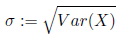
which is the square root of the variance. This ensures that the standard deviation can always be expressed as a positive number. Standard deviation then becomes a more "tangible" measure, because it gives you the average deviation from the expected value.
Let's look at an example in poker. Player A has a bankroll of $2,000. Player B offers him the following deal:
Player A gets dealt AA, and player B gets a random hand which gets played to the showdown. Player A has a choice between betting his entire bankroll once (scenario 1) or playing the game ten times, betting $200 each time. Without judging anything let's see what we can calculate.
The EV for scenario 1 is:
0.85 • $2000 + 0.15 • (−$2000) = $1400
In scenario 2 we do the same experiment ten times:
10 • (0.85 • $200 + 0.15 • (−$200)) = $1400 like in scenario 1.
The respective standard deviations (would take too much space to calculate here) are $1428.3 in scenario 1 and $451 in scenario 2. The risk of going bankrupt in scenario 2 is a miniscule 5.7665• 10−7% = 0.00000057665%, in scenario 1 however it is 15%.
The more the possible results deviate from the EV the greater the standard deviation. A NL50 player will be much more willing to risk his bankroll in scenario 2 rather than scenario 1.
More interesting than the direct calculation of standard deviations is the following observation: Poker tools like Pokertracker can calculate the standard deviation in BB/100. Given a sufficiently large database it is possible to calculate different graphs for varying numbers of hands based on your win rate and standard deviation.
Without looking into the detailed explanation the following observation is more than interesting: using mathematical simulations based on realistic standard deviations it becomes clear that for a NL BSS player, swings of up to 60 stacks are very possible, and do indeed occur even for a player with a win rate of 4BB/100 hands.
Now that you have looked at expected value, variance and standard deviation as well as tree diagrams, you have survived the mathematical introduction and explanations. After introducing you to the concepts of equity and hand ranges, you will look at the first simple examples of calculating EV in example hands.
Hand ranges
We will look at hand ranges in more detail in the second instalment of this series. For now, a basic explanation will suffice. What are hand ranges?
A hand range is a number of hands that a player would treat the same in a game situation. That means that he would play all hands in his hand range exactly the same way. This is a crucial concept, to be aware of the fact that any player in any situation could be playing not one specific hand but one from a range of hands.
This means, that when you calculate your probabilities, you need to take an entire range of hands into consideration. Similarly, when you make decisions, always consider, how your opponents will react to your action, and with what part of their hand range. It is likely that your opponent will react in one way for one part of his range and react differently for the rest of his range (i.e. he might call, or he might fold).
The bottom of a certain hand range is usually labeled with a '+' so it includes the weakest hand plus all better hands. Suited and off-suited hands are denoted with an "s" or "o". If it isn't specified, it includes both. For example: AK includes all 16 possible combinations of AK. QQ+, AQs, AK includes QQ, KK, AA, all four suited AQ combinations and all possible AK combinations.
Equity
You've probably heard of the term "equity" at some point. It is another term that originates from math. It describes the probability of winning for any player in a certain situation.
Equity is the share of a pot that a hand or hand range stands to get at that point, compared to another hand or hand range. This share of the pot allows for the possibility of a split pot, so it usually differs slightly from the exact probability of winning.
It's technically possible to calculate the equity of your hand manually. This is a simple example where the required effort is very limited:
Player A holds A , K
, K
Player B holds A , 2
, 2
the board is 7, 8, K
What is the equity of player A and player B?
You should take all possible outcomes into account. Player B will win if he hits a flush while player A does not make a full house or if he hits a 2 on both the turn and the river.
The probability of a 2 showing on both the turn and the river is 3/45 * 2/44
This is why:
There are three 2s left in the deck 2, 2, 2. The probability of hitting one of them on the turn, is the number of cards that we are hoping for, divided by the number of cards left in the deck. In this case there are 45 cards in the deck. You know the 4 hole cards of the two players and the 3 cards from the flop.
On the river we have two cards to hope for and 44 cards left in the deck hence 1/330 = 0.3%.
Add to this the possibility of hitting a flush. The probability of the flush on the turn is 9/45. If the card is not the K, player A cannot win the hand, he is drawing dead. In this case the math would look like this:
With a chance of 8/45=17.7% player B will win immediately, 1/45 times player A can hit quads or a full house on the river. This will happen 9/44 = 20.5% of the time for 2xA, 1xK, 3x7, 3x8.
For player B there is the additional chance that in 1/45 cases (probability of K on the turn) * 35/44 (probability of player A hitting neither Quads nor a full house) % = 1.7%.
So far player B has an equity of 19.7%. Now you have to evaluate the case that no will appear on the turn. If the turn is a 7, 8, A or K, player B needs a that isn't the K on the river. If none of these show on the turn, all will help player B on the river.
For player B the first case means: 9 (A, 7, 8 or K not K) / 45 * 8/44 = 3.63%, in the second case it means that 24 (no spade, no A, 7, 8 or K, nor 2, as that case we already covered)/45 * 9/44 = 10.9%. Player B has a total equity of = 35.76%.

As you can see the calculations become very tedious even in a straight forward example. Hence it is impractical to calculate more complicated scenarios that include pre-flop equity or equity for different hand ranges. However, there are different tools that can make your life easier. Using numerical integration it takes only seconds for those tools to calculate all equities in even the most complicated scenarios.
A tool like the PokerStrategy.com Equilator can calculate equities in any situation in poker using simple methods. It is possible to calculate equities for single hands like AA versus KK or you can compare equities for hand ranges like QQ+, AK versus JJ+, AQ, AK.
Different board structures as well as "dead" cards (not used in the calculations) can be analysed this way. To get a feel for equities you can have a look at the following table:
| Situation | Equity |
| pair vs. under-pair | 80% |
| pair vs. 2 overcards | 54% |
| pair vs. over- & undercard | 70% |
| pair vs. 2 undercards | 85% |
| QQ+, AK vs. 66 | 64% |
| flush draw vs. top pair | 35% |
| flush draw + overcard vs. top pair | 44% |
| set vs. flush draw | 75% |
| set vs. flush draw + gutshot | 66% |
It is extremely important to develop a feel for equities. It is possible to approximate equities in some situations using simple methods but usually there just isn't enough time.
Hence your own experience will be the most important guide. You should remember basic equities and judge them accurately when you play. You can analyse your decisions afterwards to improve your feel for the equity. Now back to a term that we introduced in the first part:
Equity is directly related to the expected value.
Cards get dealt to the showdown and every player has his share of the equity which totals "1". When repeated many times the average winnings of any player is his equity.
Using the concept of equity you can now do your own basic equity analysis calculations. There are instructions on how to do it with some examples at the end of this article.
General EV calculation
How is calculating the EV helpful if you can't really do it while you're playing? EV is useful, because you can use it to analyse your game after you have played a hand. This analysis is very important if you want to make progress as a poker player and not make conclusions like "I believe...", but have a scientific basis for the conclusions you draw.
Whoever learns to calculate the EV and strives to understand it, will be better off than someone who just relies on his "beliefs". The aim of an EV calculation isn't just to calculate a pure expected value, but also to develop a feeling for how it all comes together. How much you'd win if your opponent would fold, how much you'd win if you hit, and so on.
Usually there are certain questions that come up when calculating EVs: How big a raise can I call? What is the maximum stack of my opponent that allows me to go all-in? What hands have to be in his range to make my call profitable? The interpretation of your EV is what allows you to answer these questions.
The most important question is: do I have a positive EV or should I fold?
The EV of folding is always zero. In terms of math it's very simple. If you decide to fold there is only one possible outcome. The value linked to a fold is zero as you don't have to pay anything when you fold. There is no uncertainty in folding hence the probability is always 1.
Therefore your EV is: EV= 0 * 1 = 0. Folding is always EV neutral. Consequently any decision you would prefer to a fold should have an EV of 0 or more.
To start with an EV of 0 is your reference point. Your real condition is that EV>=0. If we assume that EV=0 we get an equation rather than an inequality. As long as you keep all but one variable constant, you can solve this equation for the one variable you are looking for. Practically speaking this means that:
If you know the size of the pot and bet sizes you can calculate the equity you need and vice versa. This way you can come up with conditions for further actions or reach a conclusion right away. With this, you can define requirements for your equity, or actions of your opponents, to see if EV (>) = 0 is satisfied. You should be aware that your play should tend towards the +EV direction rather than -EV if you want to choose a certain line.
Instructions for a simple EV calculation
It is best to calculate your EV systematically like we did in the math introduction. For one thing, you need all possible results. In simple scenarios, the result is usually the win or loss of the pot or the size of the call that you need to make.
There are several equivalent expressions for EV. We will now use the following one:
EV = Equity * (Win + Investment) - Investment
"Win" stands for any money that you can win, "Investment" is the amount that you have to pay to get a chance to win.
Now that we are done with the tedious theory let's look at some examples:
Full-ring, 100BB Stacks
Pre-flop: Hero is BU with A, 2
1 fold, UTG2 calls, 1 fold, MP1 calls, 2 folds, CO calls, Hero calls, SB calls, BB checks
Flop: 3, 8, T (Pot: 6BB)
SB bets 5BB, BB raises 10BB, UTG2 folds, MP1 raises 15BB, CO folds, Hero?
The question is: Can our Hero call?
If you are sat at the table you will have to decide one way or another. Afterwards however, you can sit down and try to calculate your EV.
EV = Equity * (Win + Investment) - Investment
In this case we will only look at your direct winnings. Hence the pot is: (6+5+10+15)BB = 36BB. The investment possible is 15BB, that you yet have to call (where investment is negative as you would lose 15BB).
The question of equity remains. However, you need to know your opponents' hands to calculate your EV. Without making any assumptions you can calculate the equity corresponding to EV=0 which is a good starting point.
EV = 0 = Equity * (36BB + 15BB) - 15BB
15BB = Equity * ( 51BB )
15/51 = Equity
You need to win slightly less than 33% of the time (exactly 29%). We learned at the start that this is the equity of a nut flush draw. A call should be fine, given that you might earn more money on the turn if you hit. You can definitely call, can't you?
Not exactly!
This analysis neglects two important facts. First, you cannot be sure that you will see the turn if you pay the 15BB. Often, the SB or BB will re-raise again which further complicates your calculations. Now you would have to calculate your EV the following way:
EV = P(NobodyRaise) * (Equity * (Win + Investment) - Investment) + P(SomebodyRaise) * (result of Somebodyraise)
P(Somebodyraise) is the probability of yet another raise, the result of which does not get looked at. This would be very complicated because all different possibilities lead down a different path. It's not impossible but very complicated.
There is another problem: You cannot be sure that you will receive your share of the pot. The equity calculation assumes that you will see a showdown. To see a showdown however, you may have to invest more money than you did on the flop, even if there is no further re-raise on the flop, because there will be betting on the turn.
As a result in this case, instead of working out the equity from the flop to the river, you should only calculate the probability of hitting something on the turn. This is expressed roughly with 8/45 i.e. 17% (you want to see a that doesn't pair the board). Otherwise you can use the equity that is relevant from flop to turn.
| Situation | Equity up to the river | Equity from flop to turn |
| pair vs. underpair | 80% | 95% |
| pair vs. 2 overcards | 54% | 86% |
| pair vs. over- & undercard | 70% | 93% |
| pair vs. 2 undercards | 85% | 100% |
| QQ+, AK vs. 66 | 64% | 57% |
| flush draw vs. top pair | 35% | 20% |
| flush draw + overcards vs. top pair | 44% | 26% |
| set vs. flush draw | 75% | 84% |
| set vs. flush draw + gutshot | 66% | 78% |
You don't nearly have the equity to make a profitable call. On the other hand, we have not taken into account that you might win more than the money currently in the pot if you make your hand on the turn.
There is, however, the fact that yours is not the last action to take place, and that someone could still raise after you (and this is quite highly probable too) along with the fact that you can't make a profitable call is sufficient to declare a fold as the best decision at this point.
The formula EV = Equity * (Win + Investment) - Investment only works if there are no options but win and lose. Should there be other situations apart from these two, the formula becomes much more complicated. Using a tree diagram it becomes clear that you have to include all possible results in your calculation. We will use this formula later in the series.
Full-ring, 100BB Stacks
Pre-flop: Hero is BU with A 2
1 fold, UTG2 calls, 1 fold, MP1 calls, 2 folds, CO calls, Hero calls, SB calls, BB checks
Flop: 3, 8, T (Pot: 6BB)
SB bets 5BB, BB calls 5BB, UTG2 folds, MP1 calls 5BB, CO folds, Hero?
The situation is similar but Hero is the last to act. Hero can call and see the turn or fold. Once again we will use the formula:
EV = 0 = Equity * (6BB + 5BB*4) - 5BB
Equity = 5BB/(6BB+5BB*4) = 0.19 = 19%
If we look once again at the equity from flop to turn for a flush draw, we would be oriented once again towards a call. Adding the possibility of seeing the river and further streets for free or winning money on the turn, the call becomes preferable to any other option.
How does EV analysis help? EV analysis helps to provide you with a mathematical foundation. You can check whether a decision that you have made during play, remains the best line once you've analysed the hand taking precise pot and bet sizes as well as the equity into consideration.
The opinion of other (good) players is particularly useful when a detailed EV analysis is impossible, because there are too many different scenarios that might occur in the hand creating too many variables to consider. Beyond statistical analysis from a database there is no other guideline other than the personal experience of other players.
Last but not least an example with an all-in situation.
Full-ring, 100BB Stacks
Pre-flop: Hero is CO with Q J
UTG+1 calls 1BB, 5 folds, Hero raises 5BB, BU calls 5BB, SB folds, BB folds, UTG+1 calls 4BB
Flop: A, K, 5 (Pot: 16,5BB)
UTG+1 checks, Hero bets 14BB, BU raises 36BB, UTG+1 is All-In, Hero?
Can Hero make a profitable call? Lets look at the variables. If you don't make your hand you lose 81BB.
One further (realistic) assumption should be made: BU will not fold his hand once you call. He has to call 59BB to play in a 300BB pot which he will almost always do. Hence you can win 215.5BB (100BB from UTG+1 and BU, 1.5BB dead money and 14BB that Hero has already bet). Hence you need the following equity for a break-even call:
81/( 296.5 ) = 0.27 = 27%
If your equity is over 27% you can call. Here you can use a well-established tool, the worst case analysis, to approximate your equity. For this, you allocate cards to your opponents that would be the worst possible cards from your perspective.
If you still have sufficient equity (or if you are very close) you can assume that a call is profitable because the worst case scenario rarely materialises. In this case the worst possible combination would be a set and another flush draw. The flush draw steals some of your outs, while the set is currently the best hand and has a re-draw against your flush. This results in the following scenario:
| Equity analysis | |||||
| Board | A K 5 |
||||
| Equity | Win | Split | Loss | Hand | |
| Player 1 | 28.57% | 28.57% | 0% | 71.43% | Q J |
| Player 2 | 70.43% | 70.43% | 0% | 29.57% | AA |
| Player 3 | 1% | 1% | 0% | 99% | T 9 |
Hence a call is clearly profitable. Your equity can't be worse than it is in this scenario. Note that the straight and the flush draw are drawing to the nuts. If this wasn't the case the calculations would become more complicated.
Summary
In this article you have learned about the basic mathematical concepts and terminology of No Limit Hold'em and how to apply them.
In the second part of the series we will look at hand ranges, fold-equity as well as implied and reverse implied odds in order to look at more complicated examples.
| LINKS | |||||
|
|||||


