


Ranges & Equity (1): Introduction to Ranges

If you knew your opponent's hand, then you would be able to make the perfect decision in every situation. Unfortunately, this is impossible as you will hardly ever be able to definitively put your opponent on one specific hand. Instead, you can rely on your knowledge, your experience and your observations to put your opponent on a number of possible hands. We call this collection of hands his range.
A range is therefore a set of hands that a player could be holding in a certain situation. This compilation of hands could be a number of single starting hands, but it could also be made of certain hand ranks such as two pairs, sets and flush draws.
If your opponent has a set on a T84 board, his range is: TT, 88, 44.
The concept of ranges is an essential tool if you want to play poker successfully. It allows you to systematically write down assumptions about your opponent's possible hands in order to analyse them. What's more, it is an indispensable instrument to help you in identifying the best course of action.
This lesson will show you how to define ranges and how to write them down following a generally accepted convention.
 |
A range is a collection of hands that a player could be holding in a certain situation! |
Defining ranges and writing them down: how does it work and what's the point?
In order to analyse a hand, you have to write down and summarise the opponent's range in a way that makes it possible to evaluate it using poker software, like the Equilab.
There is a general convention on how to note ranges down. Knowing and applying it will offer you the following advantages:
- You can exchange information with fellow poker players more easily when, for example, you are studying hands.
- You can identify the probability that your opponent has a certain type of hand (such as flush draws, sets and top pairs) more quickly.
- Analysing ranges with tools like the Equilab is more straightforward; you can work faster and in a more precise manner.
The following table offers you an overview of the various hand types and how to write them down:
| Notation of ranges | |||
| Hand category | Example range | Example range notation | |
| All pairs | 22, 33, 44, ..., AA | 22+ | |
| A sequence of consecutive pairs | 44, 55, 66, 77 | 77-44 | |
| A sequence of suited connectors | 65s, 76s, 87s, 98s, T9s, JTs, QJs, KQs, AKs |
65s+ | |
| A sequence of suited hands | 74s, 75s, 76s | 74s+ | |
| All combinations including an ace | A2s, ..., AKs, A2o, ..., AKo |
A2+ | |
| All combinations of suited aces | A2s, ..., AKs | A2s+ | |
| All combinations of offsuit kings | K2o, K3o, ..., KQo, AKo | AKo, K2o+ | |
| A sequence of suited one-gappers | 86s, 97s, T8s, J9s, QTs, KJs, AQs | AQs-86s | |
| Top x% of the strongest starting hands | 5% | 88+, AJs+, KQs, AKo | |
There are two rules for the notation of ranges:
For card sequences with one or more gaps between the lowest and highest card applies: only the smaller card grows in ascending order until it's directly adjacent to the bigger card. For example, a range of 96+ comprises 96, 97 and 98.
However, for hands with directly adjacent cards without a gap, like 65+, both cards will grow in ascending order until they reach AK i.e. 65, 76, 87, ..., AK.
Ranges can be given relative to hand strength. If this is the case, then the range will change to reflect hand combinations in relation to the board. Suppose that you believe your opponent may have a flush draw, his range would not simply indicate the starting hand but also a concrete suit.
Examples for defining and writing down ranges
The examples will allow you to practice detecting your opponent's range and writing it down.
Example 1: The board is 

 and your opponent's range is made up of top pairs, OESDs (open-ended straight draws) and ace-high flush draws. How do you build his range from this information?
First, you write down the hand combinations that reflect the various hand ranks:
Top pair: AQ, KQ, Q9-Q3, QJ (Q2 and QT can be discarded as they would be a two pair)
OESD: KJ, J9
Flush draw: As3s, As4s, As5s, As6s, As7s, As8s, As9s, AsTs, AsJs, AsKs
His complete range thus is: AQ, KQ, Q3-Q9, QJ, As3s, As4s, As5s, As6s, As7s, As8s, As9s, AsTs, AsJs, AsKs, KJ, J9

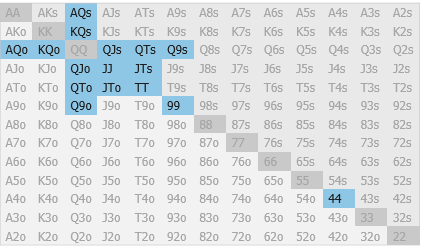
Example 2: You might have heard an experienced player answering a question like "With which range would the opponent call on this flop?" as following:
“The Flop was 

 ; I bet big and he calls. He was very passive, so he will call all of his sets and never raise them. I can however exclude QQ, because he would have pushed it pre-flop; same goes for AA and KK. I also don't see him folding his good top pairs. His range should include top two pair, too. I'm also positive that he would call his open-ended straight draw. When it comes to TT and JJ, I'm not completely sure, but I think he will probably also call those at least once on the flop.“
Having read this statement, you should now be able to turn it into a complete range. According to the convention that you now know, you can write down the opponent's calling range as follows:
Sets: 99, 44
Good top pairs: AQ, KQ, QJ, QT
OESD: JT
Top-Two pair: Q9
Specific Hands: JJ, TT
Combining this, you find the following complete range: JJ-99, 44, AQ, KQ, Q9+, JT
Summary
|
 |