


Ranges & Equity (2): Combos & Card Removal

Before this lesson, it is recommended that you read the following article:
You are already familiar with the concept of ranges and know how to notate them. Now let's imagine your opponent has a range of QQ and AK. Which hand is more likely?
You might assume that each hand is equally likely, since QQ and AK both represent one specific starting hand.
However, the correct answer is quite different. There is a 27% chance that your opponent has QQ and a 73% chance that he has AK. The reason for this is that the two hands are each made up from a different amount of poker card combinations - called combos.
Counting combos is necessary to analyze ranges correctly; in this lesson you will learn how to do this. We will also take a look at how your cards, your opponent's cards, and the board each influence the combos and the way we count them.
How to count combos for specific hands and ranges
There are four queens in the deck and therefore six possible combinations of cards that give us the hand QQ. However to make AK, there are 16 possible card combinations. Four aces combined with four kings gives you 4 x 4 = 16 combinations.

Note that the order of the cards within a combo doesn't matter; 
 is the same hand as .
The sum of all combos for a specific range (or part of a range) is an important factor in assessing how likely it is that your opponent has a certain hand. The more combos there are in a hand or range, the more likely it is that you are facing this range and vice versa.
For easy documentation, we use the "#" symbol to indicate the amount of combos that make up a range. The range QQ, AK has 6 + 16 = 22 combos which means that the short form for writing this is:
QQ, AK (#22)
 |
A combo is a specific combination of two cards that make up a certain hand. The sum of possible combos for creating a certain hand, or range of hands, is important information when estimating the hand strength of your opponent based on his range. |
The following table gives you an overview of the number of possible combos for certain categories of starting hands:
| Hand category |
Possible combos | Example |
| Pocket pair | 6 | |
| Offsuit hand | 12 | AKo |
| Suited hand | 4 | AKs |
| Suited/offsuit hand |
16 | AK |
Card removal influences counting combos
Card removal refers to the fact that the dealt community cards and your own hand directly influence the likelihood of certain hands or the number of combos in your opponent's range.
For example, we know that a pocket pair consists of six combos, and that a specific suited hand consists of four combos; this can change depending on the community cards that hit the flop. Let's look at the following situation:
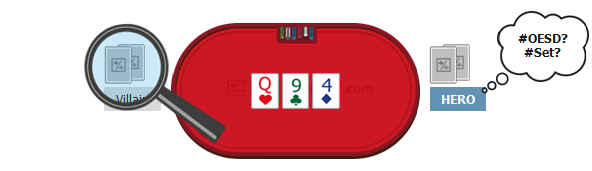
We're assuming our opponent has a range of either sets or an open-ended straight draw, and we want to determine which is the more likely holding.
Notating ranges isn't an issue for you anymore, so you know his range is QQ, 99, 44, JT.
Given what you have already learned, it is natural to assume that QQ, 99, and 44 have six combos each and that JT has 16 combos. This makes 18 set combos and 16 OESD combos, making a set more likely.
But this doesn't take the board into account. Cards on the board can't be used in your opponent's range; villain can't have a card that's already on the table. This effect is called card removal.
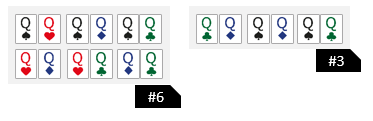
Since the  is already on the board, there are only three queens left that could make up QQ as a hand.
This means that there are only three combos that make a set with QQ. There are only nine combos that make a set with any of the three community cards.
| Without card removal |
With card removal (on   ) ) |
For an OESD on the other hand, a board like still allows for all 16 combos to be available, since there is no jack or ten on the board.
In total, there are 16 combos for an OESD as opposed to 9 combos for a set. Therefore the chances of an OESD are 64%; 36% for a set.
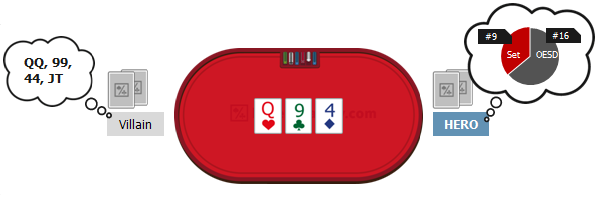
By determining the exact number of possible combos that make up a certain hand strength utilising card removal, you can calculate the likelihood of this hand strength within a range. This is a very important tool to make optimal decisions based on your analysis of the situation.
Card removal includes your own hand
Card removal takes into account both the community cards and your own hand, making it a crucial concept in online poker strategy.
How many combos are there for your opponent to hold QQ in the hand below?
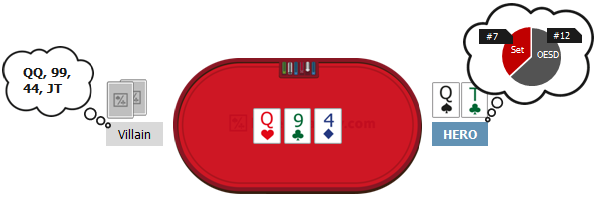
In this situation, there are even fewer queens available for making a set than previously. Due to card removal, you have to exclude the on the board as well as the  in your own hand, leaving only the and the - exactly one combo.
The effect of card removal
Card removal doesn't just play a big role in affecting the likelihood of sets, but also when you are facing hands that are far more common, such as top pair.
On a board such as 
 there are only 12 instead of the usual 16 combinations that make up a hand like AQ: 4 aces x 3 queens = 12.
If we assume that you also have a queen in your own hand (maybe  ), then there are only eight combos left for AQ; 4 aces x 2 queens. If you have an ace yourself, say
  , there are nine combos left for AQ; 3 aces x 3 queens.
The following table shows you how card removal influences the possible combos for different hands:
| Hand | With card removal on: |
Without card removal | ||||
| You have |
You have |
|||||
| AQ | 12 | 8 | 9 | 16 | ||
| AQs | 3 | 2 | 2 | 4 | ||
| Q6 | 9 | 6 | 16 | |||
| Q6s | 2 | 1 | 4 | |||
| 3 | 1 | 6 | ||||
Summary

Combos are combinations of individual cards that create a certain starting hand. The number of possible combos is different depending on the type of starting hand:
- Pocket pair: 6 combos
- Suited hand: 4 combos
- Offsuit hand: 12 combos
Card removal means taking into account that community cards and cards in your own hand cannot be included in your opponent's range. This influences the likelihood of villain holding certain hands depending on the board and your cards.