


BB Pre-flop Ranges

The big blind is the second-worst position at the table. In this lesson, you will find the typical pre-flop ranges for playing from the big blind in a No-Limit 6-max game. Compared to the small blind, you have better pot odds for just calling a raise and your call usually closes the action, making sure that nobody behind you can go for a squeeze.
You will also learn which characteristics and tendencies of the standard opponent played a part in the creation of these ranges.
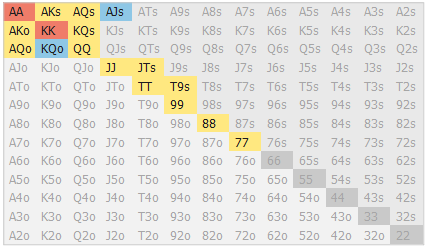
Against an open raise from UTG
| Defending range: 77+, AJs+, KQs, JTs, T9s, AQo+, KQo (8%, #108) | ||
 |
||
| Call: QQ-77, AQs+, KQs, JTs, T9s, AQo+ (6%, #80) |
||
| 3-Bet/Fold: AJs, KQo (1%, #16) |
||
| 3-Bet/5-Bet: KK+ (1%, #12) |
||
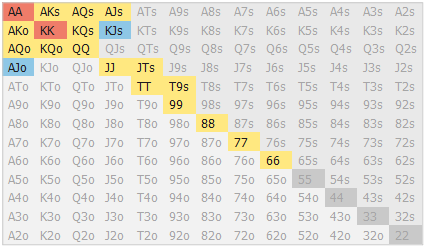
Against an open raise from MP
| Defending range: 66+, AJs+, KJs+, JTs, T9s, AJo+, KQo (10%, #130) | ||
 |
||
| Call: QQ-66, AJs+, KQs, JTs, T9s, AQo+, KQo (8%, #102) |
||
| 3-Bet/Fold: KJs, AJo (15%, #16) |
||
| 3-Bet/5-Bet: KK+ (1%, #12) |
||
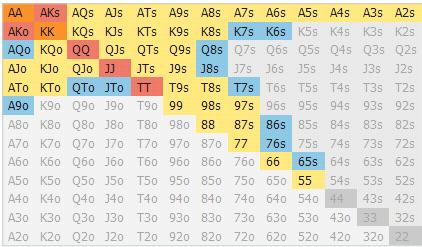
Against an open raise from the cut off
| Defending range: 55+, A2s+, K6s+, Q8s+, J8s+, T7s+, 97s+, 86s+, 76s, 65s, A9o+, KTo+, QTo+, JTo (25%, #332) |
||
 |
||
| Call: AsAc, KdKh, KdKs, KdKc, 99-55, AQs-A2s, K8s+, Q9s+, J9s+, T8s+, 97s+, 87s, AJo-ATo, KTo+, QJo (16%, #210) |
||
| 3-Bet/Fold: K7s-K6s, Q8s, J8s, T7s, 86s, 76s, 65s, A9o, QTo, JTo, AQo (6%, #80) |
||
| 3-Bet/5-Bet: QQ-TT, AdAh, AdAs, AhAs, AdAc, AhAc, KhKs, KhKc, KsKc, AK (3%, #42) |
||
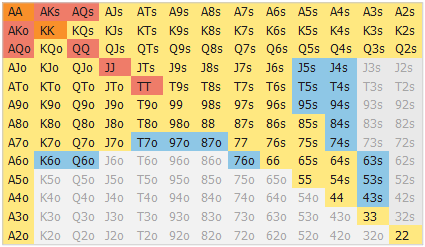
Against an open raise from the button
| Defending range: 22+, A2s+, K2s+, Q2s+, J4s+, T4s+, 94s+, 84s+, 74s+, 63s+, 53s+, 43s, A2o+, K6o+, Q6o+, J7o+, T7o+, 97o+, 87o, 76o (58%, #766) |
||
 |
||
| Call: AsAc, KdKh, KdKs, KdKc, 99-22, AJs-A2s, K2s+, Q2s+, J6s+, T6s+, 96s+, 85s+, 75s+, 64s+, 54s, AJo-A2o, K7o+, Q7o+, J7o+, T8o+, 98o (45%, #592) |
||
| 3-Bet/Fold: J5s-J4s, T5s-T4s, 95s-94s, 84s, 74s, 63s, 53s, 43s, K6o, Q6o, T7o, 97o, 87o, 76o (9%, #116) |
||
| 3-Bet/5-Bet: AdAh, AdAs, AhAs, AdAc, AhAc, KhKs, KhKc, KsKc, QQ-TT, AQ+ (4%, #58) |
||
Against an open raise from the small blind
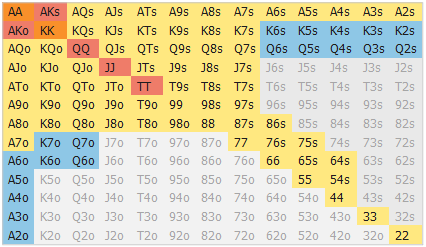
| Defending range: 22+, A2s+, K2s+, Q2s+, J7s+, T7s+, 97s+, 86s+, 75s+, 64s+, 54s, A2o+, K6o+, Q6o+, J8o+, T8o+, 98o (49%, #646) |
||
 |
||
| Call: AsAc, KdKh, KdKs, KdKc, 99-22, AQs-A2s, K7s+, Q7s+, J7s+, T7s+, 97s+, 86s+, 75s+, 64s+, 54s, AQo-A7o, K8o+, Q8o+, J8o+, T8o+, 98o (34%, #456) |
||
| 3-Bet/Fold: K6s-K2s, Q6s-Q2s, A6o-A2o, K7o-K6o, Q7o-Q6o (11%, #148) |
||
| 3-Bet/Call: AdAh, AdAs, AhAs, AdAc, AhAc, KhKs, KhKc, KsKc, AK, QQ-TT (32%, #42) |
||
Why these ranges?
The ranges for defending the big blind against open raises from UTG or MP are rather tight while the ranges against the wide open raising ranges from the cut off and especially the button and small blind are a lot wider themselves.
Since most opponents only raise 2-2.5BB from late position, you get good pot odds for calling, and you can defend a lot of hands profitably against these wide ranges. It's important to attack these wide ranges post-flop by going for an increased number of check/raises and OOP floats.
The same goes for open raises from the small blind. The standard opponent on which these ranges are based raises a very wide range from the small blind which is why your range for defending it is relatively wide itself. Keep in mind that open raising ranges of your opponents from the small blind may vary a lot. They can go from a tight 25% range to up a range of virtually 100%. The higher your opponent's open raising range, the wider should your 3-bet and call ranges from the big blind be.