


Game Plan (5): Calldown Frequencies: River

Before this lesson, you should already have read:
- Game Plan (4): Calldown Frequencies
- Game Plan (1): Introduction
- Hand Reading (6): Value to Bluff Ratio
- Ranges & Equity (4): Equity: Final Calls
If you are confronted with a bet on the river while holding a bluff catcher, it isn't always clear whether you should call or fold. In the previous lesson Calldown Frequencies you learned about four factors that influence your call frequency. Factor 2: Draw Potential and Factor 4: Future Playability aren't applicable on the river. Through this simplification, you can determine your call frequency by using Factor 1: Bet Size and Factor 3: Favourable Boards. In this lesson, you will learn how to construct your river ranges in five steps.
Calldown Frequencies: River orientates itself on your own range. It divides your showdown value range into a raise, call and fold range. The bluff catch decision is made for every hand in your range.
 |
If you find yourself in a bluff catch situation on the river, you can use Calldown Frequencies: River (CFR) to determine which of your bluff catchers to call with and which to fold. |
Your opponent's range is unknown
If you are on the river and your opponent bets into your bluff catcher, you can use two ways to make the decision between calling or folding.
- If you can estimate your opponent's range well, choose the method from the lesson Equity: Final Calls.
- If you can't properly estimate your opponent's range, then choose the CFR method.
Rarely will your opponent have a perfect bluff frequency, in which case the EV of your bluff catcher is identical with a call or fold. If your opponent bluffs more, a call has a better EV. If your opponent bluffs less, a fold has a better EV.
If you can't determine which bluff frequencies your opponent plays with which probability, i.e. whether a call or fold is better, then calldown frequencies are your best option. You play the call strategy that prevents bluffs and minimises the payoff to value bets. This lets you minimise the EV of your opponent's betting range.
|
CFR is used when... ...you hold a bluff catcher against a river bet. ...you don't know your opponent's bluff frequency. |
Calldown frequencies against regulars
You will frequently find yourself in situations in which your opponent's river bluff frequency is largly unknown. For example:
- You are playing against an unknown regular: You have no information about his Value to Bluff Ratio on the individual streets. You play calldown frequencies until you have gathered more information that can help you make exploitive calls or folds.
- You are playing against a known strong regular: He will try to adapt to your game, in the same way you are trying to adapt to his. This is also called levelling. If you can't accurately determine your opponent's VB-Ratio, then you use calldown frequencies.
Five steps to your calling range
In five steps, you divide your bluff catchers into raise, call and fold ranges.
Step 1: Determine your own river range.
Step 2: Determine your showdown value range.
Step 3: Determine the fold frequency of your showdown value range.
Step 4: Determine your raising range.
Step 5: Choose your calling hands.
These five steps are demonstrated with the following example hand.
NL1000 Cash
BU: $1000 (100 bb)
SB: $1000 (100 bb)
Hero (BB): $1000 (100 bb)
Pre-flop: Hero is BB with 

BU raises to $20, SB folds, Hero calls $10
Flop: ($45) 

 (2 players)
Hero checks, BU bets $22.50, Hero calls $22.50
Turn: ($90)  (2 players)
Hero checks, BU bets $60, Hero calls $60
River: ($210)  (2 players)
Hero checks, BU bets $140, Hero ?
Here the two conditions for CFR are met.
- You are holding a bluff catcher against a river bet.
- An evaluation of how often your opponent bluffs here isn't possible, your opponent can use different game plans that lead to different bluff frequencies on the river:
Opponent's game plan Motivation of your opponent Bluff frequency on the river No bluffs on the turn:
c-bet – give upYour check/call on the flop includes mainly Ax top pair. A further bluff isn't worth it. Very low Turn semibluffs:
barrel equityYour check/call on the flop includes some K high and middle pairs. Against that a bluff with equity is worth it. Moderate Turn a lot of bluffs:
barrel everythingYour check/call on the flop includes mainly Ax top pairs. If you don't hit two pair you will fold on the river. Against this, a 3 barrel bluff is worth it with any hand. Very high
In this hand, you don't know how your opponent plays. You can't attack his game plan, you can only defend your own game plan. You use the CFR method to determine which hands from your range you call with and which ones you fold.
Step 1: Determine your own river range
Your range on the previous streets gives you your river range.
In the example you reach the river with 161 combinations:
66-22, ATs-A2s, K6s-K3s, Q5s-Q4s, 75s, 65s, 54s, 
 ,
,  ,
,  , ,
, ,  ,
,  ,
,  ,
,  , ,
, ,  , , A9o-A2o, K6o (#161)
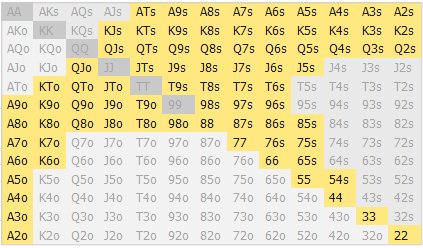
Pre-flop, you call with this range:
 |
||
| Call: 88-22, ATs-A2s, KJs-K2s, Q2s+, J5s+, T6s+, 96s+, 85s+, 75s+, 65s, 54s, A9o-A2o, KTo-K6o, Q8o+, J8o+, T8o+, 98o (39%, #514) |
||
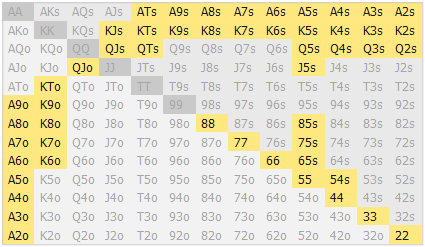
Your game on this board texture doesn't include a check/raising range on the flop or turn. Accordingly, you play a wide check/call range that includes a lot of floats. Due to card removal, you still have 464 combinations in your range on the flop. From these, you call the 1/2 pot size c-bet with 280 combinations.
On the flop, you call with this range:
 |
||
| Call: 88-22, ATs-A2s, KJs-K2s, QTs+, Q5s-Q2s, J5s, 85s, 75s, 65s, 54s, A9o-A2o, KTo-K6o, QJo (#280) |
||
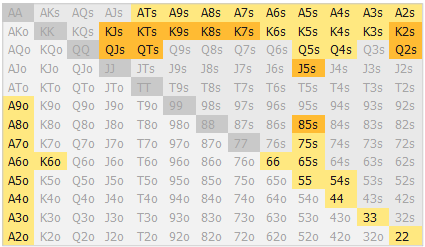
Against the 2nd barrel of your opponent, you fold the unimproved floats as well as your worst pairs. On the turn, you call the 2/3 pot size bet with 161 of your 269 turn combinations.
On the turn you call with this range:
 |
||
| Call: 66-22, ATs-A2s, K6s-K3s, Q5s-Q4s, 75s, 65s, 54s, KhJh, QhJh, KhTh, QhTh, Kh9h, Kh8h, Kh7h, Jh5h, 8h5h, Kh2h, Qh2h, A9o-A2o, K6o (#161) |
||
Call ( flushdraw; only combinations) flushdraw; only combinations)
|
||
You reach the river with exactly this range.
Step 2: Determine your showdown value range
You can divide your river range into a showdown value range and an air range. Your showdown value range includes all hands that beat your opponent's bluffs. All other hands belong to your air range.
Your opponent's bluffs are only profitable if you fold better hands. If you fold a hand from your air range, this doesn't influence the profitability of your opponent's bluffs. You need to define the part of your range that is vulnerable to bluffs - your showdown value range.
|
The lower limit of your showdown value range is the worst hand that still beats all your opponent's bluffs. |
Your opponent bluffs on the river up to jack high. From queen high onwards, i.e. from , you beat all his bluffs.
Your air range in the example consists of two combinations: , .
Your showdown value range consists of 159 combinations: 66-22, ATs-A2s, K6s-K3s, Q5s-Q4s, 75s, 65s, 54s, , , , , , , , , , A9o-A2o, K6o.
This step mirrors Factor 3: Favourable Boards. If your opponent has the stronger range, he bluffs with relatively stronger hands. Your showdown value range only starts from these strong bluffs. This means you will call less. If you have the stronger range, you possibly don't even have an air range. You then call more often.
Step 3: Determine the fold frequency of your showdown value range
The fold frequency is determined by the river bet size of your opponent and the pot size.
|
The fold frequency of your showdown value range is equal to b/(b+p). |
b: Bet size
p: Pot size
If you fold more than the fold frequency, your opponent's bluffs gain auto-profit. If you fold less than the fold frequency, your opponent generates too much value with his stronger hands.
In the example, you play a fold frequency of 40%. From the 159 combinations of your showdown value range, you fold 63.6 combinations, while you call or raise 95.4 combinations.
b = $140 - the bet size of your opponent is equal to $140
p = $210 - the pot size is equal to $210
fold frequency = b/(b+p) = $140/($140+$210) = 2/(2+3) = 40%
fold combinations = #159 * 40% = #63.6
This step mirrors Factor 1: Bet Size. Against a small bet, you fold less often than against a bigger bet.
Step 4: Determine your raising range
Your raising range consists of a value and a bluff range. The number of bluff combinations depends on the raise size and the combinations in your value range.
A bluff from your opponent is equally unsuccessful against calls and raises. Therefore, your raise range influences your call range. The more you raise, the less you call.
|
Your bluff range is r/(p+r) times as big as your value range. |
r: Raise size – the amount larger than the call
p: Pot size – the pot size in case of a call
In the example, you decide to raise all-in to $897.50 with your value range, which consists of 75s. (Note: raising a small set is too thin. If your opponent incorrectly value bets against your strategy with AK-AJ to $140 on the river, then you can exploitively raise with 66 and 44-33.)
Your value raise range consists of 4 combinations: 75s.
Your bluff raise range consists of 2.4 combinations: 5d5s, 5d5c, 5s5c (40%).
Your total raise range consists of 6.4 combinations.
r = $757.5. You raise the $140 bet by $757.50 to $897.50 – a 1.5x potsize raise.
p = $490. After calling the $140 Bet there is $140+$140+$210 = $490 in the pot.
Bluff-multiplier = r/(p+r) = $757.50/($490+$757.50) = 60.7%
Your raise 60.7% of your value range as a bluff. 60.7% of your 4 combinaton value range is 2,43 combinations, or around 2,4 combinations.
Your raise 6,4 combinations and fold 63,6 combinations of your 159 combinations of showdown value range. That means you call 89 combinations (89 = 159 - 6,4 - 63,6).
This step again mirrors Factor 3: Favourable Boards. If your opponent has the stronger range, then you can value raise and bluff raise less. You also call more often. If you have the stronger range, then you can value raise and bluff raise more often. You therefore call less often.
Step 5: Choose your hands
Your fold, call and raise frequencies add up to 100%. You reach the call frequency by taking the hands with the biggest equity into your call range.
Here you first take into account the absolute hand strength. Hands that beat the weakest value bet of your opponent are taken into your call range. For the rest of your hands in your showdown value range, the following counts:
|
Hands that lose against all value bets but beat all bluffs only differentiate in equity due to blocker effects. |
You analyse the two direct blocker effects:
- Blocking the value range of your opponent
- Blocking the bluff range of your opponent
If you hold cards that reduce the combinations in the value range of your opponent, these hands are more suitable for bluff catching. You will run into a strong hand less often. If you hold cards that reduce the combinations of your opponent's bluff range, these hands aren't suitable for bluff catching. You will run into a bluff less often.
In the example, you determine the 89 best combinations of your showdown value range for your calling range.
You will therefore fold 63.6 combinations from your 159 combinations of showdown value range. 6.4 combinations will be raised, and therefore the last 89 (= 159 - 63.6 - 6.4) combinations will be called.
Hands that beat the weakest value bets of your opponent are 66, 44-33, ATs, A6s, A4s-A3s, A6o, A4o-A3o, which is 39 combinations. These hands are always calls. You are missing 59 further call combinations to reach the 89 call combinations.
The other hands in your showdown value range lose against all value bets of your opponent. Therefore, their absolute hand strength isn't important, but rather their blocker effects. the best blocker hands are the remaining Ax combinations. All remaining top pairs, A9s-A7s, A5s,A2s, A9o-A7o, A5o, A2o are a furher 60 combinations. From these 60 combinations you choose the best 50 call combinations using the the blocker criteria. Against the river triple barrel range of AA, 66, 44-33, A6s, A4s-A3s, 75s, 64s-63s, 52s, 43s, A6o, A4o-A3o, 75o (#66), your different Ax hands block as shown in the table below.
BU's value range: AA, 66, 44-33, A6s, A4s-A3s, 75s, 64s-63s, 52s, 43s, A6o, A4o-A3o, 75o (#66).
| Your hand |
#Value range BU |
| No cards | 66 |
| A5 | 50 |
| A7 | 51 |
| A2 | 54 |
| A8, A9 |
55 |
| 55 | 56 |
Card removal
You call with A5, A7 and A2 (#36). You call with 14 further combinations of your #24 A8 and A9, to reach 50 call combinations. A9 and A8 are different due to blocking the bluff range of your opponent. A8 blocks probable 87 and 85 bluffs. Therefore A9 will more often win after a call than A8. You additionally call A9 (#12). You need two further call combinations of A8. Ax block probable , , , and bluffs of your opponent. From your A8 without , you choose two call combinations: 
 and
and  .
.
You fold A8o and  (#10).
Note that you fold A8o while calling A2, A5 and A7. Against the betting range of the button, the weaker Ax hands have more equity due to card removal.
Summarised, your river ranges in the example look as follows: you reach the river with 161 combinations. From these, #159 are in your showdown value range.
You fold #63.6 (22, 5d5h, 5h5s, 5h5c, 5s5c (60%), K5s-K3s, Q5s-Q4s, 65s, 54s, KhJh, QhJh, KhTh, QhTh, Kh9h, Ah8h, Kh8h, Kh7h, Jh5h, 8h5h, Kh2h, Qh2h, A8o, K6)
You raise #6.4, #4 for value (75s) and #2.4 as bluff (5d5s, 5d5c, 5s5c (40%))
You call #89 (66, 44-33, ATs-A9s, A7s-A2s, Ad8d, Ac8c, A9o, A7o-A2o)
Bluff raise hands
You choose hands from your folding range to bluff raise with. You want to block your opponent's top range to make a call or reraise less likely. The best bluff raise hand here is 55. You block eight combinations for the nut straight (75 goes from #16 to #8) and two combinations for the 2nd nut straight (52s goes from #4 to #2).
You dont bluff with every one of the six 55 combinations. You only bluff with 2.4 combinations. 55 without a heart is better than with. 55 with hearts blocks draws that your opponent bet/folds with. You bluff raise 2.4 combinations of 55 without heart:  ,
,  and 40% of the combinations.
When you can't use CFR
In principle, CFR can be used for every river bet and every river raise. In the following situations, however, you should not use this method.
- Multiway pots
- Protected pots
- Boards with high split pot probability
- You have made strong adjustments to your range against an opponent on previous streets. Your knowledge about your opponent has to flow into your river decision.
- Due to blocker effects, CFR can suggest calling ranges that induce large changes in your opponent's value range.
Summary
 CFR divides your bluff catchers into raise, call and fold ranges. You use the method against opponent's whose ranges are unknown to you.
Five steps to get your calling range:
Define your own river range:
Determine with which hands you get into these bluff catch situations.
Define your showdown value range:
Remove air from your range.
Define the fold frequency of your showdown value range:
Play the exact fold frequency that will lead your opponent's bluffs to not make any profit.
Define your raising range:
The more you value raise and therefore bluff raise, the less you need to call.
Choose your call hands:
Call hands with the highest equity until you reach your call frequency. Pay attention to blockers.