


Game Plan (4): Calldown Frequencies

Before reading this lesson, you should have already read:
Calldown frequencies are part of your basic game plan. They define your post-flop calling ranges.
 |
Calldown frequency: A concept to determine your post-flop calling ranges. |
In your basic game plan, you set up ranges that you will reach the flop with. If your opponent bets post-flop and you aren't quite sure what your opponent's value and bluff ranges look like, calldown frequencies are your standard response. You only deviate from this standard if you have reads on your opponent.
The aim of your call strategy is to minimise the EV of your opponent's betting range.
Pay attention to the following:
- If you don't call enough, your opponent's bluffs become too profitable.
- If you call too often, your opponent's value bets become too profitable.
There is an optimal calldown frequency where you call neither too much nor too little.
The correct calldown frequency minimises the EV of your opponent
Too many calls, as well as too few calls, can increase the EV of your opponent's betting range. There is a limit that marks the correct call frequency. Hands above this border you call with, and hands below it are folded.
If you call with hands below this border, the money you lose to his value bets will be greater than the money you gain from his bluffs.
If you fold hands above this border, the money you save against his value bets will be less than the money you lose to his bluffs.
|
Your Calldown strategy minimises the EV of your opponent's betting range. |
Example:
You are on the turn, and the following ranges meet:
Hero ($400): AQ, QQ, Q9 (#30)
Villain ($400): AK, JT (#28)
Turn: 


 ($100) (2 players)
Hero checks, Villain bets $100, Hero?
You can't profitably raise all-in with any of your hands. You have to decide between calling or folding with all of your hands. On the river your opponent will value bet and bluff accurately.
| Hand | AQ | Q9 | |
| Turn equity | 58% | 51% | 46% |
| River realization | 48% | 43% | 30% |
| River EV | $150 | $102 | $94 |
| Turn call EV | $50 | $2 | -$6 |
If you only call the turn with AQ (too little), then your opponent's betting range has an EV of $80.
If you call the turn with AQ and QQ (correct), then your opponent's betting range has an EV of $79.
If you call the turn with AQ, QQ and Q9 (too much), then your opponent's betting range has an EV of $82
Turn all-in
If you go all-in on the turn for $400, then your opponent only calls with AK.
EV(AQ, turn push) = (Villain folds %)($200) + (Villain calls %)($900*(Equity %) - $400)
= (#16 JT)/(#24 All)*$200 + (#8 AK)/(#24 All)($900*6.82% - $400)
= $20.46
This is worse than calling on the turn (see below)
Analogous for QQ and Q9:
EV(QQ, turn push)
= (16)/(28)*$200 + (12)/(28)($900*4.55% - $400)
= -$39.59
EV(Q9, turn push)
= (16)/(28)*$200 + (12)/(28)($900*11.36% - $400)
= -$13.34
This is worse than folding on the turn.
Turn call
Your opponent has 28 combinations in his turn betting range: AK (#12) and JT (#16). He shapes his betting range on every river (except on a Q) so that QQ has the same EV when folding or calling. For example, if the river is a  , he bets all AK(#12) for pot size for value and a few JT (#6) as a bluff. The rest of the JT (#10) he checks to you - QQ then wins the pot. QQ has an EV of (#10)/(#28) = 35.7% of the pot.
In this table, you can see what percentage of the pot on the river all three hands - AQ, QQ and Q9 - realise on all river cards.
| River card | # cards | Villain bet (#AK, #JT) | RL QQ | RL Q9 | RL AQ |
| 2-6, 8 | 22 | 12, 6 | 35.7% | 35.7% | 58.3% |
| 7 | 4 | all | 0% | 0% | 0% |
| 9 | 3 (Q9:2) | 12, 6 | 35.7% | 164% | 58.3% |
| T, J | 8 | 12, 6 | 35.7% | 0% | 50% |
| Q | 3 (QQ:2) | all | 28.6% | 0% | 0% |
| K | 4 | 9, 4.5 | 46% | 46% | 72.5% |
| A | 3 (AQ:2) | 8, 4 | 50% | 50% | 80% |
River card: Which river is dealt
# cards: How many of these cards remain in the deck.
Villain bet (#AK, #JT): #combinations that villain bets with that minimise the EV of our range.
RL hh: The EV as the percentage of the pot for hh on the river.
Calculation of the realization value (selection):
QQ on the river realizes 0% when villain bets. When villain checks, you win the pot.
Realization (QQ on river 2) = RL(QQ,2)
= (Villain check %)
= 1 - (Villain bet %)
= 1 - (Bet combos)/(All combos)
= 1 - (12+6)/28
= 35.7%
Q9 on a river 9 realizes 200% of the pot when villain bets. You win the pot and a potsize bet. If villain checks, then you win the pot, 100% realization.
RL(Q9,9)
= (Villain bet %)*(200%) + (Villain check %)*(100%)
= ((Bet combos)*200% + (Check combos)*100%)/(All combos)
= (18*200%+10*100%) / 28
= 164%
AQ on river 2 realizes equity against bets as well as checks. AQ blocks AK from 12 to 8 combinations. From AQ's view, your opponent bluffs so often that you can always profitably call.
RL(AQ,2) = (Villain bet %)*(((AK bet combos)*(-100%) + (JT bet combos)*200%)/(Bet combos)) + (Villain check %)*100%
= ((AK bet combos)*(-100%)+(JT bet combos)*(200%) + (Check combos)*(100%))/(All combos) = ((8)*(-100%) + (6)*200% + (10)*100%)/24
= 58.3%
RL(AQ,T) = 8*(-1) + 6*2 + 6*1 /20 = 50%
RL(AQ,K) = 6*(-1) + 4.5*2 + 11.5 / 22 = 72.5%
RL(AQ,A) = 4*(-1) + 4*2 + 12 / 20 = 80%
Your river EVs:
Realization (QQ, all rivers) = 1/(#river) * ∑river r RL(QQ,r) = 1/46 * (22*35.7% + 3*35.7% + 8*35.7% + 2*28.6% + 4*46% + 3*50%) = 34.1%
EV(QQ) = Realization (QQ) * Pot = 34.1% * $300 = $102.35
and analogous
EV(Q9) = 1/46 * (22*35.7% + 2*164% + 4*46% + 3*50%) * $300 = $94.40
EV(AQ) = 1/46 * (22*58.3% + 3*58.3% + 8*50% +4*72.5% + 2*80%) * $300 = $150.49
Since it costs you $100 to reach the river EV, the turn call EV is $100 less than the river EV.
EVs of your opponent:
If you only call the turn with AQ, then your opponent wins $49.51 against AQ and $100 against QQ and Q9. If you also call with QQ, he now only wins $97.65 against QQ. If you additionally call Q9, he wins $105.60 against Q9.
EV(AQ call) = 12/30*$49.51 + 18/30 * $100 = $79.80
EV(AQ, QQ call) = 12/30*$49.51 + 6/30 * $97.65 + 12/30 * $100 = $79.33
EV(AQ, QQ, Q9 call) = 12/30*$49.51 + 6/30 * $97.65 + 12/30 * $105.6 = $81.57
Four factors influence the correct call frequency
The correct call frequency is different in every post-flop situation. However, it is always influenced by the same four factors. From each factor, you can deduce how much you should call.
These factors are:
- Bet size
- Draw potential
- Favoured boards
- Future playability
 Factor 1: Bigger bet size - less calls
 Factor 1: Bigger bet size - less calls
The chosen bet size of your opponent influences the range that you continue to play with.
A bigger bluff bet from your opponent has to be successful more often to make a profit than a smaller bluff bet.
Similarly, a bigger value bet from your opponent generates more profit when you call than a smaller one would. Therefore you should fold against a bigger bet more often than you should against a smaller bet in order to give your opponent less value.
Have a look at the effect of the bet size in this example.
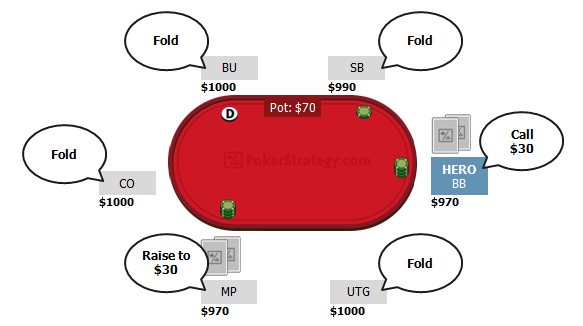

MP open raises to $30 - a 3bb raise - with 22+, ATs+, A5s-A2s, KTs+, QTs+, J9s+, T8s+, 97s+, 87s, 76s, 65s, AJo+, KJo+ (17%, #226)
You call the MP open raise in the BB with QQ-66, AJs+, KQs, JTs, T9s, AQo+, KQo (8%, #102)
These two pre-flop ranges will be used in the next three examples.
Small bet size:
Flop:  ($65) (2 players)
Hero checks, MP bets $32, Hero?
Against a c-bet of 1/2 pot size, you call with #64 of your #86 combinations. You only fold 66 and KQ. This results in a 26% "fold to c-bet". Your calling range is: QQ-77, AJs+, JTs, T9s, AQo+ (#64)
Big bet size:
Flop: ($65) (2 players)
Hero checks, MP bets $65, Hero?
Against a pot sized continuation bet, you call with #46 of your #86 combinations. Additionally, you fold 77, TT, and JJ. This results in a 47% "fold to c-bet".
Your calling range is: QQ, 99, 88, AJs+, JTs, T9s, AQo+ (#46)
| Flop |
|
|
| Bet size absolute | MP bets $32 | MP bets $65 |
| Bet size relative | 1/2 | 1 |
| #Calls from #total |
#64 / #86 | #46 / #86 |
| Fold frequency | 26% | 47% |
| Calling range | QQ-77, AJs+, JTs, T9s, AQo+ | QQ, 99, 88, AJs+, JTs, T9s, AQo+ |
Against the bigger c-bet, you call with less hands than you do against the smaller c-bet.
 Factor 2: Less draw possibilities - less calls
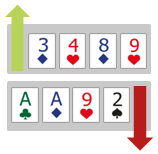 Factor 2: Less draw possibilities - less calls
The texture of the board influences the range that you continue playing with.
A board with little draw potential means that bluffs have low equity and value hands have a lot of equity. Your opponent's bluff bet must be successful relatively often to make a profit. A value bet makes a lot of profit against calls. Therefore, you should fold more often on dry boards than on draw heavy boards.
Equally, bluffs will have good equity on boards with a lot of draws. Your opponent's bluff bet only needs to be successful a small amount of the time in order to make a profit. A value bet makes less profit against a call. Therefore, you should call more often on draw heavy boards than on dry ones.
In this example, you can see the effect of draw possibilities. Again, you call a MP open raise in the BB. The ranges are the same as above.
Draw heavy flop:
Flop: 

 ($65) (2 players)
Hero checks, MP bets $65, Hero ?
Against the c-bet, you call with #78 of your #102 combinations. This equates to 24% "fold to c-bet".
Your calling range: QQ-66, AJs+, AQo+ (#78)
On 522r, every hand without a pair has six pair outs. Since both pre-flop ranges have few trips, with or , this flop is drawy. You only fold KQ, JTs and T9s, and you call with any pair and A high.
Dry flop:
Flop:
 ($65) (2 players)
Hero checks, MP bets $65, Hero ?
Against the c-bet, you call with #51 of your #93 combinations. This equates to 45% "fold to c-bet".
Your calling range: QQ-99, AJs+, AQo+ (#51)
On A55r, any hand without a pair has no outs against an ace. Both pre-flop ranges include a lot of aces. Therefore, this flop is dry. You fold everything except for top pair and QQ-99.
| Flop | |
|
| Board texture | Draw heavy | Dry |
| Fold frequency |
24% | 45% |
| #Calls from #total |
#78 / #102 | #51 / #93 |
| Calling range | QQ-66, AJs+, AQo+ | QQ-99, AJs+, AQo+ |
On a dry flop, you call with fewer hands than on a draw heavy board.
 Factor 3: Your opponent's range hits the board hard - less calls
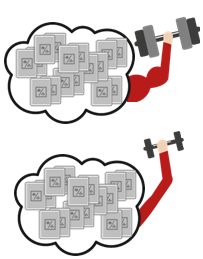 Factor 3: Your opponent's range hits the board hard - less calls
Your own range, as well as your opponent's range, influence the calling range that you continue playing with.
The ranges of the pre-flop aggressor and the pre-flop caller are different. On some boards, this leads to one of the ranges hitting better than the other.
A board on which your opponent hits considerably better than you, results in a lot of strong value hands. Your range includes few strong hands and a lot of weak hands. It isn't worth trying to deny your opponent's bluffs profit with your weak hands since you are paying off too many of your opponent's value hands. Therefore, you should fold more on these boards.
In very few cases your opponent's range is so strong that you always have to fold. You therefore allow all of your opponent's bluff hands to maximise their profit, however this is still better than paying off all of his value hands.
Equally, your opponent has few strong hands and more bluff hands on boards that hit your range better, while your range includes a lot of strong hands and few weak ones. You can also continue with your weak hands and prevent his bluffs, since they have little equity and your strong hands protect your weaker hands. Therefore you fold less on these boards.
Have a look at the following two example flops. Using the same ranges as before, you have called a MP open raise from the BB.
Hero favouring flop:
Flop: ($65) 

 (2 Players)
Hero checks, MP bets $65, Hero?
Against the c-bet, you call with #66 of your #84 combinations. This equates to 21% fold to c-bet.
Your calling range: QQ-99, AJs+, KQs, JTs, T9s, AQo+, KQo (#66)
The KJTr flop hits your range hard. You have a high percentage of broadway cards in your pre-flop range. Your AQ, JJ and TT hit very strong and your AK, KQ, and JTs hit reasonably well. AJs, T9s, QQ and 99 hit a pair and a straight draw and are playable. Your opponent also holds these hands, however he also holds a lot of weaker hands. You only fold your low pocket pairs 66-88.
Villain favouring flop:
Flop: ($65) 
 (2 Players)
Hero checks, MP bets $65, Hero?
You fold #39 of your #102 combinations. This equates to 38% fold to c-bet.
Your calling range: QQ-TT, 77-66, 9d9c, 9h9c, 9s9c, 8d8c, 8h8c, 8s8c, AKs, AcQc, KcQc, AcJc, JcTc, Tc9c, AKo, KdQc, KhQc, KsQc, KcQd, KcQh, KcQs (#63)
On , your range hits few strong hands. You hit #6 flush combinations but no sets or straights: around 6% nutty hands. Your opponent hits #16 flush combinations and #9 sets: around 15% nutty hands. Therefore, the top of his range is stronger than yours. Your middle strength hands are similarly strong.
| Flop | |
|
| Favouring range | Hero (BB) | Villain (MP) |
| Fold Frequency | 21% | 38% |
| #Call from #total | #66 / #84 | #63 / #102 |
| Calling range |
QQ-99, AJs+, KQs, JTs, T9s, AQo+, KQo | QQ-TT, 77-66, 9d9c, 9h9c, 9s9c, 8d8c, 8h8c, 8s8c, AKs, AcQc, KcQc, KhQc, KsQc, KcQd, KcQh, KcQs |
On flops that favour your opponent, you should call less often than on flops that favour you.
 Factor 4: Bad playability on following streets - less calls
 Factor 4: Bad playability on following streets - less calls
The playability of your hand on future streets influences your calling range.
A board on which your playability on the turn or river is bad increases the EV of your opponent's range. Therefore, you have to fold more often.
A board on which your playability on the turn and river is good increases the EV of your range. You can therefore call more loosely.
You estimate the playability of your hand on following streets by thinking about how many mistakes you will both make.
- How often will your opponent successfully value bet and bluff against your hand?
- How often will your opponent incorrectly value bet and bluff against your hand?
- How often will you successfully value bet and bluff against your opponent?
- How often will you incorrectly value bet and bluff against your opponent?
| You bet Your opponent bets |
Successfully | Incorrectly |
Successfully |
Even playability |
Bad playability |
Incorrectly |
Good playability | Even playability |
NL 1000 Cash
Stacksizes: 100BB
Pre-flop: Hero is BB with  /
/ 

MP raises to $30, 3 folds, Hero calls $20
Flop:  ($65) (2 Players)
Hero checks, MP bets $65, Hero?
MP open raises with the known range of 22+, ATs+, A5s-A2s, KTs+, QTs+, J9s+, T8s+, 97s+, 87s, 76s, 65s, AJo+, KJo+ (17%, #226)
He c-bets his entire range for a pot sized bet.
A hand with bad playability:
Pre-flop: Hero is BB with
MP raises to $30, 3 folds, Hero calls $20
Flop: ($65) (2 Players)
Hero checks, MP bets $65, Hero folds
66 has 39% equity against the c-bet range of MP. Even though you get pot odds of 33% against a pot sized bet, you still have to fold this hand. Your playability on the turn and river is very bad. You only have two outs with which you can catch value bets and bluffs. But even with a set, you lose against T9s and higher sets. On all other cards, you hold a weak showdown hand that you have to fold against a turn bet.
A hand with good playability:
Pre-flop: Hero is BB with
MP raises to $30, 3 folds, Hero calls $20
Flop: ($65) (2 Players)
Hero checks, MP bets $65, Hero calls
JTs has 31% equity against the c-bet range of MP. Even though you are getting 33% pot odds against a pot sized bet, you can still call. The playability on the turn and river is good. You have four nut outs that will get paid off well. You also have six further pair outs that give you a middle strength showdown hand that can call a turn bet. On a K or Q turn, you can profitably check/raise as a bluff with your eight nut straight outs.
| Hand |
|
|
| Playability turn and river |
Good | Bad |
| Pot odds | 33% | 33% |
| Equity | 31% | 39% |
| Action | call | fold |
Hands with good playability can call more often than hands with bad playability.
The following spoilered example shows you the exact calculation for realisable equity.
Example Hand
Pre-flop: Hero is BB with  /
/ 
MP raises to $30 , 3 folds , Hero calls $20
Flop:  ($65) (2 Players)
Hero checks, MP checks
Turn: ($65) (2 Players)
Hero checks, MP bets $35, Hero?
MP delay c-bets with 88, A5s-A2s, T9s, 97s (#23)
For a call, you need 26% realised equity; these are your pot odds. KQ has 36% equity against your opponent's betting range, QJ has 34%. You could think both hands are a call. Have a look at the play on all the river cards.
Assumptions about MP's river play
After a turn call, MP bets on the river with all of his Ax top pairs for value, and bluffs the correct amount of busted straights. Against a pot size raise on the river, he calls with the top 37.5% of his betting range - the exact frequency that you can't bluff raise against.
River cards
River 2, 3, 4 (not of spades). MP value bets here with #11 combinations of A2s-A5s and #3 combinations of 88. In addition to these #14 value combinations, he bluffs with #4.66 combinations of his busted straight draws. In total, he bets #18.66 of his #22 river combinations - against which QJ and KQ have an EV of zero with a bluff raise, a call, and a fold. When MP gives up on the river 15% of the time, QJ and KQ win the pot. The river EV on these cards is 15% of the pot.
River 2s, 3s, 4s, 6 and J are identical with the distinction that MP value bets #15 instead of #14 combinations. The EV for QJ and KQ is 13% of the pot.
River 8 is the same, except that MP value bets #13 combinations since 88 is blocked. The EV for QJ and KQ is 17% of the pot.
River A is the same. MP value bets #11 combinations here, since Axs is blocked. The EV for QJ and KQ is 23% of the pot.
River 5, 7. Here villain hits straights and bets his entire range. You always fold and have an EV of 0% of the pot.
River 9 . MP value bets here with #15 combinations of A2s-A5s, 88, and bluffs with #5 combinations of rivered pairs with his straight draws. He only checks down #1 combinations since the #8 straight draw combinations are blocked to #6. Against the 5% checks, QJ high loses the showdown and therefore has a river EV of 0%. KQ wins the showdown and has a river EV of 5%.
River T. MP value bets here with #19 combinations of A2s-A5s, 88, and 97s, and bluffs with #3 combinations of T9s; he bets 100%. KQ has an EV of zero with a raise or fold and a negative EV with a call. QJ is the nuts and the EV of a raise is the maximum. You raise pot size and are called by 37.5% of the betting range - around #7 combinations, and have an EV of 350% of the pot. You raise and get a fold from 62.5% of MP's betting range, and have an EV of 150% of the pot. Your total EV with QJ is 225% of the pot.
River Q, K. MP value bets here with #15 combinations of A2s-A5s, and 88, and bluffs with #5 combinations of his busted straight draws. QJ has an EV of zero with a raise, a call, or a fold. The river EV is equal to the checking frequency of 13%. KQ can value raise. Against a pot size raise, MP calls 50% of his initial value range, #7.5 combinations. You lose against #3 of 88 and win against #4.5 combinations of Axs. You have 60% against the calling range. You have an EV of 100% against checks, 150% against bet-folds and 110% against bet-calls. With 13% checks, 62.5% bet-folds and 37.5% bet-calls, this gives a total EV of 130% of the pot.
| River | Amount | EV KQ | EV QJ |
    |
9 | 15% | |
    J |
10 | 13% | |
| 5, 7 |
8 | 0% | |
| 8 | 3 | 17% | |
| 9 | 4 | 5% | 0% |
| T | 4 | 0% | 225% |
| Q, K | 6 | 130% | 13% |
| A |
3 | 23% | |
River realisation
Add the EV of all possible river cards multiplied by their probability to determine the total realization.
RL(KQ) = 1/(#river) * ∑river r RL(KQ,r)
= 1/46 * (9*15% + 10*13% + 3*17% + 4*5% + 5*130% + 3*23%)
= 23%
RL(QJ) = 1/(#river) * ∑river r RL(QJ,r)
= 1/46 * (9*15% + 9*13% + 3*17% + 4*225% + 6*13% + 3*23%)
= 29%
KQ wins 23% of the pot over all possible river cards. Since you get 26% pot odds on the turn, you can't call the bet.
QJ wins 29% of the pot over all possible river cards. You can therefore call on the turn.
Summary
KQ and QJ have more equity on the turn than they are getting pot odds for. Through playability effects on the river however, KQ has to fold while QJ can call.
Both hands have bad playability on blanks. They both get value bet and bluffed effectively.
KQ has good playabilty on five two pair outs. You however still lose against 88 with these outs and therefore a value raise doesn't give you a lot of value. In total your realisation on the turn is not enough to make the call.
QJ has extremely good playability on four nutstraight outs. QJ overstraighted 97s and has a very profitable value raise. In total your realisation is therefore enough to call on the turn.
Notes
The effect that some rivers occur less often due to MP's hole cards is ignored.
The effect that river K with KQ and J with QJ occur less often is included in the river realisation. KQ only sees five instead of six Q and K rivers, QJ only sees nine instead of ten 2s, 3s, 4s, 6, J rivers.
The effect to bluff raise with QJ on Q/K and with KQ on T is not included since your call range includes further bluff catchers. Therefore MP bets his entire range on a 5.
Summary
Four factors influence your call frequency:

- Your opponent's bet size tells you how much equity you need to realise with your calling hands.
- Your hands have an equity distribution that depends upon the board that comes out. On draw heavy boards, a lot of hands have middling equity, and few hands have either a lot or very little equity. You have a lot of hands with middling equity that you call with. With few draw possibilities, a lot of hands either have a lot or very little equity; few hands have middling equity. You have a few hands with a lot of equity and all others have to be folded.
- Depending on how well the pre-flop ranges hit the board, this influences your equity distribution.
- How much of your flopped equity you can realise, depends upon how well your hands play on the following streets.