


Game Plan (3): Steal-EV
Steal-EV tells you how much more money you must win after you make an open raise to make a profitable play. Knowing it gives you two advantages:
- You can define the weaker hands in your open raise range more closely.
- You can set out your post-flop lines to take into account how many pots you have to win to make a play profitable.
In this lesson, you will learn how to calculate Steal-EV, as well as the implications it has on your post-flop lines. You will also see the application of Steal-EV in practice.
Steal-EV assumes that your hand is lost if you don't win the blinds with your open raise.
After an open raise, your opponents can either fold, in which case you win the blinds, or also enter the pot by making a call or a 3-bet. Steal-EV assumes that in those cases the hand is directly lost.
This results in the following formula:
Steal-EV = Fold Equity * Blinds + (1 - Fold Equity) * (- Open Raise Size)
Your opponents fold when they neither call nor 3-bet you. You can therefore calculate the fold equity for each individual opponent by adding these two values and then subtracting them from 1. You can then calculate the total fold equity by multiplying the fold equities of the individual opponents. In the following example your Steal-EV from the CO with an open raise size of 2.5 bb is -0.5bb.
| Position of your opponent | Call | 3-Bet | Fold equity |
| Button | 11% | 9% | 0.8 |
| Small Blind | 8% | 7% | 0.85 |
| Big Blind | 19% | 7% | 0.74 |
| Fold Equity (total) | 0.5 | ||
Steal-EV = 0.5 * 1.5BB + (1-0.5) * (-2.5) = 0.75 - 1.25 = -0.5BB
On a typical NL 6-Max table, the Steal-EV values could be as follows:
| Your position | Average opponent |
| UTG | -0.3 |
| MP | -0.3 |
| CO | -0.5 |
| BU | -0.4 |
| SB | -0.15 |
Steal-EV shows how wide your opponent's range is
All statements about Steal-EV values derive from the following general conclusions:
- The smaller the Steal-EV is, the wider the ranges of your opponents are on average. You have to win more money after an open raise in order to play profitably.
- The bigger the Steal-EV is, the tighter the ranges of your opponents are on average. You have to win less money after an open raise in order to play profitably.
- If Steal-EV > 0, it is referred to as auto-profit. It occurs when your opponents clearly play too tight. Your open raise on its own is already profitable. You could open fold post-flop and still make a profit.
 |
The smaller the Steal-EV is, the more accurately you need to know how you will make money post-flop. If your Steal-EV is close to zero, you will be playing against a strong range post-flop but you only need to win a small amount of the time to play profitably. |
Typical applications of Steal-EV
Steal-EV gives you a starting point to determine and adapt your open raising ranges.
Example 1
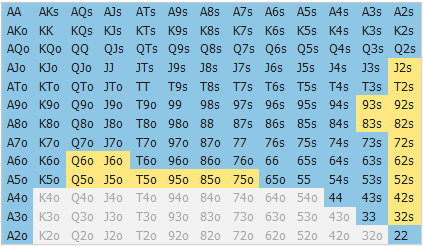
You are on the button and all the other players have folded around to you. The small blind plays an 8% 3-bet range but hasn't got a calling range. The Steal-EV is better than on a table with average opponents. On average there is more dead money in play against the big blind. This means you can open raise more hands:
 |
||
| Old range: 22+, A2s+, K2s+, Q2s+, J3s+, T3s+, 94s+, 84s+, 73s+, 63s+, 53s+, 43s, A2o+, K5o+, Q7o+, J7o+, T6o+, 96o+, 86o+, 76o, 65o |
||
| Extended range: 22+, A2s+, K2s+, Q2s+, J2s+, T2s+, 92s+, 82s+, 72s+, 62s+, 52s+, 42s+, 32s, A2o+, K5o+, Q5o+, J5o+, T5o+, 95o+, 85o+, 75o+, 65o |
||
Example 2
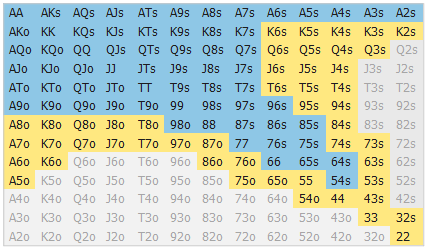
You are in the small blind. The big blind folds to a steal from you 59% of the time. The Steal-EV is better than on an average table. You can play a wider range, but should be cautious post-flop. You are playing a wider range against a tighter than usual range.
 |
||
| Old range: 66+, A2s+, K7s+, Q7s+, J7s+, T7s+, 96s+, 85s+, 75s+, 64s+, 54s, A9o+, K9o+, Q9o+, J9o+, T9o, 98o |
||
| Extended range: 22+, A2s+, K2s+, Q3s+, J4s+, T4s+, 94s+, 84s+, 73s+, 63s+, 53s+, 43s, 32s, A5o+, K6o+, Q7o+, J7o+, T7o+, 97o+, 86o+, 75o+, 65o, 54o |
||
Example 3
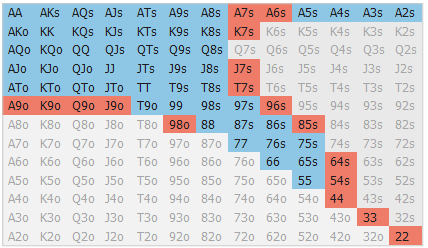
You are in the CO and have two very aggressive LAGs to your left. Steal-EV is worse than on an average table, and you have no clear notion why you should win more money later on in the hand than usual. You should play a tighter range.
 |
||
| Old range: 22+, A2s+, K7s+, Q8s+, J7s+, T7s+, 96s+, 85s+, 75s+, 64s+, 54s, A9o+, K9o+, Q9o+, J9o+, T9o, 98o |
||
| Tighter range: 55+, A8s+, A5s-A2s, K8s+, Q8s+, J8s+, T8s+, 97s+, 86s+, 75s+, 65s, ATo+, KTo+, QTo+, JTo, T9o |
||
Example 4
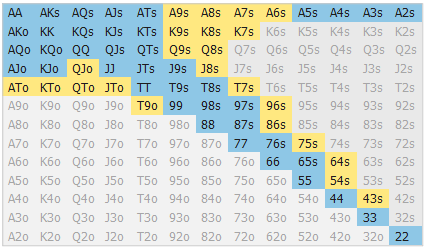
You are in MP and a passive fish with 82% VPIP is in the big blind. Your Steal-EV is worse than on an average table. You can still play a wider range, however, since you have a higher EV post-flop:
 |
||
| Old range: 22+, ATs+, A5s-A2s, KTs+, QTs+, J9s+, T8s+, 97s+, 87s, 76s, 65s, AJo+, KJo+ |
||
| Extended range: 22+, A2s+, K7s+, Q8s+, J8s+, T7s+, 96s+, 86s+, 75s+, 64s+, 54s, 43s, ATo+, KTo+, QTo+, JTo, T9o |
||
From Steal-EV, you can derive the equity that you need to realise with a hand to be able to play it profitably
To get a better understanding of Steal-EV, it is worth looking at the relationship between the Steal-EV and the equity required post-flop. If Steal-EV < 0, the following is true if you get called by an opponent:
Required Equity x = - (Steal-EV/((1-p)*Pot)))
1st case: Your opponents fold
You win p * blinds.
2nd case: You are called by the big blind.
The equity required is referred to as x. Your EV in this case is (1-p) (x * pot - open raise) and this must be –(p*blinds) in total in order to be at least break even.
This gives:
(1-p) * x * Pot – (1-p) * Open raise = -p*Blinds
⇔ (1-p) * x * Pot = -p* Blinds + (1-p) * Open raise
⇔ -(1-p) * x * Pot = p* Blinds – (1-p) * Open raise = Steal-EV
⇔ x = - Steal-EV / ((1-p) * Pot))
Attention: in practice your opponents will also 3-bet you. Especially for hands that you will fold to a 3bet, you should replace (1-p) with the call probability of your opponent.