


Things to Consider at Showdown
You should have already read:
When reading a hand, you start pre-flop by assigning an average range to your opponent according to his player type. Then you narrow down his range post-flop using the funnel principle. Both processes are based on assumptions about how your opponent is likely to play certain ranges.
You can put these assumptions to the test at showdown by comparing the range that you expected with the hand your opponent actually holds. If you recognize a deviation from what you expected, then you should consider adapting your range accordingly.
In this lesson you will learn how to recognize deviations from average ranges and how to modify these ranges if needed. You can also gain useful information about your opponent's post-flop range at showdown, especially concerning his value, bluffing, and calling ranges.
Pre-flop: Pay attention to deviations from average ranges
The average range is the foundation of your hand reading, and it is based on assumptions about what hands your opponent will open raise, 3-bet, cold call and limp.
Your opponent can deviate from the average range in two ways:
- He plays a hand outside of the average range.
- He does not play a hand from the average range, or he plays it differently than expected.
Your opponent plays a hand outside of the average range
If your opponent plays a hand outside of his average range, you should complement his range with that hand and stronger hands of the same category. However, before adding the said hand(s) to your opponent's range permanently, you should check if one of the following exceptions is true:
- He plays this hand instead of another hand from his average range.
- Your opponent will not include this hand into his range permanently, but he only played it because of a certain situation at the table (table dynamic).
You can check whether your opponent plays the hand in question instead of another hand from the average range by checking the database of your tracking software. You will require at least 1,000 hands from the opponent to confirm this, and it would be wise to do the analysis away from the tables.
While you're playing, you can check specifically whether you see the worst hands of your opponent's average range at showdown. You can exclude the first exception if this is the case.
To find out whether your opponent played the hand only because of table dynamics, you should examine the table for unusual features. The most common reasons for deviations are:
- Stack sizes differ significantly from 100bb.
- A recreational player is in the blinds.
- Hyper aggressive players have position on your opponent.
Have a look at the following example:
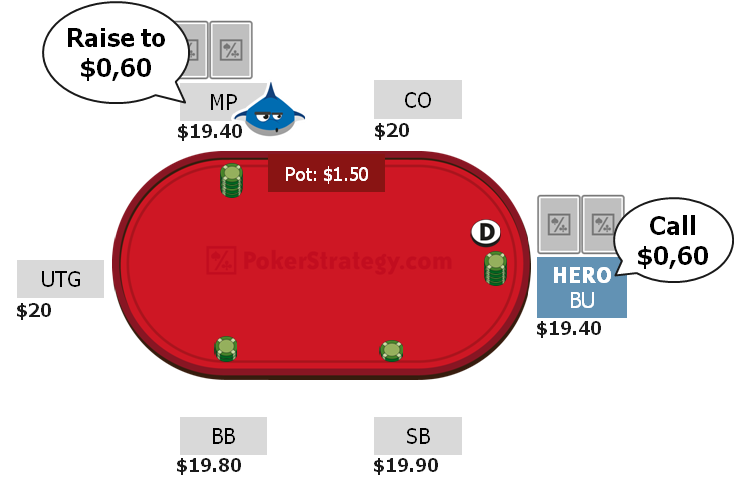
You identified your opponent as a TAG, so you put him on the following range:
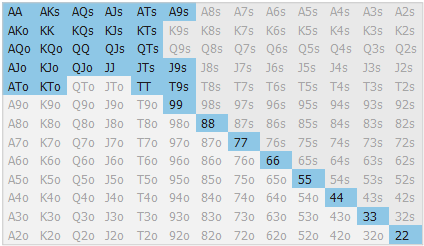
If you see a hand like A7s at showdown, it is outside the scope of his average range. Before you add this hand to his average range permanently, make sure that his open raise was not an exception.
You load up your tracking software and find out that he raises every other hand in the average range and there is no unusual change in table dynamics.
Therefore, you include A7s and better suited aces (i.e. A7s+) in your opponent's open raising range from MP.
However, if you play against maniacs or calling stations, you should consider that their hand selection will often be irrational and so it will vary wildly. Therefore, you should use this information with caution.
He does not play a hand or he plays it differently
If an opponent doesn't play a certain hand from his average range, it can mean one of two things: either this hand is missing from his range completely, or he plays it differently than what the average suggests.
You will need tracking software along with a sample size of at least 1,000 hands on your opponent in order to prove the complete absence of a hand from his range.
While playing at the tables, you can pay attention if an opponent plays as expected with a specific hand. The most common deviations for LAGs, TAGs and nits can be found in their 3-betting and calling ranges.
These ranges are mutually exclusive, so if a hand appears in one of these ranges it means that it will be missing from the other range. The same is true for limping and open raising ranges of maniacs and calling stations.
But when facing TAGs, LAGs and nits, you should always consider if the reason for the deviation can be found in the table dynamic.
For example, if you raise on the CO and a LAG cold calls his QQ on the BU instead of 3-betting, you extend his calling range to include QQ and take that hand out of his 3-betting range.
You should check the table dynamic before making a permanent change to your understanding of your opponent's average range: if there is no recreational player or extremely squeeze-happy player in the blinds, you should just assume that your opponent will cold call QQ on the BU against an open raise as a standard.
Typical deviations
There are certain typical deviations that can frequently be found in the play of LAGs, TAGs and nits:
- Your opponent 3-bets either more polarized or more depolarized than expected in the average range.
- Your opponent's calling range from the blinds against steals is looser/tighter.
- Your opponent open raises suited connectors and suited aces from EP/MP instead of ATo or KJo.
- Your opponent 3-bets looser for value because of a stack size <60BB.
- Your opponent has a tighter 3-bet range because of a stack size >150BB.
Post-flop: Pay attention to the composition of your opponent's range
When you get to showdown, you will see how your opponent played his hand on every street and therefore you can gain information about the composition of his value, bluffing and calling ranges.
In the process, you will test your pre-existing assumptions and gain new information in spots where you are still uncertain about the composition of your opponent's range.
The higher your limit and the higher your opponent's skill, the more important it becomes to sort the new information according to the situation. In order to accomplish this, you should note down the board texture, the stack sizes, and the positions of the players involved.
Value range
You can test and eventually change your assumptions about your opponent's value range using the following information: the worst hand that your opponent will bet for value or raise and on how many streets he will do so.
The opposite case is also important: what hands doesn't your opponent value bet, contrary to your assumptions?
$25 NL Hold'em (6 handed) 100BB Stacks
UTG: TAG
Pre-flop: Hero is Button with 

UTG raises to $0.75, 2 folds, Hero calls $0.75, 2 folds
Flop: ($1.87) 

 (2 players)
UTG bets $1.50, Hero calls $1.50
Turn: ($4.87)  (2 players)
UTG bets $4.00, Hero calls $4.00
River: ($12.87)  (2 players)
UTG bets $11.00, Hero calls $11.00
If you see a hand like AT or A4s at showdown, it represents a deviation from your assumptions about his value range. That range should include hands like AA, AK, AQ, 88 and 33.
You can draw the conclusion that your opponent will value bet too thinly on the turn and river if the board is dry.
However, if he checks a hand like AQ or AJ on the river, you will know that he only value bets top pair top kicker or better in this spot. Using that information, you will be able to make tight folds in the future with a hand like AQ if he doesn't bluff that much.
Bluff range
To achieve better assumptions about your opponent's bluffing range, you should pay special attention to the hands he uses to bluff with and on how many streets. The opposite case is also important: what bluffs will your opponent give up and when?
What hands does he use for bluffing:
- Does he only bluff with straight draws and flush draws?
- Will he also bluff with overcards and gutshots?
- Does he bluff weak made hands?
- Does he bluff hands with no outs?
Look at the following example:
$25 NL Hold'em (6 handed) 100BB stacks
CO: TAG
Pre-flop: Hero is Button with 

2 folds, CO raises to $0.75, Hero calls $0.75, 2 folds
Flop: ($1.87) 
 (2 players)
CO bets $1.50, Hero calls $1.50
Turn: ($4.87) (2 players)
CO bets $4.00, Hero calls $4.00
River: ($12.87)  (2 players)
CO bets $11.00, Hero calls $11.00
If your opponent shows down a hand like KQo in this spot, he will likely bluff with a lot of hands in total. The reason is that there are many better hands with more outs that your opponent could bluff with on three streets. That includes many straight draws (JT), flush draws (
 ) and gutshots.
If he bluffs these hands also, which is very likely, his VB-ratio will be very small: he has a lot more bluffs than value hands.
However, if your opponent in the example checks the turn with little showdown value and many outs like  , it is likely that he will play the turn honestly and hardly ever bluff.
Calling range
If you are the aggressor yourself, it is important to know what hands your opponent will call with - and on how many streets he will continue. Knowing this, you can decide whether a value bet or a bluff is profitable in a given spot.
$25 NL Hold'em (6 handed) 100BB stacks
BU: TAG
Preflop: Hero is Cut off with
2 folds, Hero raises to $0.75, BU calls $0.75, 2 folds
Flop: ($1.87) (2 players)
Hero bets $1.50, BU calls $1.50
Turn: ($4.87) (2 players)
Hero bets $4.00, BU calls $4.00
River: ($12.87) (2 players)
Hero bets $11.00, BU calls $11.00
It is no surprise if your opponent calls with a hand like A9s or TT on the river - but you wouldn't expect him to call three streets with T8s or 77. If he does, you can assume that he will frequently call when many draws bust. Therefore you should bluff less and value bet more in these spots in the future.
Summary

At showdown, you can check if your assumptions about your opponent's ranges are correct.
As soon as you see a hand outside of his average range, you should adapt your opponent's range accordingly.
You should also pay attention to what hands he will bluff, value bet or call with post-flop, and also for how many streets he does this.
In the process, always look out for stack sizes, the positions of the players involved, and the development of the board.