


Jump on to shorthanded!
Differences between full ring and shorthanded:
Imagine you're playing a full ring table and the first four players fold. Shorthanded is not fundamentally different from FR! Many players make the mistake of thinking they must play loose-aggressive, but this is simply wrong! Tight is still right! 😉
Pre-Flop: The SH silver chart
Since you are now playing with only 5 other players you will be confronted with situations which are not adequately addressed by the starting hand chart (SHC). We would like to give you a new tool to work with pre-flop. This collection of charts replaces the old SHC:
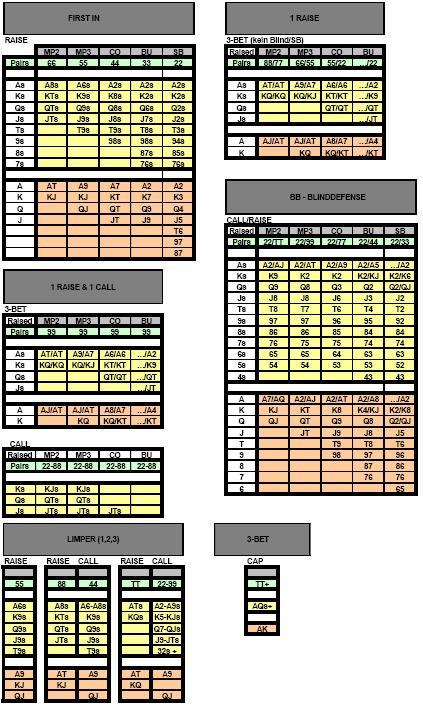
Explanation of the charts
"First In" Chart
(All players before you fold):
Every player before you folds and you're in the positions listed in the columns of The "First In" Chart. The hands given there tell you the minimum hand needed to raise. All other hands are folded. As long as no raise or call came before you, you ALWAYS play "raise or fold" pre-flop. You never ever just call when nobody entered the pot before you.
"1 Raise" Chart
(1 Raise before you):
One player raises before you. You have a hand that you are not sure whether to 3-bet or fold. Therefore you should take a look at the position of your opponent (not your own position) So you have to use The "1 Raise Chart". It shows you the minimum requirement of hands you need if your opponent raises. So just look from which position your opponent raised and then go down the column to see what is the minimum requiremt for a 3bet. The hand on the right side of the "/" shows you the hand you need when you are in the SB.
Example: Villain raises out of MP3 you are the Button with ATo. Now you look at the column of MP3 and you see you need at least AJo to 3bet here. So you have a clear fold. With AJo you could 3bet
"1 Raise 1 Call" Chart
(1 Raise, 1 Coldcall before you):
You 3-bet with hands that are ahead of the raiser according to The "1 Raise" Chart. If the hand is not good enough to 3-bet, but would have been a call on the old SHC, you call (look at the call chart below). Other hands are folded. Just handle this situation like only 1 raiser.
Exception: Only with Pocket Pairs you need at least 99 or better to 3bet here!
1 Call, 1 Raise before you:
3-bet according to The "1 Raise" Chart, as if the raise came from MP2. If you're in the small blind, you'll raise exactly the same hands. Do NOT look at the entry to the right of the "/"; use the left entry!
"3 Bet" Chart
(1 Raise, 1 3 Bet before you):
Here you can only cap or fold. Standard cap hands from the SHC (Ako/AKs/AA/KK/QQ) are still capped, but on 6-max tables you can add Aqs, JJ, and TT.
The "Limper 1,2,3" Chart
The First column is of course what you should do against 1 limper the second against 2 Limpers and so on, here is a detailed explanation
1 Call before you:
Raise all hands in the column MP3 from The "First In" Chart.
2 Calls before you:
Raise according to "First In" Chart and call the hands that are in the CO column of the same chart.
3 or more calls:
Use the old SHC.
Blind Defense:
If you want to be exact, poker is always a battle for the blinds. If there were no blinds, it would be easy to play perfect poker. You could just fold every hand and only raise AA.
The blinds cause players to start fighting for the pot with raises.
In general, the SHC gives you a rough expectation for playing in the blinds, however, it is only concerned with multiway pot situations. In what follows I will explain how to play your hands when you are attacked by a raise while in one of the blinds. The blind defense situation is typically heads-up with you finding yourself out of position. Both of these are factors that lead to difficult post-flop decisions. Furthermore, it is too unprofitable to simply dodge these situations post-flop by folding. If you are heads-up on the flop, use the information in the article Standard Moves on the Flop Heads-Up.
Blind Defense from the SB:
3-bet hands according to Chart(2) that are to the right of the "/". The columns are the position of the opponent attacking your blinds.
Blind Defense from the BB:
Use Chart (3):
Example 1) You're in the BB and the MP3 raises, with everybody else folding. You have K4s. The entry in the MP3 column for Ks is "K2". So you call with K4s.
Example 2) You're in the BB and MP2 raises, with all players ahead and behind folding. You have Ajs. The entry in the MP2 column is: "A2/AJ". So you can 3-bet AJs since it is to the right of the "/" in the entry. So you can 3-bet all hands AJs and better.
If you had A9s, it would have been a call from the BB since A2 is to the left of the "/" in the entry. Thus, you would call all hands from A2s to Ats inclusive from the BB.
On the Odds & Outs table from Chart (4):
You should already be familiar with this chart. If you aren't, it's time to work on the topic of Odds & Outs!
Post-Flop:
Since your opponents will play looser, they will have a really good hand less often. That means that you will often find your opposition bluffing or making moves with a bottom or middle pair. This will lead to you playing more aggressively yourself to exploit the mistakes of your opponents. Hence, in SH a top pair weak kicker is a substantially better hand than in FR.
Psychology:
SH has more swings; this is an unfortunate fact. So when you change to SH, you must be clear about this. You should get used to downswings in the 100BB range as a normality. You will even sometimes run into swings over 200BB and might even call them normal. If you haven't experienced a downswing yet, you should take preventative measures and work through this thread. Others should have read this thread at least once: [Psychology] Downswing – a psychological consideration
When should I switch?
The best time to switch is when you feel ready. This sounds banal but a better answer is not to be found since it is such an individual question. If you have succeeded on $.5/1 FR, then you should try SH tables.
You can learn more in our Advanced Bankroll Management article.
How many tables should I start out playing?
You should start SH with a maximum of 2 tables. The decisions you'll have to make post-flop are more difficult than at FR tables. In the beginning, you should take time to think through new situations and difficult hands. The fact that on average, fewer players with worse hands see the flop alone can lead to you being unable to pinpoint where you stand. Often both you and your opponent have hit nothing more than a pair. But someone has to win the pot at the end. Play with more concentration at SH than at FR. Don't fall into routing and think through every single situation again.
Table and seat selection:
Table selection is not very important on the 0.5$/1$ - 1$/2$ SH tables. The reason for this is that there is an extreme number of poor players and you don't have to look for them. Of course, if you find yourself at a very tight table you should switch to a new one. But most tables will shock you with their loose pre-flop play.
True table selection with the buddy list or analysis program is not necessary.
Seat selection is substantially more important. In the optimal case, you will have a loose passive fish to your right who you can often isolate with raises and play against heads-up. You should avoid having a maniac or very loose-aggressive player to your left, since they will often put you to difficult decisions that you should try and dodge, at least in the beginning.