


Odds and Outs
Drawing Hands (Draws)
We differentiate between drawing hands and made hands. A made hand has at least a pair (as a pocket pair or in combination with the community cards). A drawing hand is an unfinished hand. It is not infrequent to get a made hand on the flop and still be behind. This is the situation when multiple opponents are in the hand and you have just a single middle pair (you have a pair with the middle community card) or bottom pair. Or, you have the top pair with a weak kicker and suppose that a better top pair is against you. If there is a lot of action on the flop (a raise before you and maybe even a 3-bet after), even top pair top kicker might not be enough. Probably, the opposition has 2 pair or better. In these cases you must look at your made hand as a drawing hand, since you seem to be behind and must better your hand to win.
The payoff-risk relationship
So I begin to look at my hand as a drawing hand. Now the question is whether I give it up or whether my chances and the pot size justify paying to see the turn card.
The decisive question is: Will I get more, or less money than I put in, on average.
To find the relationship between payoff and risk I must take several values into account:
The Outs
An out is a card that will make my hand a winner.
Example: Suppose I have 7 6 on the button against 5 opponents. The flop is 8
 4
4 A
A . With my gutshot draw (I'm missing one card for a straight), I have four outs: any 5 will do. Against multiple opponents, the outs on 6 and 7 are not to be taken. It is not impossible but it is improbable that a 6 or 7 on the turn will give me a winning one pair hand.
The Odds
Probability gives the chance that an event occurs. It is expressed as a number between 0 and 1. In contrast to probability, the odds express the chance that an event will not occur. For poker, it's easier to use odds. Odds are expressed as a comparison between the desired and undesired outcomes. In our example with the gutshot draw there are 47 possible turn cards. There are 52 cards in the deck, I have 2, 3 are on the flop and the other 47 are unknown to me and therefore are possible turn cards. Of these 47, 4 are good and 43 are bad. The odds are 43 to 4 (conventionally written 43:4). We simplify this to get a 1 on the right hand side, 10.75:1 (divide 43 by 4). The number on the left expresses the chances that the event will NOT occur. The event „gutshot straight on the turn" is the 1 and „not straight" is the 10.75. As a further simplification, let us round 10.75 to 11. Now the odds 11:1 tell us that in 12 trials, we'll hit the gutshot once and miss it 11 times. To be clear, the probability of the gutshot is 1/12, not 1/11! This expression of the odds represents 12 cases divided into „bad vs. good" cases.
The Pot Odds
The pot odds describe the relationship between what I will put in (the risk in the sense of payoff-risk relationship), and what is already or will be in the pot. It is my potential gain. I speak of the future because the past plays no role in this consideration. The money I have already put into the pot no longer belongs to me. I must not mourn this investment and chase good money with bad.
Example: I must pay 1 dollar to see the next card and there are 10 dollars in the pot. It follows that my pot odds are 10:1.
The entire calculation
1. Calculate pot odds
2. Consider outs
3. Calculate win odds from outs
4.Compare pot odds to win odds
Let's go back to our example with the gutshot. Before the flop, a total of 6 people called for 6 SB (small bets). The small blind bets on the flop. The rest call. There are now 11 SB in the pot and I must pay one SB to stay in and see the turn card. Pot odds are 11:1 and my win chances are 11:1. The relationship is even so it's an easy call. It would be even better if the pot odds were 20:1. This situation would be quite profitable. I would lose 1 dollar eleven times and win 20 dollars once in 12 trials. The 9 dollar difference divided between 12 cases gives an expected value of 9/12 or .75 dollars/case. If the pot odds were 5:1 it would be different. I would win 5 dollars in one case and lose 1 dollar in 11 cases, which is -6 dollars. -6/12= -.5. My call would have an expected value of -.5 dollars.
The odds table
It is not necessary to calculate win odds from outs every time. There is not enough time in the heat of battle, especially if you're playing more than one table. The solution is to learn a handful of cases from memory. At first, keep a table on your desk or post it somewhere close at hand. Then you can look up the odds you need. Over time, the numbers will soak into your brain and you won't need the table anymore.
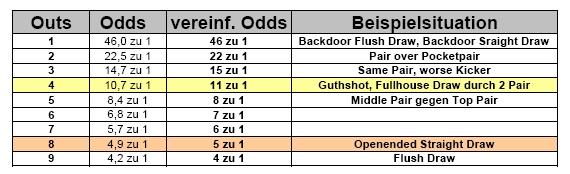
Explanation:
The table shows the chances of hitting your draw on the next card after the flop. These odds are rounded but are easier to learn and are good enough to calculate your chances.
1 Out: Backdoor flush means you have 3 flush cards (analogous to backdoor straight).
2 Outs: If you're playing a small pocket pair against more than one opponent, you're speculating to flop a set. If that doesn't happen, you should usually give up these hands, since multiple overcards will guarantee that somebody has a higher pair or will make one. With only two outs, the pot must be huge for pot odds to be high enough.
3 Outs: If you're playing potentially dominant cards like small aces you'll often run into a kicker problem against bigger aces. In this case, you only have 3 outs since you have to hit your kicker. The same goes for the classic trap hands KJ, KT, QJ, QT and JT. If you hit the flop with these hands, you will often be dominated by a hand with a better kicker.
4 Outs: Suppose you have 2 pair and there's a lot of action on a dangerous board. It could well be that one of your opponents has a three of a kind, flush, or straight. In this case you have 4 outs to hit a full house. Draws with 4 or fewer outs are called weak draws (yellow)
5 Outs: If you have a middle pair in combination with a board card, you have 2 outs for trips and 3 outs for two pair.
8 Outs: After 8 outs it's a strong draw (orange). Strong draws are usually taken all the way to the river . If there are 8 cards that could give you a straight, you have an open ended straight draw. 8J on a 9TA board is an example, since any seven (4 outs) and any four (also 4 outs) will give you a straight.
9 Outs: With 9 winning outs your chances of winning are 35%. For this reason, you should raise the pot for value if there are 2 or more opponents and you have 9 or more outs (but be sure that at least two players call). This is creating profit for yourself directly.
10 or more outs: Deciding whether or not to call is no longer relevant with extreme draws. You mostly bet and raise them for value (where you make profit directly). Hence, they don't mean much to our topic.
14 Outs: At 14 outs you are „even money" You have a 50% chance to win if you go to the river.
Hold'em is a difficult game. Further factors make our probabilistic considerations more complicated.
Discounted Outs
The outs is the count of all cards that will better my hand. But what I really need to know is: How many cards will make my hand a winner? Not every turn card that will improve my hand will be enough for me to win. Thus, not all outs are equal. We must discount the weak outs. The sum of all outs, discounted and full valued, is called the discounted outs. We must use the discounted outs to get correct results from our calculations.
Example: I've got A K, and the board is Q 7 5 . Even with a pair, we would surely be behind against multiple opponents. I have 6 outs: 3 aces and 3 kings. But the A and the K are dangerous because they put a 3-flush on the board, making it possible for an opponent to complete a flush. If these cards come up they will better my hand, but they possibly improve the opponent's even more. A further danger is that if an ace appears on the turn I will lose to somebody who played with A7 and now has 2 pair. It's also possible that somebody has already made a three of a kind on the flop. As you can see, dangers lurk everywhere. For this reason, an overcard draw with AK is not a strong hand. We must discount our 6 outs. Against 2 opponents we would discount 3. Against 3 or more opponents we must be much more radical with our discounts.
Even outs that would give me a nut hand must sometimes be discounted. This is usually the case with a one card straight draw.
Example: The board is K Q T and I've got A8. My four gutshot outs on the jack don't have full value because every player with an ace will share the pot with me.
Relative position
To calculate pot odds you must have some idea of how much it will cost you to see the turn. This is dependent upon your relative position to the aggressor. Suppose I'm sitting directly left of the better with a gutshot and that there are 3 players after me. Eleven times what I must bring to the pot is already in the pot, so that I can probably play my hand if I have good enough winning odds. But what happens if I'm raised from behind? This would cut my odds considerably, since I will half to pay at least twice the price for the next card. This hand is not playable from our position!
For calculating pot odds it would be ideal if I could close the betting action. If this is not the case then I need much better than odds than the minimal necessary as a margin of safety.
Equity
The equity is the share of the pot you stand to gain with your chances of winning. A straight-flush draw has 15 outs on the flop and thus an equity of 54.12 % to the river. Even though it is not a finished hand, more than 50% of the pot belongs to the player with the straight-flush draw (assuming there is no draw for a higher flush or straight underway). Against a single player you should put as much money in the pot as possible. It is directly profitable (value) and prepares for a bluff on the turn if the next card doesn't help you. The following situation is even more important. You get a nut flush or second nut flush draw on the flop with three opponents. With 9 outs, you have an equity of 34.97% (odds of 2:1 to have the best hand at the river). You should feed the pot here too (as long as you aren't driving away flush customers), since you are only contributing 25% of the money, but you expect 34.97% back (so you win approximately 10% back on every dollar you put into the pot).
Exercises
Foreword
These practice problems are about correctly discounting outs. It is most effective to read the question, come up with a complete and precise answer, and then compare it to the solution given. You can make the solutions visible by highlighting them.
I will describe a situation during a hand. The question is presented above the problem sets.
Are outs relevant here?
1) You are MP2 and have A K
UTG raises und MP1 calls the raise cold.
Answer in white:
-----
No. Outs are uninteresting here. We'll play the pre-flop strictly by the chart since it has already accounted for odds and outs.
-----
2) You are UTG and hold 3 3
You limp pre-flop and so do UTG+1, MP1 and 2, and CO. SB raises and BB calls. All other players have already folded. You call. UTG, the MP's, and CO also call.
The flop: 4 7 K
SB and BB check to you. You also check. UTG+1, MP1 and MP2 check. CO bets and SB check-raises. BB folds.
Answer in white:
-----
Yes. You are probably not ahead. You have many opponents and you have just one underpair. It's interesting to know whether it's worth it to stay in the hand.
-----
3) You are the button with A A .
All players fold except MP2 and CO, who both limp. You raise. SB folds. BB and the other two players call.
The flop comes up 7 7 2 .
MP2 checks but CO bets.
Answer in white:
-----
No. You have two pair with one on the board and the best possible overpair. As long as nobdy has the a 7 or pocket twos you are far ahead. Here you should think more about a raise than odds and outs.
-----
How many discounted outs do I have?
Now the quiz really gets started. I will describe a situation and you must count and discount your outs. After discounting the outs you can think about how you would approach this situation. But that is just a small part of the job; focus on properly discounting the outs.
4) You are the button and have J T
UTG+1 limps and so do MP2 and MP3. You decide to call as well. SB folds and BB checks. The pot is 5.5 SB on the flop.
The flop: 3 5 9 .
UTG+1 bets, MP2 folds und MP3 calls.
Answer in white:
-----
3.5 outs.
You have 2 overcards and a backdoor straight draw. Otherwise the board didn't help much. Overcards are 3 discounted outs for us. It's true that there are 6 cards that could help us, but a top pair is a vulnerable hand. We could be beaten by two pair or a set. Somebody might have a flush draw that could hit on the river and our top pair would be worthless. Therefore, it's best to discount 3 outs. Depending on the situation you can easily move this up or down. On boards with a lot of draws and cards from the playing zone (cards between 9-A are played more often), discount your outs more heavily. On boards with fewer draws you can be a little more generous with keeping your outs.
We have backdoor straight draw. These are often pretty worthless, for which reason we will no longer count it as a full out. We'll give it a value of .5 outs since the board still has flush possibilities and there are enough players that one might have a flush draw.
Strategy:
We have 3.5 discounted outs. That means we need pot odds of at least 15:1 to justify a call. But there are only 7.5 SB (5.5 Pre-Flop + 1 bet + 1 call) in the pot. We will have to call a bet and we act last, so this gives us pot odds of 7.5:1. It is a clear fold.
---
5) You're the button and once again have J T .
everybody folds up until MP1, who raises. All players after him call. With so many players in the pot you can only call. SB folds and BB calls.
With a pot of 12.5 SB you all see the flop: 8 3 9 .
MP1 bets, MP2 and MP3 call. CO raises.
Answer in white:
-----
16 outs
Even though you didn't hit a pair, you have a very strong hand. You have a flush draw with 9 outs and an OESD that gives you a further 6 outs (OESD= 8 outs, but 2 of them are hearts and have already been counted in the flush draw). That makes 15 outs altogether. These are worth a lot more than overcard outs since straights and flushes are draws that almost always win when they appear. You also have outs on your two overcards, but here it is more likely than in the previous hand that we are playing against high pockets, two pair, or a set (more action and higher flop cards lead us to suspect better hands). We therefore give ourselves only 1 out for the overcards. All together we have 16 outs. We will not throw this hand away on the flop.
-----
6) You are in the big blind and have 5 7 .
UTG, MP2, MP3 and CO limp, SB completes. All others fold. You check.
Pot: 6 SB.
Flop: A 3 7
SB checks, you check. UTG bets and everybody up to you calls. The pot now has 11 SB.
Answer in white:
----
5 outs
We have a middle pair and cannot presume that it is the best hand. If there were not some special considerations here it would just be a fold. We have pot odds of 11:1 (1 SB to call and 11 SB in the pot). Such odds are gigantic. Any 7 or 5 will improve our hand.
There are 3 fives left in the deck. It's possible that a 5 could complete a straight. That would be a reason to discount these outs. But since an opponent would need 64 for this, we won't worry about the straight. We decide to keep these outs. We get 2 more outs for the remaining sevens. We have one, one is on the flop, so only 2 are left in the deck. We don't need to discount outs on trips.
You have 5 discounted outs. If we look in the table, 4 outs would be enough to call, so our call will be profitable.
-----
7) You are the big blind and have T 9 .
UTG, MP2, MP3 and CO limp, SB completes. All others fold. You check.
Pot: 6 SB.
Flop: A T 8
SB bets.
Answer in white.
-----
3 Outs
Once more we have a middle pair, but now the situation is worse. This middle pair is a little higher and somewhat more valuable, but we have fewer discounted outs.
Our 3 outs on 2 pair will have to deal with the danger of straights. This time, the threat is real. Now there are many more hands that a fish might start with that could make a straight with a 9 (our 3 2-pair outs). On the low end is 76. This hand is connected. Fish love to call suited hands. It continues with J7s, which already has a face card. Finally even a hand that shows up on our SHC: QJ. Even offsuited it's not that bad a hand. For that reason this hand is the most likely. We must discount our 2 pair outs drastically. I would say that we get to keep 1 of our 3 outs.
We do not need to discount our outs on T. That makes 3 full outs on trips. Together we have 4 outs, which is a fold here since the pot odds are 7:1. Even if the pot were 11 SB we would have to fold here.
This time the relative position to the aggressor is very important. It is possible, if not probable, that one of the remaining players will raise after I call. This makes my call unprofitable in many situations! Our position is also very important when we decide whether a call will pay off.
-----
8 ) You are MP2 with J T
Everybody before you folds. You raise. MP3, button, SB, and BB call.
Pot: 10 SB
Flop: K 9 7
SB and BB check to you. You see your outs for the double gutshot (8) and for the backdoor flush draw (1.5), and know that you should play 9.5 outs aggressively. You have a lot of value against so many opponents. You decide to bet and all opponents call.
Pot: 7,5 BB
Turn: J
SB and BB check to you.
Answer in white:
-----
6,5 Outs
You can forget about your backdoor flush. You now have a pair but you cannot say with certainty that it is the best hand. It is likely that an opponent has top pair and that you must improve your hand.
So we think in odds and outs: we must strongly discount our outs here for the following reasons:
- Somebody might already have a straight with QT or T8.
- It is possible that somebody will make a straight on our two pair outs.
- It is now possible for somebody to get a flush on the river.
I would leave 1.5 discounted outs from these 5 outs.
We must also discount our straight outs since someone could make a higher straight with our Q out. Any 10 gets the same straight as us which would lead to a split pot. It's possible that somebody could hit a flush on the river. As you can see, there is a lot that speaks in favor of discounting our 8 outs. I propose to reduce our 8 outs to 5. Together, we now have 6.5 outs.
We should no longer bet or raise on the turn with just 6.5 outs, provided we don't have the chance to get all our opponents to fold. There are simply too many of them. We should check/call on the turn.
If you should be raised from behind after checking, you must discount your outs even more. The raise makes it more likely that...
- somebody has a setsomebody
- already has a straight
- somebody has a monster draw
- somebody has already has a two pair that dominates your own.
If you are confronted with a raise in this situation, you can no longer give yourself more than 4 to 5 discounted outs.
Recommended reading
Small Stakes Holdem by Ed Miller has a very good passage about odds and outs. He discusses many interesting examples and explains them well. You can start a successful poker career without this book, but it can't hurt.