Tilt: Scared Money

The Fear of Losses
If you are scared of losing your
money, then you will make bad decisions.
Scared Money is a topic that is more
important than one may think. The phrase 'playing with scared money' is used
when you are scared of losing the money you are playing with, preventing you
from making optimal decisions. You can't play in an uninhibited way any more because
the money you bet compromises your decisions. Playing with scared money can be
seen as a form of tilt.
On the one hand, we want to avoid playing
with scared money ourselves, but on the other hand, we very much want our
opponents to be playing with scared money. If we notice that a player is playing with scared money and is therefore playing a style that is very tight, we can put this player under pressure with more aggressive play, causing him to give up a lot of pots. We
want our opponent to make mistakes of a psychological nature in addition to
those of mathematical nature.
Money has a personal dimension
We should see chips as small, printed
plastic discs, and not as an equivalent to real money that lets us purchase
goods that we want or need. It is often claimed that not caring about money
makes you a better poker player. This is true, but luckily many players do care
about money, as not caring about money is a problem that usually causes lifelong financial instability and is a burden
for the player and the player's family and companions.
Your attitude towards money is affected by your
personal circumstances. If, for example, you earn 5 euros an hour in your
current job, then you may find it hard to deal with losing a whole week's wages
in one evening's mini-downswing. A big earner may just laugh off losses that
would make others wake up at night in a cold sweat.
 |
| A lot for some, little for others |
So, money has a value relative to each
individual, depending on the individual's socio-economic background, and it
doesn't make much sense to talk about the value of money in general without
taking the individual into account. If
your base for calculating the worth of money is removed or changed abruptly,
then you run the risk of losing perspective (e.g. if you are on
holiday in a country with a different currency, you may start spending more than usual, or if a country switches
currency to the euro, people are not sure how much their money is worth, etc.). A lack of the usual reference points can
cause you to spend more money than was planned.
Adapting to changed circumstances often
takes much longer than you might have expected. In the 90s, for instance, many
elderly French citizens calculated prices in old francs, despite the fact that
there had been a currency reform in 1958 which introduced the new franc, worth
1/100 of an old franc.
Uncertainties can also arise when a
person's financial situation suddenly changes drastically, e.g. when someone
wins the lottery. Many people who experience this kind of change in their financial
situation cannot deal with it, which often leads to them returning to their
original financial situation sooner or later.
These examples are meant to show that the value
of money depends on the individual's financial history and current
circumstances, which has to be taken into account for bankroll management.
Bankroll management has a psychological side
 |
| There are other factors apart from the numbers |
What does this mean for us as players? The
aim of bankroll management is to give us more stability at our current limit
and to minimize the risk of going bust. This is the mathematical and financial aspect of bankroll management which is aimed at keeping your bankroll at a size that allows it to cope with the everyday swings of variance. Not to be underestimated though, is the psychological side to bankroll
management that takes other aspects into account. Mathematical, technical
bankroll management usually behaves in a linear way, with no big surprises. "Move up if you have the necessary bankroll, and move down if you don't have
sufficient capital to stay at your current limit."
The psychological part of bankroll
management is slightly more complex. Completely different questions arise.
Don't just read the following questions, instead actually ask yourself the
questions:
- Which
limits are in my comfort zone? When was the last time I felt completely
comfortable about the amounts of money I was playing with at a limit? - At which
limits have I been able to make the right decisions without thinking about
the money that was on the line? - How many
stacks/big bets/buy-ins can I lose at my current limit without my game
being in danger and having to worry? Do I constantly calculate whether my
bankroll is sufficient and how my last session has affected my bankroll?
Psychological Bankroll Management
The Comfort Zone
 |
| In the Comfort Zone |
If you are playing in your comfort zone,
then the money you are betting at your limit doesn't make you feel
uncomfortable.
You are able to choose whichever action you
think most suitable, be it betting, raising, or maybe even going all-in in a no
limit game. Even losing several stacks during a session is just a normal part
of the game and variance to you.
You can even bear a couple of bad beats, as
they
aren't a threat to your long-term-oriented game plan. Despite the minor improvements which you could implement here or there (these always exist), you are convinced
that you can beat your limit. You play with a certain ease, which is because
you're not putting a strain on your bankroll or jeopardizing your long-term
goals.
Outside the Comfort Zone
 |
| In the Battle Zone |
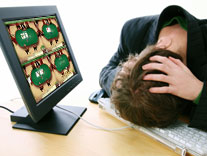
If you play outside your comfort zone, then
you may feel as if something is holding you back, even when sitting down at
the table. Thoughts about possible losses and their consequences control you
and torture you.
You may deliberately play especially tight and passive, avoiding marginal situations
so as to minimize losses and variance. Aggressive opponents and frequent all-in
situations intimidate you and, in difficult situations, you may start calling and
folding instead of choosing the aggressive option, even if you
would usually have liked to.
Losses or several bad beats in quick
succession in a session quickly push you past your limit and cause your game to
become more impulsive and emotional. Instead of always folding, you will
occasionally get impatient and attempt reckless and unprofitable moves in order
to win a big pot.
Pay attention to any change in your game: Are you playing differently to how you usually would?
Are you playing worse than you should - considering your skill level and knowledge of the game? If you are
playing differently, then ask yourself what you are doing differently and which
thought processes are responsible for this.
Are you ready for your limit?
Some players might now be surprised to find out
that the limit that the above asked questions apply to, is one or
even several levels below the limit they are currently playing at, or at least below the
limit that their mathematical bankroll management would suggest them to play.
The question of possible discrepancies
between mathematical and psychological bankroll management arises. Isn't it
minus EV to focus on psychological aspects instead of just playing at the limit
that the size of your bankroll allows?
Of course, a linear ascent using
mathematical bankroll management is optimal and theoretically has the highest
EV. For players who have no difficulty climbing up the limits and are always in
their comfort zone, standard bankroll management is definitely the best option.
It should also be avoided that you no longer move up in limits by consistently gauging your skill and bankroll size in order to decide which limit you
should play. (e.g. don't think along the lines of 'Well, I do have the right
bankroll for NL400, but I just feel really comfortable playing NL5, so I'll
play that.')
The point is to add another aspect to
normal bankroll management, namely which limits the player is psychologically
fit for. The fear of losing the money you are now betting, which you will often
have won in small and painstaking steps at a lower limit, can cripple your
game.
If you either suspect or know that you have
a scared money problem, then don't blame yourself, but rather take the necessary time required to adjust step by step to the
psychological demands of higher limits. Even many top players have taken
years to really get comfortable after a move up in limits.
To show what kind of difficulties even top
pros have had climbing the limits, here's an extract from Michael Craig's very
good book, The Professor, the Banker and the Suicide King, in which he
describes Jennifer Harman's climb up the high limits.
"Between 1990 and 1995 Jennifer
played $50-$100, $75-$150 and $100-$200 Texas Hold’Em in Reno, Los Angeles and
Las Vegas. In the early 90s, she saw a big game for the first time, a $300-$600
game in the Mirage, and decided that she really wanted to play in it...That was
to be the start of a pattern that
lasted from the late 80s until 1997. Every time Jennifer managed to build up a
bankroll, she took a shot at the $200-$400 and $300-$600 games, lost all her
money, and started building up a bankroll again. ...If her estimates are
correct, then she moved up only to lose enough to have to move down to the
smaller games at least eight times.... In 1997 Jennifer Harman finally achieved
the breakthrough." [translation of a
translation, therefore not in the same wording as the original]
Be Patient with Yourself
Don't expect too much of yourself, be
patient with yourself.
The educational content
that is available on PokerStrategy facilitates a rapid rise through the
limits. This lets you experience sizeable successes relatively quickly. However,
you have to cope with these successes psychologically. By and by, you will master
the adjustments required for playing with large amounts of money. Maybe you should also try the following:
 |
| You have Time |
If your current limit and your comfort zone
are not too far apart (e.g. NL25/NL50 or NL200/NL400), then ask yourself whether
staying at the lower limit and thus playing your stress-free A-game may even be
+EV compared to the theoretically higher profit at the higher limit. You must,
by no means, underestimate the increased stress and higher frequency of mistakes
caused by continuously playing outside your comfort zone.
If you find that you are doing well at
your current limit but have misgivings about
moving up, then there's nothing wrong with simply staying where you are for
now. You can enjoy your winnings while at the same time continuing to improve
your skills without being under additional pressure caused by the higher
stakes. If you then feel like moving up after while, you can still do so
whenever you like.
Development and Learning
Plateaus
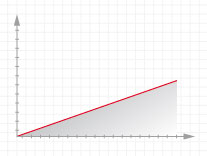
It is a well-known fact that progress in
one's knowledge, ability and development usually isn't linear. One's progress
usually looks more like what you see in ill. 2, instead of the linear progress
in ill. 1.
 |
 |
| illustration 1 | illustration 2 |
Our learning progress often reaches a
plateau, where nothing seeming to happen for a long time until there is a sudden
surge of progress and we maybe notice that there has actually been progress.
Also, not everyone has the same learning
curve. Some players start off slowly, making only small progress for a long
time until they experience a surge of progress with a big step towards
comprehension, as in ill. 3.
Others immediately make major progress and
then slow down, their learning curve flattening out as in ill.4. The course of
progress is very individual, and you will inevitably have to make some detours
and endure some dry patches.
 |
 |
| illustration 3 | illustration 4 |
Summary
-
Watch out for signs that your
game is being affected by playing at a limit that is too high. -
Play in your comfort zone!
-
Invest time in your development
and understand that you have your own individual path and type of learning
progress.
About the author: Robert Langer is a psychological
consultant, coach and trainer with a practise in Saarbrücken. He also teaches
Psychology at a large German school for alternative medicine, and holds
lectures and seminars in NLP, conflict solving psychology and
psychological typology.
| LINKS | ||||||||||
|
||||||||||