Tilt: Of Shark and Fish

You have no edge when on tilt
"Competition is won or lost on the six-inch playing field between the ears" (Bobby Jones, legendary golfer)
One would think that good players would welcome playing against the worst players, the so-called 'fish'. After all, aren't they the ones that provide the dead money? Don't they make mistakes that better players profit from? Don't they just call with anything in the hope of a weak draw hitting? Isn't it true that they are unaware of the mathematical probabilities and simply gamble, play far too many starting hands, choose awful bet sizes, ignore position, and well....... calling station, weak-tight? BAAH!
Yes, all of this is true, and through these mistakes, fish represent the likelyhood of better players. And yet, fish are stumbling blocks for many good players, as their bad play inevitably leads to occasional horrendous bad beats, 2-outers etc. Or perhaps its just one of those days where the fish are just constantly getting lucky or making irrational plays that put us on tilt.
 |
| Bad players can win too |
If fish didn't occasionally win despite their bad play, then good players would have astronomical win-rates. The only problem would be that the oceans could suffer from over-fishing after a while. The poor fish should be allowed to feel comfortable in the role of the losing player. They should be allowed to lose as much money as possible without complaining, leaving this money for the other players to collect.
Anyone with a degree of experience in poker is familiar with this problem. Bad players make us angry, while at the same time we have to acknowledge that the largest part of our poker earnings come from bad players. The anger will often however take control and put us on tilt. Why is this?
It is because anger is of emotional nature and touches us directly. It distracts and upsets us, while the awareness of the fact that bad players pay our bills is distant and based on intellect. Since our brain classifies this intellectual understanding differently, the thought process has less influence on our emotional state. In a similar fashion, when we are winning, then we usually attribute this to our own skill and competence and to the others' mistakes.
This however leads to a shift in our perception, away from our own game and towards the others' game. While doing this may take some weight off your shoulders, it doesn't benefit your game much. If you fall into this line of thought, you stop trying to improve your own game because you make the other players responsible for what happens at the table. This however implies that you are also letting them determine the outcomes, even though these are in fact influenceable by you.
One's own Skill or Opponents' Skill as explanation for results?
Anyone who blames the results on the competence or incompetence of the opponents, frees himself of responsibility for what is happening, but also takes away his role as a person with the ability to influence these happenings. You end becoming a person that cannot act, but only react, namely to that what others do. You end up playing the others' game instead of your own. You'd like to play your own game, but the others won't let you, because they are playing the way they do...
Players who are self-determined accept the facts of the game and recognise their self-responsibility. They know that they can only work on their own game, not on the others' game. They see bad session or downswing as a call to improve their own game. They may have fewer excuses to relieve themselves of responsibility, but they have the power to improve the situation.
 |
| Your lead is not so big |
Poker is a game of minor advantages over opponents. Even a very good player will sometimes only have a small edge over the competition in the short run, as the luck factor is very large there.
In the long run, the many small advantages add up to a noticeable (and lucrative) advantage over the competition.
Nevertheless, poker is at least for the moment a game of minor advantages, which shows itself in the high variance that is experienced in poker. And it is variance that leads to the familiar emotional situations during a session or an evening of poker. The stats and curves for whole years, on the other hand, are usually taken in a distant, cognitive way.
If you think that you just have to sit down at the table and will immediately destroy the admittedly bad competition, then you are putting yourself into a psychologically dangerous situation, as the actual level of success you will experience will inevitably not be as high as you would actually think it should be.
In actual fact, many players have a much smaller edge over their competition than they think. This belief....
- ... also prevents you from noticing your own contribution to the down, i.e. it prevents you from registering your own mistakes.
- ... causes you to tilt more quickly, as the responsibility for what is happening seemingly lies with your opponent rather and not with you.
- ... makes you feel that you don't need to continue working hard at improving the quality of your own game. „What am I supposed to do if they'll beat me anyway?“
If, on the other hand, you act realistically and with self-determination, then you can accept your responsibility and accept where you stand. There's no reason to hide, but neither is there a reason to succumb to delusions of grandeur after six months of playing poker.
If you invest in your game, are dedicated and have the right perspective, then you will have the success that corresponds to the quality of your play. This includes seeing fish for what they really are: an opponent and fellow player who has mathematical probability on his side to the same extent as we do.
To put it differently, fish giving us bad beats is unavoidable. Is there actually any reason for us to lose self-control, simply because of the fact that even the worst player will occasionally hit? After all this is the way it HAS to be, considering that probability treats everyone as equals.
Reframing
What I did in the previous section was an example of so-called reframing, an approach you will already have encountered in the forum. For example, a player writes that the constant bad beats he is getting are making him angry, and another player anwers that the poster will profit from the bad play of the fish in the long run. This is a perfect example of reframing.
Reframing means putting something in a different frame, seeing something in a different context, or interpreting it differently. This is a process that human conscience constantly performs. We constantly reframe by interpreting impressions in our chosen frame and evaluating them correspondingly. If new impulses and impressions are present, then we are ready to reevaluate the situation and put it in a more appropriate context if necessary.
In a way I am explaining the concept of reframing on a meta-level, so that you can learn to perform your own reframes in future. Reframing is an individual matter, as a new context that works for someone else may not be right for you.
An example: Someone who has just had his hand bitten by his dog may not react to his girlfriend's reframing suggestion of considering what a cute dog it is. However, if you consider that the dog will of course get annoyed and will often snap at you when you take his ball away, then your anger will fade and you will have performed a reframe that is appropriate for you.
If we think about reframing and what goes on during reframing, then we realise that WE can decide how to interpret what happens. What may seem like a good thing to one person may not satisfy another at all. In between there is room for the individual interpretation.
So far, so good. You will probably already be familiar with these things, but we are seldom willing to accept how subjective the ways we see things are. We always assume that our frame is objective (e.g. 'I don't just think it is, it really is').
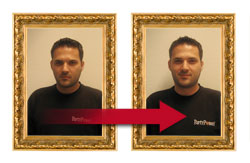 |
| Reframing: Putting things in a new context |
In poker, we have the power to decide how to interpret things too. We have the choice of creating a more or less unbearable frame: 'I always lose with AK, so there's no point in even playing it!' or a frame that is more constructive: 'That's part of the game and the mathematical probabilities, and will start working in my favour sooner or later' or similar.
Choose a frame that appeals to you. There are plenty of sensible suggestions in the strategy and psychology sections as well as from users in the forum. It is important for the frame to be one that you can live with and find plausible. Of course, you also have the option of retaining your old habits. Nevertheless, I want to motivate you to examine the way you think about downswings, tilt, poker, and - in fact - anything, so that you can maybe realise how much power you have over what happens, when you give yourself the freedom to decide how to interpret things. Just try it out. It's hard to break old habits, but practice makes everything easier.
Think of a situation that often worries you, and consider how you could interpret this situation in a positive way. Try to find a positive frame that lets you deal with the problem more easily. How would someone else judge the situation from their point of view? What other ways of looking at the situation are there? What could be the positive effects of the negative event? It often turns out that there is something positive to be found in a situation that was experienced as being negative. It is important to get a feel for this. Play around a bit with the possibilities.
Summary
-
Try to be realistic. Both world class players and amateurs will regularly experience variance. However, there is a big difference in the way they deal with it.
-
Even if it may be psychologically relieving to remove pressure, many players don't have as big of an edge over fish as they imagine. Stick to your game and look for advantages. Respect your opponent. If you go on tilt because of fish, then THEY have an edge over you!
-
Spend extra time studying the articles on playing individual types of opponents. This way, you are better prepared and are less prone to tilting because you feel that you can take counter-measures.
About the author: Robert Langer is a psychological consultant, coach and trainer with a practise in Saarbrücken. He also teaches Psychology at a large German school for alternative medicine, and holds lectures and seminars in NLP, conflict solving psychology and psychological typology.
| LINKS | ||||||||||
|
||||||||||