


Chip Value (3): Application of the ICM
Before reading this lesson, you should have previously read through:
- Chip Value (1): The Principle of Diminishing Chip Value
- Chip Value (2): The Fundamentals of the Independent Chip Model (ICM)
You already have an idea of how to understand the value of your stack in SNGs and how it's possible to evaluate it. These abilities are crucial, but they're not enough when it comes to making profitable decisions.
In this lesson, you will learn how evaluating stacks allows you to evaluate your decisions. You'll see how to use the ICM when you are about to call, and how to take advantage of it when you push.
Why is this ability so important? At the end of the day, it's not about obtaining chips, or about knowing their value. It's about earning money, and this can only be done by making profitable decisions.
Using the ICM: call
Take a look at the following example from the 10-man SNG $10+$1 (payout structure: 50/30/20). There are four players left and the blinds are 300/600.
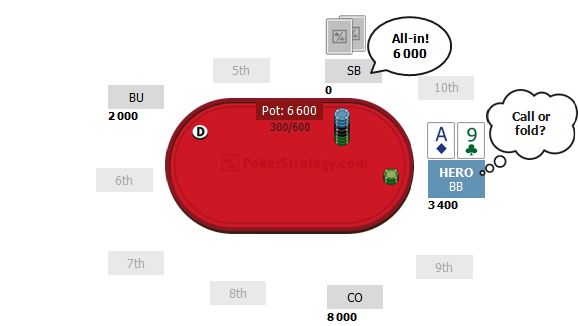
You assume that the SB will often put you under pressure, pushing with top 85% of his hands. Against such a range you have of course a profitable call in terms of cEV; 
 has about 60% equity vs. 85% hands range, and on top of this the odds are great. But what about a real, monetary profitability? Is call with +$EV here?
There are 3 possible scenarios for you:
- Fold
- Call & win
- Call & lose
In the previous lesson, you've learned how the ICM gives the monetary value to chip stacks. With this in mind, take a look at what $EV for all 3 scenarios looks like according to the ICM:
- $EV of your stack after fold: $21.50 with 3,400 chips
- $EV of your stack after call & win: $34.40 with 8,000 chips
- $EV of your stack after call & lose: $0 with 0 chips
By weighting the last two cases with the probability of winning, you get $EV of your stack after a call, which equals here ~$20.60.
Monetary expected value of your stack after a call ($EV) = probability of winning the hand *
monetary expected value of your stack after call & win + probability of losing the hand
* monetary expected value of your stack after call & lose
probability of winning the hand: 60%
monetary expected value of your stack after call & win: $34.40
probability of losing the hand: 40%
monetary expected value of your stack after call & lose: $0
$EV = 60% * $34.40 + 40% * $0 = ~$20.60
Since you already know what is the expected value of your stack both after a call and after a fold, you are able to decide which action has the greater $EV.
$EV of your stack after a fold = $21.50 > $EV of your stack after a call = $20.60
As you can see, the best play in this situation is a fold. Calling is a mistake costing you $0.90.
 |
In terms of money, a +cEV call may be worse than a fold. |
Using the ICM: push
In the similar way you can apply the ICM the other way around, so when making the decision between push and fold.
Take a look at the same example, but with the roles switched. Suppose you sit on the SB and hold 
 .
.
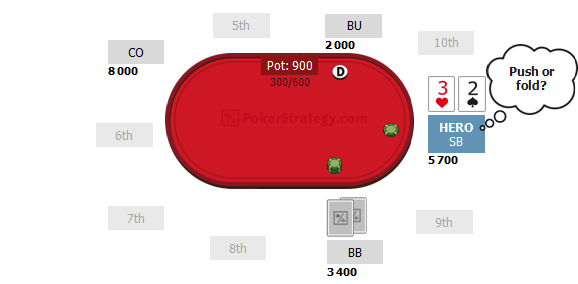
Disregrding call, this time there are 4 possible scenarios for you:
- Fold
- Push & BB folds
- Push & BB calls & you win
- Push & BB calls & you lose
According to the ICM, $EV for all 4 scenarios looks like this:
- $EV of your stack after fold: $28.68 with 5,700 chips
- $EV of your stack after push & fold: $31.05 with 6,600 chips
- $EV of your stack after push & call & win: $38.89 with 10,000 chips
- $EV of your stack after push & call & lose: $15.56 with 2,000 chips
The decisive factor here is how you estimate the calling range of the BB. Say he is a regular, decent player who has some knowledge of the ICM and has a calling range of around 10% (66+, A9s+, ATo+, KJs+). Against this range, has 25.28% equity.
$EV of your stack after a push is $30.10 here and can be calculated by weighting the values given above according to their probabilities.
Monetary expected value of your stack after a push ($EV) = probability of winning the hand without the showdown (Push&Fold) * monetary expected value of your stack after push & fold + probability of a call * (monetary expected value of your stack after call & win * probability of winning the hand when called + monetary expected value of your stack after call & lose * probability of losing the hand when called)
probability of winning the hand without the showdown (Push&Fold): 90%
monetary expected value of your stack after push & fold: $31.05
probability of a call: 10%
monetary expected value of your stack after call & win: $38.89
probability of winning the hand when called: 25.28%
monetary expected value of your stack after call & lose: $15.56
probability of losing the hand when called: 74.72%
$EV = 90% * $31.05 + 10% * ($38.89 * 25.28% + $15.56 * 74.72%) = $30.10
If you compare the $EV of your stack after a fold with the $EV of your stack after a push, you can clearly see that you have an easy push here.
$EV of your stack after a push = $30.10 > $EV of your stack after a fold = $28.68
The difference between the two decisions is $1.42.
In other words, folding is a mistake that costs you $1.42.
Since is usually described as the weakest starting hand in heads-up, it is evident that in this situation you have a profitable push with any two cards.
|
There are spots in which you can profitably push any two cards. |
ICM programs
Calculating exact value of decisions during the game – similar to evaluating stacks – is too complicated to be practically possible. However, understanding the ICM and practising it on different spots allows you to develop the ability to evaluate decisions intuitively.
Fortunately, special programs can do the most complicated work for you. To practice with simulated situations, you can use our special designated ICM software, The ICM Trainer and The ICM Trainer Light.
In order to review and analyse your hands, as well as to make more complicated simulations, you can rely on SitNGo Wizard, HoldemResources Calculator and ICMIZER.
Summary
Application of the ICM is not limited to the above situations, so you will learn more about it in the future. However, after this lesson you should already be able to make further adjustments by yourself. Remember:
 Evaluating stacks according to the ICM allows you to evaluate your decisions.
- In terms of money, a +cEV call may be worse than a fold.
- There are spots in which you can profitably push any two cards.
 Evaluating stacks according to the ICM allows you to evaluate your decisions.