


Playing Postflop (1): As the Preflop Aggressor
Before reading this lesson, you should have read through:
After the two previous modules, you should have an understanding of how to play preflop. In the later stages of SNGs, preflop is usually all there is to play with the stack sizes so short and risk premium high enough to discourage flat calling and playing postflop.
However, in the early stages of SNGs, you often find yourself in postflop situations where your preflop raise was flat called. This lesson will help you approach such spots, understand what factors are important when considering what to do, and develop a default strategy in case of no specific reads on the opponent.
Continuation betting
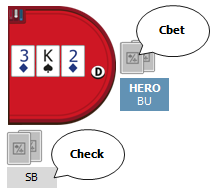 |
This is the most frequent postflop spot you will find yourself in. You have raised preflop, were called by one or more opponents, and the action has either been checked to you, or you are first to act on the flop.
Generally, in these situations you should be aggressive because you have the initiative and your range is typically stronger than that of your opponent. With a good hand, you should bet for value and to protect it from draws. You should also bluff with as many missed hands as you can get away with. Sometimes you can combine these goals if you have a weak hand but a good draw – this is called a semibluff. You will now see when exactly it makes sense to continuation bet (shortened to "c-bet"), and how much you should make it.
When to bet
The first thing to check is whether you are heads-up or multiway. In a heads-up pot, you should generally c-bet all but the very worst of boards. However, in multiway pots you should only c-bet if you have hit, if the board is very dry, or if the board is highly unlikely to have hit your opponents.
What is meant by good or bad boards to c-bet? A wet board, that is a board with lots of possible draws, is more likely to have hit the preflop caller than the raiser. Also, a low board is bad for the aggressor since he will, on average, have fewer low cards in his range than a player who just calls. On the other hand, if the board comes dry, with no or few draw possibilities, it is less likely to connect with your opponent's range and your c-bet should be very profitable. All in all, it is best for the preflop raiser if the board contains a single high card.
An example of a good board to c-bet:

An example of a bad board to c-bet:

Another factor to consider is your position relative to your opponent's position. As a default, you should apply the following c-betting strategy:
 |
Out of position, you should c-bet all boards that you hit, almost all boards against a single opponent, and only the best boards that you miss when against multiple opponents. |
|
In position, you should check behind with your weak showdown value hands. Depending on the situation, these can be anything from a good A-high to a top pair weak kicker. Otherwise, you should c-bet with the same hands that you would when playing out of position. |
This outline of a strategy should be modified if you have additional reads on your opponents, or if the overall situation is in any way non-standard. In particular, you should think about what range your opponent is likely to have in a given spot and how he perceives your range. Typically, casual players will not think about your range, but regulars most certainly will.
Another thing to look out for are the postflop tendencies of your opponent. If he's tight and folds a lot to a flop bet, your c-bet might be profitable regardless of your holding and the board structure.
On top of that, you need to remember that if you are closer to the bubble, you should play more cautiously if a postflop spot occurs. That is because the risk premium is higher, and potentially losing a large pot would prove much more costly than in most other stages of the tournament.
The last thing to take into consideration is if your opponent has a short stack, and if he is, or can easily become, committed to the pot. In such cases, you should weigh your betting range more towards value hands since you will have to take your hand to showdown more frequently.
How much to bet
Now you know when you should c-bet. But what should the bet size be? That depends mostly on the board texture.
|
On a wet board, you should size your bet between 50% and 60% of the pot, trying to make it closer to 60% on average. |
|
On a dry board, you should size your bet between 40% and 50% of the pot, trying to make it closer to 40% on average. |
One adjustment to make is if a c-bet of that size commits you to the pot, but a slightly smaller size would not, you should go with the smaller size.
If you have reason to believe that an opponent's reaction will not depend on the size of your bet (it is called an inelastic calling range), you can make it larger with good hands and smaller with bad hands. However, you should not make a habit of this. You need to have good reasons to unbalance your bet sizes, otherwise you may get exploited.
When your c-bet gets raised
If your c-bet gets raised on the flop, you should proceed very cautiously and straightforwardly. If you believe you have a hand that beats the opponent's raising range, go for it. Otherwise, just fold unless you have a good draw which justifies calling.
To illustrate the "straightforward" strategy, assume that your c-bet gets raised on a wet board.
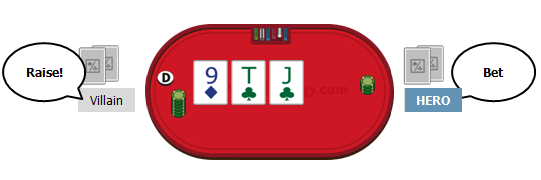
In the above situation, you should raise and try to get it in if you have a straight or a set. If you have AT, you should give up and fold. With a drawing hand, such as 
 or
or 
 , you can call and reevaluate on the turn, based on the card that comes and your opponent's action.
Barreling
So you raised preflop, bet the flop, and still got called. Betting the turn and/or the river after c-betting the flop is called barreling. It is also sometimes known as turn/river c-betting. If your hand is strong enough (beats your opponent's likely continuation range), you should continue and bet for value. You should strive to balance your barreling range, and in order to get maximum value for your nut hands, you need to bet with some bluffs too.
An important thing to consider when it comes to barreling is that you need to plan your moves ahead. Most importantly, you need to adjust your bet sizes to split the whole effective stack into two or three conveniently sized barrels. It is therefore necessary to know what your SPR (Stack to Pot Ratio - the ratio of the pot to the remaining effective stacks) is.
For example, assume that the pot on the flop is 2000, and the remaining effective stack is 6000. If the board is wet, you would normally like to bet 1200 (60%), but this leaves you with an awkward stack of 4800 to a pot of 4400 on the turn.
In such a scenario, you are better off either making your bet bigger on the flop, e.g. 1600 (80%) leaving 4400 behind to a pot of 5200 (85%) – or making it smaller, e.g. 950 (47.5%) on the flop, making the pot 3900 by the turn with stacks of 5050. You can then bet 1600 (41%) on the turn making the pot 7100 by the river and leaving 3450 (49%) with which to go all-in.
Other than that, you should be aware of what your opponent's folding frequencies are when facing a second or third barrel, and what cards are good for you to continue barreling.
A good barreling card is a card which either increases your equity by giving you additional outs (such as giving you a backdoor flush draw or a backdoor straight draw), or is a scarecard – a card which is likely to have hit your perceived range (such as an ace, which is always likely to have hit a preflop aggressor).
|
As a default strategy, you should barrel as a bluff only if a good barreling card falls on the turn. |
Reacting to a donk bet
 |
It can happen that your opponent does not give you the chance to c-bet. When you are in position and an opponent acting before you bets out, despite not being the preflop aggressor, his bet is called a donk bet.
You will be faced with donk bets from time to time and so it is important to know what it typically means and how to react. We can divide these situations into two major groups.
A small donk bet from a weak player is typically unbalanced and weak. Weak players like to donk bet small with (often weak) drawing hands or weak pairs. They do this because they don't want to face a larger bet by you. Your default counterstrategy should be to raise such donk bets, either as a bluff or for value.
On the other hand, a larger donk bet from a weak player, or any donk bet from a good player (although this would usually be on the larger side) is typically balanced and rather strong. A good player donk bets mostly on flops that you might not c-bet, with all his monster hands (sets, two pair hands), and his drawing hands. With the former, he wants you to pay; with the latter, he wants you to fold. As his strategy is balanced, there is no simple counter. You should generally fold with your missed hands, call with your medium-strength made hands, and raise with your monsters.
|
As a default strategy, you should raise a small donk bet by a weak player, and play according to your hand strength against a donk bet from a good player or a large donk bet from a weak player. |
Playing as the preflop 3-bettor
All of the above basically applies regardless of the preflop action (given that you were the last person with the preflop betting initiative). However, when the pot has been reraised (i.e. 3-bet) preflop, there are several implications worth mentioning.
First of all, the ranges are tighter. Your 3-betting range is surely tighter than your opening range, and it might or might not be polarised. Your opponent's calling range is tighter, and it might be capped – in this case, meaning that (some of) the best possible combos are not in his range, for example if he 4-bets with AA almost always – or uncapped.
Typically, if your range is depolarised (meaning you don't have bluffs in your 3-betting range), a knowledgeable opponent will 4-bet with his top range, so his flatting range will be capped.
On the other hand, if you are capable of 3-betting light, a knowledgeable opponent might just call with aces to keep your bluffs in the pot.
The other implication is that stacks on the flop are much shallower relative to the pot size. The resulting SPR will be much lower, and there will often be no betting left on the river - or even on the turn. You need to take this into account when sizing your bets, often scaling them down in order not to become unnecessarily committed to the pot.
Last but not least, most 3-bet pots will be heads-up. You will very rarely stumble upon a multiway 3-bet pot. As a consequence, you will be able to bluff c-bet even more frequently.
Summary
In this, lesson you have learned that:
|
 |