


Chip Value (1): The Principle of Diminishing Chip Value
One of the most important skills for a SNG player is the ability to understand and calculate the real value of chips. By doing so properly, you will be able to better understand the trade-off between risk and reward in all of the situations you face. Naturally, as you gain a fuller understanding, you will make more profitable decisions at the table.
Why is this ability so crucial and what does "chip value" actually mean?
Surely you have an intuitive sense of how important chips are in SNGs. For example, in most SNGs you can’t re-buy after you lose all of your chips. Therefore, it is often argued that one should handle their chips more carefully and wisely in SNGs.
Of course this is true, but simply knowing this fact is not enough when it comes to evaluating chip value. Imagine that you are playing in a cash game where you only have one buy-in available. Should your decisions be exactly as “cautious” as those that you make in a SNG?
The answer is a clear no, and this lesson is going to show you why. You will make the first step to understanding the real value of chips by learning the principle of diminishing chip value.
 |
Important: Chips in SNGs have different value than in cash games! |
The chip value in SNGs is different than in cash games
In order to be able to understand the real value of your stack, you need to see the relationship between the quantity of one's chips and their real value.
The number of chips in cash games equals their value
Consider first the following example from a cash game: $0.05/$0.10 No-Limit Hold’em.

Seven players fold and a maniac, who sits in the SB, raises all-in. Hero makes an easy call with his aces and wins the hand. Assuming that there is no rake, Hero has a stack of $20.
You can clearly see that by doubling his stack Hero has also doubled his money.
The number of chips in SNGs and their value are not directly correlated
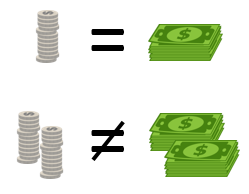
Imagine, however, that Hero is in a 9-man $10 SNG with a 50/30/20 payout structure (for simplicity purposes suppose there is no rake).
At the beginning of the game, each player’s 1,500 chips are worth $10 (the buy-in). If Hero busts before getting into the money, he loses $10. However, if Hero wins and at the end has all 13,500 chips, he doesn’t get $90, but only $45.
Hero has 100% of the chips, but gets only 50% of the buy-ins. He has multiplied his stack by nine, but hasn’t equally multiplied its value. What follows from this observation is that chips that he won were worth less than ones that he risked.
From this observation we can derive the general principle:
|
The principle of diminishing chip value: A chip you are about to win in a SNG is not necessarily worth as much as the one you're risking to win it! |
That is exactly how we understand the value of chips in SNGs.
Different kinds of expected value
Take a look at the following example from a 10-seater Double Or Nothing SNG (once again suppose there is no rake). It's a type of a SNG which awards 5 of 10 players double their $10 buy-in as a prize. This example is a bit extreme, as it's based on an unusual situation, but it clearly shows the specific nature of chip value in SNGs.
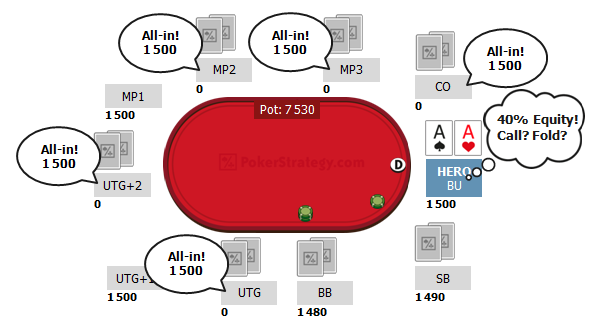
First hand of the game has just been dealt. Posted blinds are very small, so it can be assumed that all players have equal stacks worth $10 each. Five players have gone all-in and two others folded. You sit in the button and assume that with pocket aces your equity in this spot is 40%. You also assume that if you call, both SB and BB fold.
You have now a 40% probability of winning 9,030 chips (supposing there are no ties); by calling you win 2,112 chips on average. Therefore this call is very profitable in terms of chips.
At the same time, you have 40% probability of winning a prize, which is $20 (20% of the prizepool), but you also have a 60% chance of busting from the game with nothing. Therefore, in terms of money, you lose $2 on average - calling is unprofitable here.
As you can see, in this situation calling makes you earn chips, but lose money.
An interesting thing is that also folding can be evaluated here. This aspect is more complicated and interesting though, so you will learn about it in the next lessons.
Below you can find details regarding calculations:
Call expected value in terms of chips (cEV):
cEV = your stack if won * your equity + your stack if lost * probability of losing - chips you risk
your stack if won = 9030
your equity = 40%
your stack if lost = 0
probability of losing = 60%
chips you risk = 1500
cEV = (9030 * 40% + 0 * 60%) - 1500 = 2112
Call expected value in terms of money ($EV):
$EV = value of your stack if won (prize) * your equity + value of your stack if lost * probability of losing - value you risk (your buy-in)
value of your stack if won (prize) = $20
your equity = 40%
value of your stack if lost = $0
probability of losing = 60%
value you risk (your buy-in) = $10
$EV = ($20 * 40% + $0 * 60%) - $10 = - $2
Since chips won in SNGs are not necessarily worth as much as ones you already have, it can be said that you risk more “value” in order to win less “value”. That is why in SNGs you need more equity than in cash games in order to call a bet profitably.
In respect of the above, expressing the difference between a given number of chips and their value uses two types of the expected value: chip expected value (cEV) and monetary expected value ($EV).
- Chip expected value (cEV):
The average number of chips you can expect as the result of an action. - Monetary (dollar) expected value ($EV):
The average amount of money you can expect as the result of an action, based on your current prize pool equity. $EV is the monetary equivalent of cEV. $EV is also used to describe the monetary value of a given stack.
Recognising the real profitability of decisions
This leads to the very important conclusion - always think about your decisions in terms of their real profitability (monetary expected value: $EV), instead of profitability measured in chips (chips expected value: cEV).
This approach is crucial, as it helps you to recognise decisions earn you chips but lose you money. The above example showed you that such a scenario is possible.
|
Important: A given decision can be +EV (profitable in terms of chips) but -$EV (not profitable in terms of money). |
In the next lessons, you will see how the above statements correspond to specific in-game situations by learning about the fundamentals of the Independent Chip Model.
Summary
In this lesson, you have learned how you should think about and recognise the value of your chips.
|
 |