


Which hands over or under realise equity?
How well a hand performs relative to its equity is a massive concept that drives modern poker strategy.

In the self study series Barry Carter shows you how he tried to solve a poker problem then consults a coach or solver to get feedback on his method.
I heard a quote recently from Patrick Leonard that I cannot stop thinking about, which was simply "Poker is all about realising equity".
Essentially he was saying (I think) that you should play your hand in the way that realises the most equity. With value hands it is making the right bet size, with weak hands it is picking the right bluffs, and so on. One thing I have learned from solvers is they go out of their way to avoid folding when they have equity. For example, they hate bet/folding with a strong draw.
Equity in poker is the raw strength of your hand if it was checked down with no more betting action. Equity realisation (EQR) is how well a hand performs relative to its equity. Hands can over and unrealise equity. Hands over realise equity when more money goes into the pot/make a player fold, and they under realise equity when they fold when they had a chance of winning.
To explore this further, let's look at a simple hand from GTO Wizard.
The flop is A♥9♦2♦ and this is the UTG range in a single raised pot against the BTN. The colours represent equity realisation. Green means the hand over realises equity, red means it under realises equity.
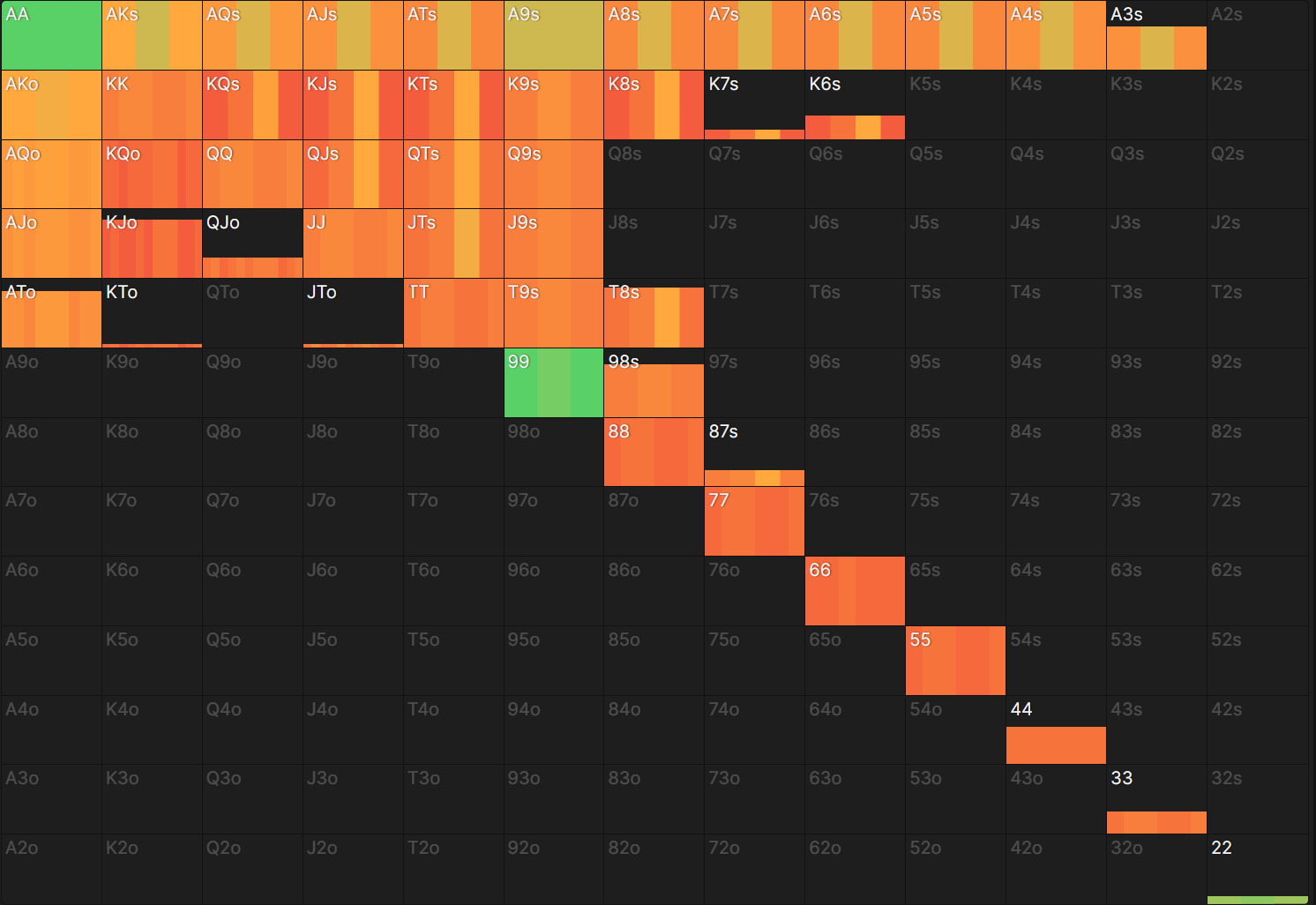
Small pairs tend to under realise equity. In this example 44 has an EQR between 46 and 56%. Anything under 100% under realises equity, anything above it over realises it. This will no doubt make sense to you, because most flops will show three overcards to a small pocket pair. In this example 44 has as much as 34% equity, but it will usually have to fold to the first or second bet.
The exception to this is when the small pair makes a set. Here 22 makes bottom set and has an EQR of 217%. That means it makes more than twice as much than it's equity would suggest. This is because a set is usually the best hand by the river, it is incentivised to bet and they are often well disguised, and 'unblock' calls. If 22 leads here all manner of hands will continue.
Suited hands over realise equity. In this example, KQo has EQR as high as 47% but K♦Q♦ has an EQR of 117%. This is much bigger than the difference in equity between KQo (33%) and K♦Q♦ (54%). The reason for this is suited hands are more playable. A diamond draw can call a bet here, it can bluff, it can check/raise etc. It certainly won't be folding any time soon. Even backdoor draws like K♥Q♥ make profitable bluffs that can turn equity.
Ironically, terrible hands can realise a surprising amount equity. In this example 8♥7♥ has an EQR of 72%, which is under realising equity technically, but given that it only has 20% equity on this flop that seems pretty good. The reason for this is that very bad hands are often good bluff candidates. 8 high is rarely going to win on this board at showdown, so it bluffs, with the backdoor flush and backdoor straight possibilities as a backup if called.
Compare this to a hand like K♥J♥ which is a much stronger hand in a vacuum, but it has an EQR of just 29%. This hand beats a lot of bluffs and when it is used as a bluff, the hands it makes fold it was probably ahead of anyway. This hand has 49% equity, compared to the 20% equity of 8♥7♥. Understanding this really helps you pick your bluffs. When you successfully bluff with 8♥7♥ you almost certainly making a better hand fold, which is a great result. Medium strength hands under realise equity.
I'm really early in my exploration of equity realisation but since I heard that quote from Pads, I am thinking about EQR in every hand I play and study. It's a much more important metric than many players assume.
Previous self study articles
- Playing against disconnected players
- Overbetting with Ace King
- Why do we check back with Range Advantage?
- Why do I turn top pair into a bluff?
- How I use ICMIZER
- How wide can we go with Antes?
- Why can we bluff missed straight draws more than missed flush draws?
- How to play a strong underpair on a wet board
- How to play a 15BB stack
- How often does Villain have an Ace?
- Why do we not check/raise with the nut flush draw?
- Why do we bet small on the turn?
- When do we open shove the flop?
- The difference between SB and BB defends
- Blocker/Unblocker
- How to pick your bluffs
- When NOT to bluff a big draw
How do you study away from the tables? Let us know in the comments:
