


SB Pre-flop Ranges

The small blind is the worst position at the table since you will always be out of position when you play a hand. This is something you need to consider for your hand selection.
In this lesson, you will find typical pre-flop ranges for playing from the small blind in a No-Limit 6-max game. These are primarily designed to be a response to raises in front of you because usually you are already facing a raise when it's your turn to act.
Due to the positional disadvantage, you mostly have to follow a tight approach, but you can expand your calling and 3-betting ranges quite profitably against the wide open raising ranges from the cut off and button. There is no need to wait for premium hands.
In this article, you will also learn how to continue with your open raising range against a 3-bet from the big blind.
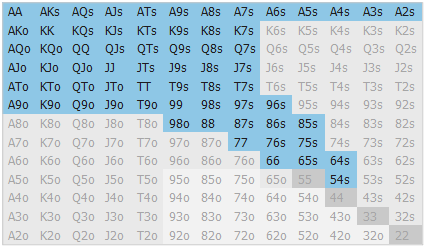
Open raising range
| Range: 66+, A2s+, K7s+, Q7s+, J7s+, T7s+, 96s+, 85s+, 75s+, 64s+, 54s, A9o+, K9o+, Q9o+, J9o+, T9o, 98o (31%, #410) |
 |
| Open raising size: 3BB |
| 3-Bet sizes: vs 2BB: 7.5BB vs 2.5BB: 9BB vs 3BB: 11BB |
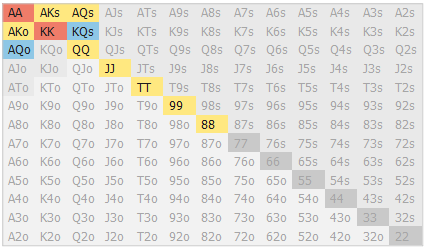
Against an open raise from UTG
| Defending range: 88+, AQs+, KQs, AQo+ (6%, #78) | ||
 |
||
| Call: QQ-88, AQs+, AKo (4%, #50) |
||
| 3-Bet/Fold: AQo, KQs (1%, #16) |
||
| 3-Bet/5-Bet:
KK+ (1%, #12) |
||
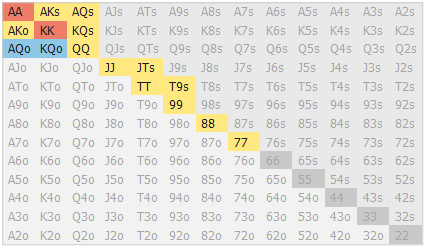
Against an open raise from MP
| Defending range: 77+, AQs+, KQs, JTs, T9s, AQo+, KQo (8%, #104) | ||
 |
||
| Call: QQ-77, AQs+, KQs, JTs, T9s, AKo (5%, #68) |
||
| 3-Bet/Fold: AQo, KQo (2%, #24) |
||
| 3-Bet/5-Bet:
KK+ (1%, #12) |
||
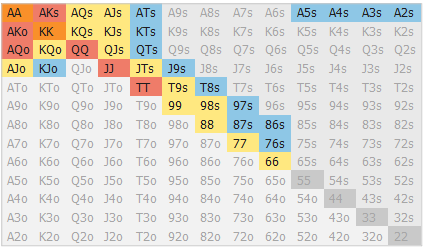
Against an open raise from the cut off
| Defending range: 66+, ATs+, A5s-A2s, KTs+, QTs+, J9s+, T8s+, 97s+, 86s+, 76s, AJo+, KJo+ (15%, #202) | ||
 |
||
| Call: 99-66, AsAc, KdKh, KdKs, KdKc, AQs-AJs, KJs+, QJs, JTs, T9s, 98s, AJo, KQo (6%, #84) |
||
| 3-Bet/Fold: ATs, A5s-A2s, KTs, QTs, J9s, T8s, 97s, 86s+, 76s, KJo (5%, #64) |
||
| 3-Bet/5-Bet:
QQ-TT, AdAh, AdAs, AhAs, AdAc, AhAc, KhKs, KhKc, KsKc, AKs, AQo+ (4%, #54) |
||
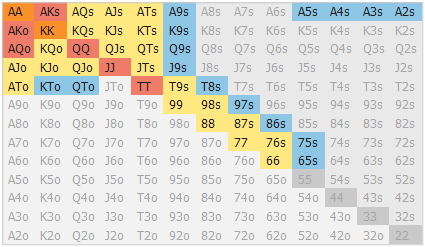
Against an open raise from the button
| Defending range: 66+, A9s+, A5s-A2s, K9s+, Q9s+, J9s+, T8s+, 97s+, 86s+, 75s+, 65s, ATo+, KTo+, QTo+ (20%, #270) | ||
 |
||
| Call: 99-66, AsAc, KdKh, KdKs, KdKc, AQs-ATs, KTs+, QTs+, JTs, T9s, 98s, 87s, 76s, AJo-ATo, KJo+, QJo (11%, #140) |
||
| 3-Bet/Fold: A9s, A5s-A2s, K9s, Q9s, J9s, T8s, 97s, 86s, 75s, 65s, KTo, QTo (6%, #76) |
||
| 3-Bet/5-Bet: QQ-TT, AdAh, AdAs, AhAs, AdAc, AhAc, KhKs, KhKc, KsKc, AKs, AQo+ (4%, #54) |
||
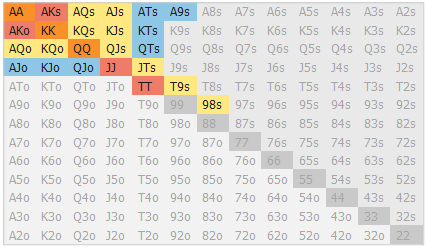
Against a 3-bet from the big blind
| Defending range: TT+, A9s+, KTs+, QTs+, JTs, T9s, 98s, AJo+, KJo+, QJo (12%, #154) | ||
 |
||
| Call: AsAc, KdKh, KdKs, KdKc, QdQh, QdQs, QdQc, AQs-AJs, KJs+, QJs, JTs, T9s, 98s, AQo, KQo (5%, #63) |
||
| 4-Bet/Fold: ATs-A9s, KTs, QTs, AJo, KJo, QJo (4%, #52) |
||
| 4-Bet/Call: JJ-TT, AdAh, AdAs, AhAs, AdAc, AhAc, KhKs, KhKc, KsKc, QhQs, QhQc, QsQc, AKs, AKo (3%, #39) |
||
Why these ranges?
The ranges for defending your small blind against open raises from UTG or MP are rather tight, but are a lot wider against the cut off and the button.
Your open raising range has been designed for the standard opponent who has a solid defending range in the big blind. Keep in mind that you can open raise 100% from the small blind if the BB folds more than 62.5%. Since the standard opponent in the BB 3-bets a lot against open raises from the SB, your defending range against 3-bets is relatively wide.
The open raising ranges from the cut off and button are usually quite wide, and calls from the small blind are often under attack by high barrelling frequencies post-flop. That's why you should attack the wide ranges of your opponents with an increased number of check/raises and OOP floats.