


Notes

By evaluating the showdown, you have gathered information about your opponent's pre-flop and post-flop game. In order to use this information as sensibly as possible, you should systematically capture it in notes.
A structured template and abbreviation system increases readability and helps you to quickly find the right note.
Creating a note template
A template helps you to quickly write down your notes in a consistent structure. You should create it in advance, so you can utilize it repeatedly. In this way, your notes always take the same form and are clear and easy to read.
A note should include the following information, which is recommended to be directly adapted into your template:
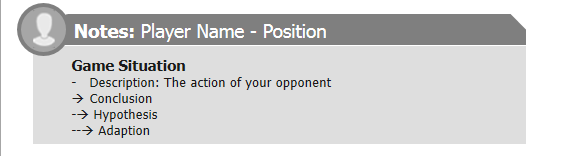
In the following game situation, a note could look like this:
$25 NL Hold'em (6 handed) 100BB Stacks
Pre-flop: Hero is Button with 

UTG raises to $0.75, 2 folds, Hero calls $0.75, 2 folds
Flop: ($1.85) 

 (2 players)
UTG bets $1.50, Hero calls $1.50
Turn: ($4.85)  (2 players)
UTG bets $4.00, Hero calls $4.00
River: ($12.85)  (2 players)
UTG bets $11.00, Hero calls $11.00
Villain shows: 


Use abbreviation systems
Using abbreviations in notes allows you to quickly read and understand them. Quick readability is especially important, since during a game you have very little time to read your notes. Use a system which works well for you and is easy to understand. What this ends up looking like is completely up to you.
Special importance should be placed upon the abbreviations for the different board textures here. For this the following system has proven to be useful:
| Abbreviation system for different board textures | ||||
| Board texture | Flop | Turn | River | Abbreviation |
| Rainbow flop |    |
K72r | ||
| Twotone flop |  |
K72s | ||
| Monotone flop |  |
K72m | ||
| Twotone flop with 3rd suit on the river | |
 |
 |
K72s35s |
| Twotone flop with 3nd suit on the turn | |
|
K72s2s | |
| Twotone flop with 3ed suit on the turn and 4th on the river |
|
|
|
K72s2s5s |
| Rainbow flop with BDFD on the turn | |
 |
K72r3s | |
| Twotone flop with BDFD on the turn and flop flush hits on the river |
|
|
 |
K72s3ss9s |
| Twotone flop with BDFD on the turn and 3rd suit for BDFD on the river |
|
|
 |
K72s3ss9ss |
Other abbreviations could possibly be FD (flush draw), SD (straight draw), BDFD/-SD (backdoor flush/straight draw). Actions can also be abbreviated: OR (open raise), RR (reraise) and much more is possible. Here you should create your own easily readable system.
Sort notes by situations
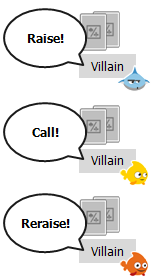 The amount of information becomes confusing with an increasing number of notes. To prevent this, use a system which sorts notes by situations and thereby allows you to quickly find the right note. The following system of classification of three different situations has proven to be useful:
- As PFR = Your opponent is the pre-flop aggressor in a single raised pot.
- As caller = Your opponent called an open raise or limped and called after that.
- RR = Reraised pot: your opponent played in a pot in which happened a reraise, either as a caller or as the pre-flop aggressor.
You can either use these categories as headlines and all notes below belong to that category, or you can write a shorthand symbol in front of each note, such as [AsPFR].
By using this system, you can quickly find the right information during the game. If you for example open raised and your opponent called, you can read through all the notes that start with [As caller].
At the end of each session, you should check if you have made multiple notes for one player with identical or very similar content. These you can possibly summarize clearly.
Describe your opponent's actions
The note you create after the analysis of the showdown should include the following information:
- Description: Your opponent's action(s)
- Conclusions and hypotheses: What you learn about your opponent (his game)
- Adaption: Possible future adaptions against this opponent
First, you describe your opponent's action(s) and in the next step you make conclusions and hypotheses. In the last step, you note how to play him in the future based on this information.
Description: Your opponent's action(s)
You note down your opponent's actions on each street and summarize them afterwards:
Pre-flop:

Your opponent open raised 54s from UTG. If 54s is good enough for him to open raise, he will probably also open raise better suited connectors, that is 54s+. You can write down the note:
- Open raise 54s+ UTG
On the flop:

Your opponent c-bets a gutshot on a dry A83 board that allows hardly any draws:
- C-bets gutshot (54s) 80% PS on A83r UTGvsBU
"PS" here means "pot size": your opponent almost bet pot size or exactly bet 80% PS. Additionally, you should note which positions play against each other.
On the turn:

Your opponent hits a backdoor flush draw on the turn and double barrels 80% pot size.
- Double barrel A83r3s with backdoor flush draw (54s) 80% PS
On the river:

Your opponent does not hit and bluffs a third time with a large bet size: he triple barrels.
- Triple barrel A83r3s7 missed backdoor flush draw (54s) 80% PS
Summarize the gathered information
If you summarize the gathered information, your note could look as follows:

Make statements regarding your opponent's game
In this step, you make conclusions and hypotheses regarding your opponent's game that effect or might effect of the analysis of the showdowns.
A possible conclusion of this hand could be that your opponent bluffs too much. Though you only saw one hand, it could be a hint towards this.
- Triple barrel 80% PS Axxr with backdoor flush draw on blank runout when misses -> bluff happy?
The question mark at the end of the statement tells you that you are not sure yet. It is still a presumption. In the future, you should pay more attention to how often your opponent bluffs in order to verify or falsify your presumption. As soon as your read has proven to be true, you can erase the question mark. If the read is proven false, just erase the hypothesis.
Additionally, the bet sizing is interesting: he c-bets very large, that is 80% pot size. If he always c-bets this large, you do not gain information through this. But as soon as you see him c-betting smaller with other hands, the read on how large he c-bets with his draws is very valuable.
- Triple barrel 80% PS Axxr with turned backdoor flush draw on blank runout -> bets bigger with air?
The second part of your note is a possible conclusion from this that you still have to confirm: in the future, you pay closer attention to his bet sizing with different hands.
Note adaptions as orders of actions
When reading a note, you have to comprehend with one look how to adapt your game to your opponent: should you call/raise/3-bet more or less, etc.? Make a clear order of action for yourself and place the basis for this up front:
-> Bluff happy -> calldown lighter
Your opponent bluffs a lot and therefore you call him lighter. In this case, you already know that your opponent bluffs a lot. Since you still miss this security in the example hand, here you can not yet formulate secure adaptions and would mark them with a question mark.
Your entire note would look as follows:
As PFR: - open raise 54s+ EP - Triple barrel dry Axx with turned backdoor flush draw on blank runout -> Bluff happy? -> Calldown lighter? -> Bets bigger with air?
Summary:

In order to be able to quickly read your notes during the game, you should create a template, use abbreviation systems and sort the notes by their situations:
- As PFR = Your opponent is pre-flop aggressor in a single raised pot.
- As caller = Your opponent called an open raise or limped.
- RR = Reraised pot: your opponent plays in a pot in which a reraise happened, either as a caller or as the pre-flop aggressor.
You should keep the following information in a note:
- Description: Your opponent's action(s)
- Conclusions and hypotheses: What you learn about your opponent's game
- Adaption: Possible adaptions to your opponent based on the gathered discoveries