


Exploits (3): Exploitive Folds
When you make an exploitive fold, you fold a good hand because your opponent doesn't bluff enough. You exploit your opponent because you don't pay him off on his big hands.
So to make an exploitive fold requires you to identify a situation where your opponent's range is very strong. Top pair top kicker can become a clear fold in these spots.
In this lesson, you will learn how to recognize these spots. The main indicatiors for exploitve folds are:
- The board development improves your opponent's hands so he can have less bluffs.
- Your opponent almost never plays certain lines as a bluff.
Identify the VB-Ratio and find situations for exploitive folds
You start by establishing your opponent's range and then calculate the VB-ratio. You can call any made hand on the river if your opponent's range contains enough bluffs. However, if your oppoonent doesn't bluff enough, you have to calculate how much equity your made hand has against your opponent's range.
Accordingly, you have to find out when your opponent's range is mostly composed of strong value hands. This happens very frequently in the following scenarios:
The board development improves your opponent's range
In certain situations, the development of the board improves your opponent's range so significantly that almost all of his possible holdings will be made hands. If your opponent doesn't like to turn his weak made hands into bluffs, his betting and raising ranges will be so strong that you should make an exploitive fold. The most common spots are:
- Your opponent has a "draw+pair" range on the flop.
Example: Your opponent cold calls your open raise from the SB and plays check/call on a 

 flop. The turn brings a
  and both check. When the
  rolls off on the river, your opponent makes a big bet. You can fold Q9 without thinking too much about it.
- A certain card comes that helps your opponent's range a lot.
Example: The flop is K73. You know that opponent c-bets his weaker hands in position, but he will check behind with his middle pairs and ace high on this board. The turn brings an ace. If you check and your opponent bets, you can throw away 88 instantly.
Look at the following example:
MP ($25) - TAG Hero ($25)
Pre-flop: Hero is CO with 
1 fold, MP raises to $0.75, Hero calls $0.75, 3 folds
Flop: ($1.85) 

 (2 players)
MP bets $1.30, Hero calls $1.30
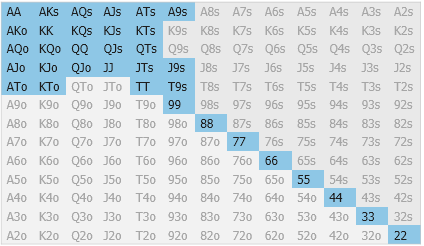
A TAG will on average open raise the following range from the MP:
| Open raising range: | ||
 |
||
| Open raise: 22+, A9s+, KTs+, QTs+, J9s+, T9s, ATo+, KTo+, QJo (17%, #226) |
||
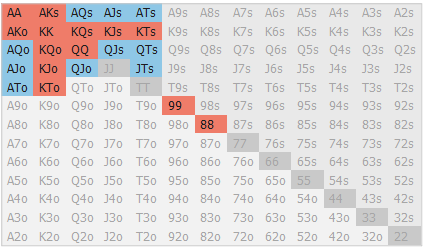
He will c-bet the following hands out of this range:
 |
||
| Bluff: AQs-ATs, QTs+, JTs, AQo-ATo, QJo (#63) |
||
| Value: QQ+, 99-88, AKs, KTs+, AKo, KTo+ (#46) |
||
You call the flop because you have 68% equity against your opponent's range and there is no weaker hand that would call a raise.
Turn: ($4.45) (2 players)
MP bets $4.00, Hero...
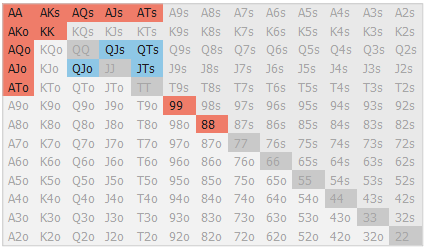
The turn brings the best card in the deck for your opponent's range. His betting range looks as following:
 |
||
| Bluff: QTs+, JTs, QJo (#19) |
||
| Value: KK+, 99-88, ATs+, ATo+ (#46) |
||
So in this case, the ace has improved your opponent's range so greatly that you can only continue with two pair or better.
Regardless of board development, you should also look at your opponent's lines and find out whether there are some lines that he will play almost exclusively with strong hands.
Your opponent almost never takes his line as a bluff
There are lines in your opponent's play that he will almost never play as a bluff. If he chooses such a line, you can fold exploitively.
You identify these lines by examining the ratio of bluffs and value bets at showdown.
If your opponent chooses one of the following lines, you can make exploitive folds against a lot of opponents:
- Check behind flop, raise turn as the pre-flop aggressor
- Bet flop, check turn, raise river as the pre-flop aggressor
- Check/call flop, check/minraise turn by a calling station as the pre-flop caller
Check behind flop, raise turn as the pre-flop aggressor
If your opponent checks the flop behind as the pre-flop aggressor, this often means that he has a weak or medium and he is likely to give it up on the next streets. However, if you bet the turn and he raises, this often means a turned two pair, a set or an even stronger hand. Very few players use this line as a bluff so you can frequently make exploitive folds in these spots.
CO ($20) - TAG Hero ($20)
Pre-flop: Hero is SB with
2 folds, CO raises to $0.60, 1 fold, Hero calls $0.60, 1 fold
Flop: ($1.40) 

 (2 players)
Hero checks, CO checks
Turn: ($1.40)  (2 players)
Hero bets $1.00, BB raises to $4.00, Hero...
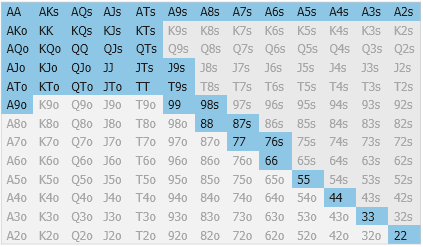
The average CO opening range of a TAG looks as follows:
| Open raising range: | ||
 |
||
| Open raise: 22+, A2s+, KTs+, QTs+, J9s+, T9s, 98s, 87s, 76s, A9o+, KTo+, QTo+, JTo (23%, #302) |
||
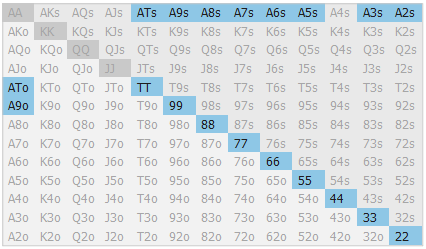
Your opponent will c-bet his strongest and his weakest hands on this board. His check behind range includes mostly middle pairs, ace highs and only some bluffs:
 |
||
| Check behind: TT-22, A9s-A5s, A3s-A2s, ATo-A9o (#94) |
||
Your turn bet was a profitable value bet against ace highs and weaker pairs. After your opponent raises the turn, you can discard these medium hands from his range and make an exploitive fold against his monster holdings.
Bet flop, check turn, raise river as the pre-flop aggressor
If your opponent bets the flop as the pre-flop aggressor but opts to check the turn, this indicates either a marginal hand with showdown value or some hand that he has given up. If you bet the river and your opponent raises, this likely means that he has improved his hand significantly. This is also a spot where you should strongly consider making an exploitive fold.
Check/call flop, check/minraise turn by a calling station as the pre-flop caller
If a calling station chooses to check/minraise the turn after playing check/call on the flop, his range will mostly consist of monster hands like sets and even better hands. This is a spot where you should fold everything but your strongest hands and expect to exploit your opponent.
Summary

Exploitive folds are an exploit that will help you to abuse your opponents' tendencies to bluff too infrequently by folding most of your range.
You can find the appropriate spots by determining your opponent's range and calculating the VB-ratio.
Certain board runouts will improve your opponent's range so significantly that virtually any hand in his range will become a made hand. Since your opponent hardly has any bluffs left in his range, you should consider folding exploitively.
There are certain lines in your opponent's play that he will hardly ever take as a bluff. You should make an exploitive fold if he plays on of those lines. The most typical candidates are:
- Check behind flop, raise turn as the pre-flop aggressor
- Bet flop, check turn, raise river as the pre-flop aggressor
- Check/call flop, check/minraise turn by a calling station as the pre-flop caller