


The Funnel Principle


Before reading this article, you should have read:
You already know how to determine your opponent's pre-flop range by assigning him to one of opponent types which you have developed and then looking at average range of this group.
For determining his post-flop range, you use the information that the lines he chooses to play provide. This can be done with a technique known as the funnel principle. The meaning of this and how it works will be the subject of this lesson.
The funnel principle
The funnel principle describes how on every street certain hands are "eliminated" from your opponent's range and therefore, much like a funnel, his range narrows further down as you progress through the hand. You can use this for your hand reading and estimate villain's hand more precisely on every street.
The basis for hand reading on every street is your opponent's range on the previous street
Villain's average range is the basis for the analysis of his range post-flop. His flop range has to be part of his pre-flop range, his turn range has to be part of his flop range and his river range has to be part of his turn range.
This means that you base your hand reading on every street on your opponent's range of the previous street. If you assume that villain has a range comprised of draws and top pairs on the turn, but excluded any sets, there can't be a sudden comeback of sets in his range on the river.
Eliminating hands from villain's range
Think how villain would play his entire range on one street. Which hands would he raise? Which hands would he call? With which hands would he fold? This way you can eliminate those hands on later streets from his range that he would have played differently on earlier streets.
If villain only called pre-flop, but you assume that he 3-bets JJ+ pre-flop, there can't be any AA, KK, QQ or JJ in his range on the flop. This continues on the flop. If he calls there, you can eliminate hands from his range with which he would have check/raised or check/folded on the flop.
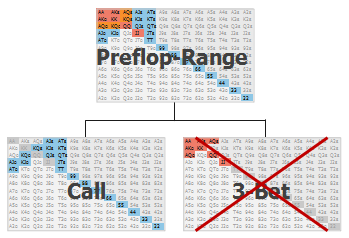
On the flop, this means that villain has the following calling range:
Flop call range = Pre-flop range – Flop raise range – Flop fold range
 |
In order to determine your opponent's range post-flop, you eliminate all hands from his total range which do not fit into the lines he played on previous streets. |
Applying the funnel principle street by street
Pre-flop
Example: NL 25 - 100BB stacks
Preflop: Hero is on the Button with XX
3 folds, Hero raises to $1.00, SB (TAG) calls $1.00, 1 fold
Your hand doesn't matter at this point since you only look at villain's range. First you need to assign him to one of the types of opponents based on his characteristics. Your opponent is seated at the table with 100BB, plays another four tables and you haven't seen much bluffing from him so far. So far you can assume that he is a TAG.
The average calling range for a TAG in the small blind is as follows:
| TT-22, AJs-ATs, KTs+, QTs+, JTs, AJo-ATo, KJo+ (#134) | ||
 |
Flop
Flop: ($2.25) 

 (2 players)
SB checks, Hero bets $1.50, SB calls $1.50
Based on your thought process lined out above, you know that villain sees the flop with the following range: TT-22, AJs-ATs, KTs+, QTs+, JTs, AJo-ATo, KJo+ (#134). Since your opponent called again, you can eliminate those hands from the range that he would have raised or folded.
Villain would raise strong hands on the flop such as sets to maximize his value and he would also raise semibluffs such as flush draws to get better hands to fold. Hands that haven't hit anything or weak pairs would be folded on the flop. That's why you can eliminate these hands from his calling range on the flop.
 |
||
| Fold: 66-44, AJ, AT, QJs, QTs, JTs (#57) |
||
| Raise: 3d3h, 3d3c, 3h3c, 2d2s, 2d2c, 2s2c, AsJs, AsTs, QsJs, QsTs, JsTs (#11) |
||
| Call: TT-77, KTs+, KJo+ (#51) |
||
As you can see, you have narrowed down villain's range significantly compared to his pre-flop range. The funnel is getting smaller.
Turn
Turn: ($5.25)  (2 players)
SB checks, Hero bets $4.00, SB calls
On the turn, you can follow the same principle used on the flop. Villain can call, raise or fold. If he calls, you can eliminate those hands that he would have raised or folded.
Your opponent won't raise any hands on the turn: all strong hands would have raised the flop and there are no decent options for a bluff.
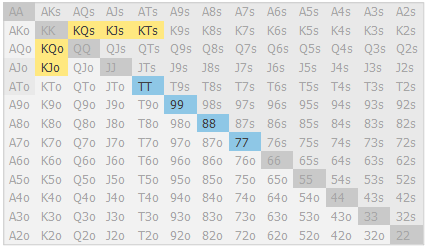
Now you have to ask yourself which hands he would fold on the turn. Most likely he would fold TT-77 (#30).
Eliminate these hands from villain's calling range on the turn:
 |
||
| Fold: TT-77 (#24) |
||
| Call: KTs+, KJo+ (#27) |
||
As a result, you see the following calling range on the turn: KTs+, KJo+ (#27)
River
River: ($13.25)  (2 players)
SB checks, Hero bets $9.00, SB calls $9.00
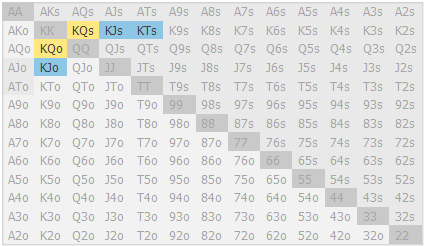
Since you have already removed sets and flush draws from villain's range on the flop, there are no hands left on the river that he would raise. He folds KT and KJ, leaving only KQ from his calling range on the turn that he would call again on the river.
 |
||
| Fold: KJ, KTs (#15) |
||
| Call: KQ (#12) |
||
Limitations of the funnel principle
The funnel principle is about eliminating hands from villain's range street by street. This means that certain hands can't suddenly reappear in your opponent's range on later streets.
There are cases, however, where it is possible that hands you have already excluded are likely again based on villain's actions.
Example:
NL 50 - 100BB stacks
Preflop: Hero is Cut off with 

2 folds, Hero raises to $1.50, BU calls $1.50, 2 folds
Flop: ($3.75) 
 (2 players)
Hero bets $2.50, BU calls $2.50
Turn: ($8.75)  (2 players)
Hero bets $6.00, BU calls $6.00
River: ($20.75)  (2 players)
Hero bets $15, BU raises to $40, Hero???
You are playing against a nitty opponent and you assume the following range with which he would make it to the river: AK, KQ. You have already excluded sets such as 99 and 88 on the flop based on your assumption that he would raise them either on the flop or, at latest, on the turn.
Now you are faced with a river raise and the only two reasonable bluffs that villain could have are  and
and  , but you block both of them.
Strictly following the funnel principle, villain could only have AK and KQ which means you have to call. However, nits would never bluff raise with a made hand. It's more likely that your earlier assumptions were wrong and that villain chose to call on the flop and turn with 88 or 99 in order to raise the river. That's why you should fold.
Summary

You start your hand reading based on villain's average range. This range can be narrowed down further street by street through excluding certain hands from his range based on the lines he plays.
Hands that you eliminate from villain's range on one street can - apart from rare exemptions - not reappear within your opponent's range.
Following this technique, your opponent's range will get smaller and smaller throughout the hand - just like a funnel.