


Value to Bluff Ratio
In this lesson, you will get to know an application that combines the concepts of hand combinations and the funnel principle: the Value to Bluff Ratio. This tells you the ratio of value hands to bluff hands in your opponent's range. It helps you to decide whether you should call or fold.
The calculation of the Value to Bluff Ratio
In order to calculate the Value to Bluff Ratio (from here on VB-Ratio), you have to divide your opponent's betting range into a value range and a bluff range.
- The Value Range consists of hands that your opponent bets with and gets called with by worse hands.
- The Bluff Range consists of hands your opponent bets in order to get you to fold a better hand.
You determine the number of combinations in both ranges and then divide the number of value hands by the number of bluff hands.
VB-Ratio = #value hands / #bluff hands
For example, if your opponent value bets #60 (60 combinations) and bluffs with #30, then the VB-Ratio is 60/30, which gives 2:1. Your opponent therefore has two value hands for every bluff. Or put differently, he value bets twice as often as he bluffs.
The VB-Ratio as a decision making aid
You should practice this calculation regularly, since it is an important basis for decisions. This is especially true for the river. There is the following rule:
 |
If the VB-Ratio on the river is smaller than the pot odds, you can always call with a hand that beats villain's bluffs. |
If your opponent bets full pot size on the river, you get pot odds of 2:1. You can always make a call with a hand that beats his bluffs if the VB-Ratio is 2:1 or less.
If your opponent bets ½ pot size on the river (pot odds of 3:1) or less, a VB-Ratio of 3:1 or less is sufficient to make a profitable call with a bluff catcher.
When the VB-Ratio can help you
You should mainly use the VB-Ratio as a decision making aid on the river. On the turn and especially on the flop, hands in your opponent's bluff range often still have a lot of equity. Your opponent's range is also so large that it is very difficult to estimate while you're playing the hand.
Determining the VB-Ratio in practice
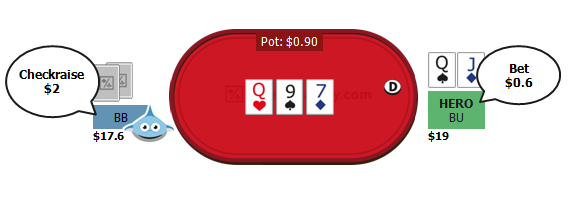
Look at the following example for the calculation of the VB-Ratio. A LAG in the BB calls your BU open raise pre-flop and check/raises the flop.
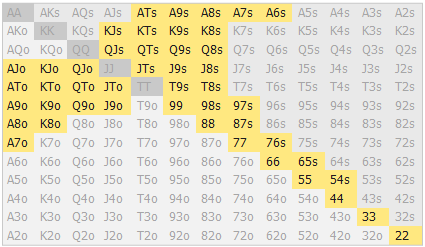
You estimate his average pre-flop range that he calls with in the BB to be:
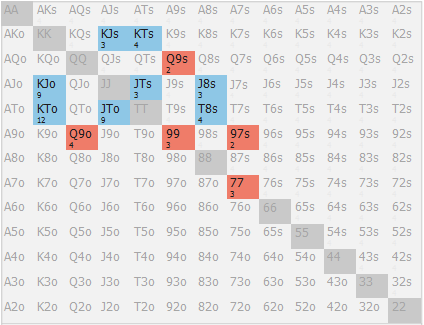
You approximately determine your opponent's VB-Ratio. In this example that could look like this:
- Value range: A LAG will raise two pair+ here for value: That gives Q9 (#6) and 97s (#2). Then we add sets with 99 (#3) and 77 (#3). That makes 14 combinations.
- His bluff range could look as follows: OESDs with JT (#12) and T8s (#4) as well as gutshots like KJ (#12), KT (#16) and J8s (#3). In total that makes 47 combinations.
You should try and determine the value range as accurately as possible since it is likely small, and even small deviations can lead to wrong results. The bluff range on the other hand is usually quite large and therefore can't be determined accurately during play.
 |
||
| Value range: 99, 77, Q9, 97s (#14) |
||
| Bluff range: KJ-KT, JT, J8s, T8s (#47) |
||
The VB-Ratio amounts to 1:3.4 (#14/#47)
On the table, it is sufficient if you reach the conclusion that the VB-Ratio is between 1:3 and 1:4. In most cases, this approximation will be enough for you to reach the right conclusion.
Turn: ($4.9)  (2 players)
BB bets $4, Hero calls $4
The turn doesn't change anything, and your opponent will bet again with all of his range.
River: ($12.9)  (2 players)
BB bets $10, Hero?
In order to make a decision between calling and folding on the river, you have to take the pot odds and the VB-Ratio into account. You already know that you can call if your opponent bets less than pot size and the VB-Ratio is 2:1 or less. It is therefore sufficient if your opponent's betting range on the river includes half as many bluffs as value hands.
The fastest way to make a decision is by determining your opponent's value range and then taking half of it. You then start counting his bluffs, and as soon as the bluffs reach half the number of the value bets, you stop counting and make the call.
In this case, your opponent value bets the same hands as he did on the flop as well as T8s which hit a straight on the river. Together this makes #18. Therefore #9 bluffs are enough for you to make a profitable call. Your opponent will bluff with KJ, KT, JT and J8s, which is far more than the #9 required. You can therefore call profitably.
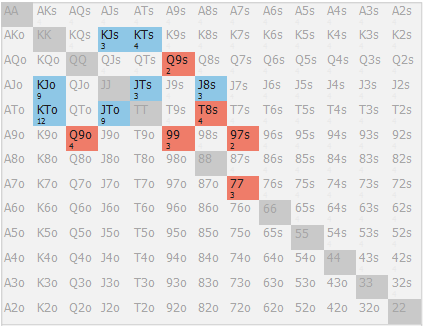 |
||
| Value range: 99, 77, Q9, T8s, 97s (#18) |
||
| Bluff range: KJ-KT, JT, J8s (#43) |
||
| VB-Ratio: 1:2,4 |
||
| Pot odds: 2,3:1 | ||
Summary
 The VB-Ratio shows the relationship of value hands to bluffs in your opponent's range.
In order to calculate it, you determine the number of combinations in the value and bluff range.
VB-Ratio = #value hands / # bluff hands
The VB-Ratio is especially helpful on the river when making the decision between calling and folding. If the VB-Ratio on the river is smaller than the pot odds, then you can always make the call when your hand beats your opponent's bluffs.