Tilt: Excessive Play

You are not a machine
Playing poker can be demanding. Not taking breaks from the game can wear you out.
Those who play more than the average Joe face additional challenges in poker. When it comes to excessive play, we need to take two aspects into special consideration: game volume (number of hands played per day/month/year) and money volume (size of limit/bankroll/overturn).
The two don't necessarily go hand in hand, but when it comes to online poker they often correlate. Players in higher limits often play more and at multiple tables. A solid, winning player sticks to the limits that are right for him. He spends a large part of his day with poker, not just playing, but practicing, learning, and thinking about the game.
For him, poker is more than a hobby, it's a profession or a source of additional income. This makes poker all the more important in his life, even away from the tables. So what kind of strain does this put on a player? How does this connect to tilting?
Multi-tasking
Multi-tasking often refers to computers and their operating system's ability to process multiple operations in such quick succession, that it seems as if they were all being performed simultaneously.
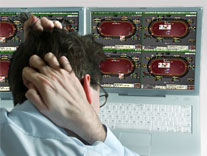 |
| Multi-tabling is hard work, and stressful. |
Nowadays psychologists also speak of multi-tasking when it comes to modern companies. Workers have to find their way through the company hierarchy, manage data and communications efficiently, and perform many diverse tasks. As some of you may know, this is very stressful. Today's workers have an estimated workload three times as large as their grandparents' generation. In other words: one hour of work in a modern, multi-tasking work environment is comparable to three hours of work in an "old-fashioned" work environment.
There is a difference between playing a few hours of poker to unwind and spending 6-8 hours a day in front the computer concentrating on the game (and working on improving). Long hours at multiple tables put players at risk of facing the damaging side-effects of multi-tasking.
The mistakes start adding up. Many business consultants preach multi-tasking as the solution to overburdened workers. Economists, neurologists and psychologists, however, warn: The more decisions being made at once, the poorer the individual decisions will be.
Interestingly enough, most people tend to consider themselves to be successful multi-taskers. Making quick decisions is often equated to making good decisions. This is however not true. When the rate of error increases you need extra time and capital to compensate for these mistakes. Multi-tabling can be great if it leads to an increase in profit, but it also leads to an increase in stress and brings with it a higher risk of tilt. As you start making more mistakes, you get yourself into more and more trouble. Many players lose their objectivity and can't tell if they just suffered a bad beat, or if they beat themselves by making a mistake.
Further side effects of multi-tasking can be:
- Loss of concentration, worse short-term memory, and the tendency to develop an incoherent "present oriented" way of thinking
- Loss of interest in other activities, isolation from the outside world
- Sleeping disorders, irritability, emotional imbalance, depression
Get a life …
It is important to take breaks from the game to allow your body to recuperate. This will help your performance in general and help keep you from tilting. Taking a break is good for your brain, nervous system, eyes, wrists...
Taking a break from poker shouldn't mean doing something else on your PC. Some may think surfing the net or watching a movie is a good alternative, but they are mistaken.
Keep in mind that playing poker is a complex task that is demanding on your body. Even if you are young and in top physical condition, you can burn out at the poker table.
Reducing the number of tables may be helpful. But don't experiment for a single session. You will need to try this over a period of time before you can be sure that this boosts your performance. Evaluate your game. Did your stats/profit go up? Does this make playing easier or more difficult for you? You don't necessarily need to change the way you play, but it can't hurt to try out new possibilities.
 |
| Relax |
Give yourself a set time to take a break. Fatigue and faltering concentration aren't signs that you need to take a break but rather they indicate that a break is overdue. Give yourself a window of time for playing poker, for example 90 minutes, before you take a break. If you're in an upswing, you don't have to cut yourself off at exactly 90 minutes, but it is good to get into the habit of taking regular breaks.
A break should let you forget about poker for awhile. Don't turn on the TV. Do something that doesn't stimulate the eye and use your other senses. You could finally get around to the household repairs, play sports or just go for a walk. Or, if you don't want to do any of those things, you can just relax, breathe slowly, and let your stress slip away.
It's also important to have days where you don't play poker. Get out of the house, meet with friends or find something else to do. Poker is work; if you can't get away from it occasionally, you won't be able to do your job well.
You are more than just a poker player who spends a large part of his time in front of the computer. Remember, you have other interests. What did you use to do, before you started playing poker? You might get the feeling that poker is taking over your life or that you have to force yourself to turn off the computer. If that happens, try to find other activities to get your mind off the game. Once you find something that helps, stick to it. It will help you and your game.
Great expectations
Many players expect more from poker than just winning a game. For example, some hope for:
- a dependable source of (substantial) income
- a steady job / poker career
- better social standing and / or a new lifestyle
- a new future, something secure to fall back on, etc.
 |
| In the end it's just a game |
All of these expectations are part of the game. They give you a reason to play and work on your game and are part of the competitive nature of poker.
These expectations can become a burden, for example, when a player gets caught in a downswing and watches his bankroll and his hopes slowly disappear.
Even if you have never been caught in a bad downswing - which is nearly impossible - you will always be under ever-growing pressure, which can put you at risk to go on tilt.
Try to answer the following questions to yourself. Be honest:
-
Why do you play poker? What motivates you? Don't just think about the money. Contemplate what you really hope to get from playing poker and what you expect to achieve.
-
There's nothing wrong with reaching for the stars, in fact, it's good to set goals that will be difficult to reach. But be realistic about them, just dreaming of success won't help you find it
-
Try to see poker as a game, despite everything else and the money involved. There is always life after the game. So enjoy it, it's worth it. If your expectations are too high they only will get in your way.
Control your breathing
I'd like to make a suggestion that will help you to easily and effectively relax. Work on controlling your breathing. This subject isn't specifically tied to tilting, but it is worth mentioning as a subject that can effect your game.
Many people don't breathe properly. They either don't use the full capacity of their lungs, or they breathe in quickly and exhale slowly, or vice versa. There is no need to worry about healthy living and eating when you can't even breathe right. You can survive a few weeks without eating, a few days without drinking, but only a few minutes without breathing, just to put things in perspective. There is another reason to practice controlling your breathing: It's impossible not to relax when you're breathing correctly.
-

Controlled breathing helps relax Take the time to consciously take several deep breaths. Breathe through your nose, first to the stomach and then the chest. Many people just breathe from their chest or their stomach.
You should be able to feel yourself breathing deeply from the stomach - your belly should bulge a bit - and then from the chest - your rib cage will expand as the chest fills with air. You will notice how much more air you can take in this way. Once you've completely filled your lungs, exhale slowly through the mouth. Do this a few times and see how you feel.
-
Another good exercise is breathing deeply while walking. Take two steps while inhaling and two steps while exhaling. Do this a few times, then increase to three steps per breath.
Make sure you keep a steady pace during this exercise. Once you're comfortable breathing in for three steps, try four, then five, etc. See how far you can get. Once you've reached your limit, work your way backwards until you're back to taking two steps per breath.
If you do this regularly your capacity will grow and you'll soon be taking more and more steps per breath.
IMPORTANT: Your movements should be natural during these exercises. You shouldn't be hurrying your breath or your gait to stay on track. With a bit of practice you'll find your natural rhythm. This exercise will help you relax and make you more aware of your breathing in general.

Conclusion
-
Playing poker online is mentally and physically straining. Taking breaks and relaxing are as essential for your game as being at the table. They help you stay on top of your game.
-
Keep in mind that you are more than a poker player. You may have great expectations, but your life does not depend on poker. Remember: In the end, poker is just a game. Don't let it control your life.
About the author: Robert Langer is a psychological consultant, coach and trainer based in Saarbrücken. He also teaches Psychology at a large German school for alternative medicine, and holds lectures and seminars in NLP, conflict resolution psychology and psychological typology.
| LINKS | ||||||||||
|
||||||||||