


Bubble Strategy (1): Introduction
Before reading this lesson, you should have read through:
By now, you should already be familiar with the risk premium concept, thus you know you need extra equity on top of your pot odds to call a bet profitably. This extra equity tends to be the highest on the bubble, and immediately before it - when the last “unpaid” players are being eliminated. This phase of a tournament is called the bubble phase.
Dynamics similar to the bubble phase can be present at other times throughout the tournament, however these are much more pronounced during the bubble phase. Therefore, dealing with these situations is an important skill to develop.
In this module you will learn what your gameplan should be in the bubble phase, depending on your stack size relative to those of the other players. You will also learn in what way bubble scenarios differ between various SNG types.
You can find specific advice regarding bubble strategy in most of the popular SNG formats in the lessons to follow.
The bubble phase
Obviously, you cannot draw a line and say “here is where the bubble starts”. The bubble phase dynamics arise gradually, building up as the tournament gets closer to the actual bubble. As you gain more and more experience, you will get a feel for this, and learn to adapt to these dynamics gradually.
For now though, and for the purpose of this lesson, the bubble phase needs to be specifically defined.
 |
It will henceforth be assumed that the bubble phase starts when there are 20% more players left in the tournament than there are on the exact bubble. |
For example, in a 9-man SNG with a typical payout structure, there are 4 players left on the bubble, so the bubble phase starts with 4*(100%+20%) = ~5 players left. In a 180-man SNG which pays 27, there are 28 players on the bubble, so the bubble phase starts with 28*(100%+20%) = ~34 players in the tournament.

You can try to do that calculation for other tournament types that you play. If you play a given SNG format, you will notice that the dynamics start to become recognisably more “bubbly” around a certain point.
Putting pressure on the bubble
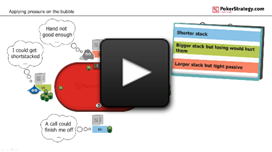
The first thing you should ask yourself during the bubble phase of a tournament is whether you are in a position to put pressure on other players. This depends much more on your stack size relative to stacks of the players left to act, than on your absolute stack size measured in BBs.
You should think of a bubble phase situation as one where you can apply pressure if all the players left to act have either:
- a shorter stack than you do
- a bigger stack than you do, but losing an all-in pot against you will cost them a large chunk of their stack and jeopardize their chances of making the money
- or a bigger stack than you do, and bound to make the money regardless of the outcome of an all-in pot against you, but they are tight passive and will not use the stack setup to their advantage unless they “have a real hand”
Below you will find a simple situation when you're in a good position to apply pressure:
 Your default gameplan in a spot where you are in a position to apply pressure should be the following.
You should be opening most hands, making exceptions only when you have a weak holding AND according to stack sizes or player tendencies (i.e. there is a big chance of getting called/raised despite you being in a position to apply pressure). You should avoid attacking players who can call you light. Their light calls hurt them, but they also hurt you, benefiting all the other players due to the ICM. Marginal calls from other players lead to one of you either busting or losing a large portion of your stack. As a result, the remaining players (not being part of the all-in) are closer to the money and their EV increases.
Your default play when folded to should be to minraise, although a push is a better solution in cases where players behind you react tightly to an all-in but reshove wide if you minraise. That depends largely on specific stack setup and the tendencies of your opponents.
If there is a raise in front of you, you should take into account the combination of your fold equity, your showdown equity if called, and the risk-premium needed, and reshove or fold accordingly. You should rarely just call.
If there is an all-in already when the action gets to you, you should proceed according to the guidelines pointed out in the lesson Playing Preflop: Calling and Isolating All-ins. The good news is that you don’t have to worry about an overcall – these happen extremely rarely in a bubble situation.
What to do when you can’t apply pressure
There are times when a spot where you could apply pressure is unlikely to occur. This is mainly due to you having a short stack during the bubble phase. In such a case, there are only two moves left in your arsenal: wait it out or take a stand.
An example of a bad situation to apply pressure:
 The process of calculating whether to take a stand is actually very similar to when you have a bigger stack and there is a raise in front. The difference is that when it is the villain who covers you, your risk premium is a lot higher and in effect your ranges should be much tighter.
If action is folded to you and you are a short stack, you should not consider minraising. Your actions are limited to pushing and folding, and once again your decision depends upon the combination of fold equity, showdown equity if called, and risk premium needed.
If you cannot apply pressure, and it is not profitable to take a stand, you need to wait it out. In a STT, there is not much you can do except folding, and trying to manipulate the blind increases in such a way that they increase immediately after passing you.
In a 180-man or 90-man SNG though, where the bubble is played out on more than one table, on top of manipulating the blind increases, you should use all your allotted decision time to maximise the odds of someone busting at the other table before you are forced to take a stand.
Additionally, if you are taking a stand and the tournament is not yet playing hand-for-hand, and there are shorter stacks at the other tables, you should strive to make the hand last as long as possible, in particular by leaving a single chip behind instead of going all-in, which gives you yet another opportunity to use some more of your decision time.
Differences between SNG formats
 |
You will be provided with in-depth advice on how to deal with the bubble phase in different formats in the next couple of lessons.
However, after completing this lesson you should be able to understand the basic differences in bubble play approaches.
Let’s look at them more closely:
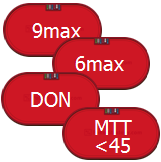
- The risk premium largely depends on the payout structure. The size of the risk premium dictates your ranges. The bigger the risk premium, the tighter you should call, and the wider you should push (against knowledgeable or scared opponents). You will notice that the highest risk premium is found in DoNs and satellites.
- The bubble of a STT, an 18-man, a 27-man or a 45-man is played out on a single table, whereas the bubble of a 90-man or a 180-man takes place on more than one table, allowing for additional stalling, but at the same time causing computational problems, as it is harder to calculate the risk premium with more than one table left (due to problems with calculating the underlying ICM).
- The bubble of a STT or a 18-man is played shorthanded, whereas the bubble of a 45-man or a 180-man takes place more or less on a full ring table which, in general, causes the ranges to be tighter in a MTT SNG than in a STT and forces the short stack to take a stand much quicker in a STT.
Summary
In this lesson you have learned that:
|
 |