


Bubble Strategy (4): Multi-table SNGs Part 2

Before reading this lesson, you should have read through:
- Bubble Strategy (1): Introduction
- Bubble Strategy (2): Single Table SNGs
- Bubble Strategy (3): Multi-table SNGs Part 1
By now you should have a general idea on what the bubble phase is and how you should approach it in general. You have also learned about the intricacies of the bubble in single table SNGs specifically, as well as the nuances of the bubble in multi-table SNGs, where it takes place on the final table.
This lesson focuses on multi-table SNGs, where the bubble is played out before the final table. Two common structures are considered – a 90-man SNG with a 27.55/18/14/9.2/6.7/4.95/4/3.35/2.75/2.25(x4) payout structure and a 180-man SNG with a 30/20/11.4/7.4/5.8/4.3/3/2.2/1.5/0.95(x9)/0.65(x9) payout structure. The numbers represent the percentage of the prize pool allocated to each place respectively.
The Bubble Phase in a 90-man SNG
When it Begins
By definition, the bubble phase in a 90-man SNG with the top 13 spots paid begins with 17 players left, so more or less with the start of the semi-final table. Almost 30% of the prize pool is allocated on the exact bubble, as 13 players secure at least a 2.25% payout. It means that, in absolute terms, the almost 30% “bubble pool” is larger than in 45-man SNGs. It is also larger compared to first place money than it is in 18-mans, and only slightly smaller than it is in 27-mans. This means that the bubble is of greater relative importance than in multi-table SNGs with a single-table bubble. It remains to be the most important part of the tournament.
Typical Risk Premium
At this stage of the tournament, there are still two tables left, so it does not make sense to come up with a typical stack setup as the resulting risk premiums and strategies are dependent upon the other table.
Instead, take a look at how the average risk premium changes throughout the bubble phase:
| Number of players | 17 | 16 | 15 | 14 |
|---|---|---|---|---|
| Average risk premium | 11.3% | 11.8% | 12.8% | 14.3% |
This calculation assumes, for simplicity and comparability, that all stacks – including yours – are medium. In practice, you need to adjust these numbers, keeping in mind that:
• the lower your opponent’s stack, the lower the risk premium;
• the closer your own stack size to that of your opponent, the larger the risk premium;
• the more short stacks there are on both tables, the larger the risk premium.
Default Gameplans for Specific Stack Sizes
All the conclusions from the single-table bubble SNG considerations still stand. As the number of players is now even larger, stacks tend to be more varied, and with short stacks, medium stacks and deep stacks in play, risk premiums are generally higher than the above table suggests, so it needs to be taken with a grain of salt and adjusted to your specific situation.
It is also worth noticing that the risk premium on the bubble is higher than in a 45-man, 27-man and 18-man SNG, which is 12.4%, 11.5% and 11.6% respectively (based on the examples used in the previous lesson).
What is new in the 90-man scenario is the fact that two tables are left in play. It is therefore important to always be aware of the stack setup on the other table and adjust accordingly. If there are short stacks likely to bust soon, you need to be more reckless as the big stack and more careful as the short stack. Another strategy which can be employed by a short stack in the bubble phase, but before the exact bubble, is stalling each hand in the hopes that more hands are played on the other table thus increasing the chances of someone busting there before you are forced to take a risk of your own.
The Bubble Phase in a 180-man SNG
When it Begins
By definition, the bubble phase in a 180-man SNG with the top 27 spots paid begins with 34 players left, so more or less when there are 4 tables in play. Around 17.5% of the prize pool is allocated on the exact bubble, as 27 players secure a payout of at least 0.65%. This means that the bubble in a 180-man is the least important of all covered SNG bubbles, as both in absolute and relative (to first place money) terms, the share of the prize pool allocated on the bubble is by far the lowest.
It is no longer the single most important point of the tournament because in 3-handed play a similar share of the prize pool (17.2%) is allocated. 4-handed, 5-handed and heads-up are all not far behind with 12%, 10.4% and 10% allocated respectively.
Typical Risk Premium
At this stage of the tournament, there are still four tables left, so it does not make sense to come up with a typical stack setup because the resulting risk premiums and strategies are dependent upon the remaining tables.
Instead, take a look at how the average risk premium changes throughout the bubble phase:
| Number of players | 34 | 32 | 28 |
|---|---|---|---|
| Average risk premium | 7.0% | 8.0% | 8.8% |
Again, this calculation assumes, for simplicity and comparability, that all stacks – including yours – are medium. In practice, you need to adjust these numbers, keeping in mind that:
• the lower your opponent’s stack, the lower the risk premium;
• the closer your own stack size to that of your opponent, the larger the risk premium;
• the more short stacks there are on all four tables, the larger the risk premium.
Default Gameplans for Specific Stack Sizes
There are two opposing factors when it comes to describing the specifics of a 180-man bubble. On the one hand, it is by far the least important of all SNG bubbles, which should lead to a looser approach for both the big stacked and the short stacked players.
On the other hand, more players means that the presence of an all-in-compelled short stack is more likely, and more tables mean stalling is more effective and a cooler or a bad beat is more likely. As a result, the bubble bursts faster and so the opportunity cost for a short stack of holding back and largely waiting out the bubble is lower.
As a result, short stacks should remain similarly tight compared to other SNG formats, and big stacks can play a bit looser. The stack size which profits the most from the specifics of the 180-man bubble phase, as opposed to other SNG formats, is the medium stack. Medium stacks can play significantly looser compared to other formats because they stand to lose less with low risk premiums, while possible gains remain the same.
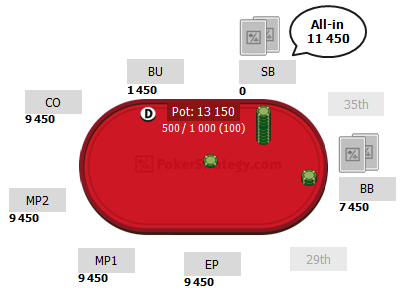
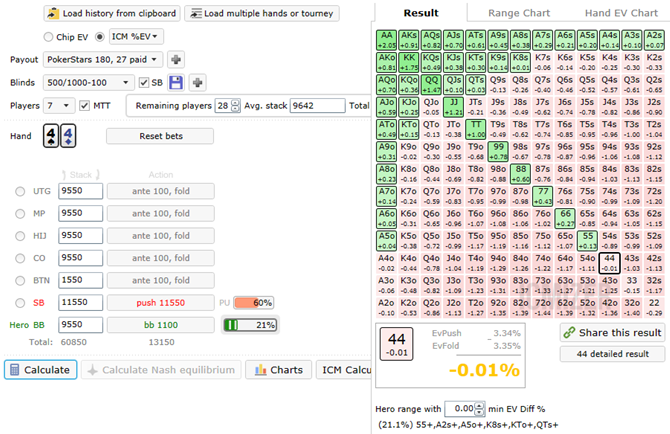
To see this, take a look at the following example showing the bubble of a 180-man. With the short stack in play, the big blind would have to fold in most SNG formats to avoid unnecessary elimination. However, in this structure he can call lighter due to the factors mentioned above.
In this particular example, as you can see in the included calculation, it is safe to call with Axs, A5o+, pairs 55+, K8s+, KTo+ and QTs+.
Summary
In this lesson you have learned that:
|
 |
EP (2000 chips) – 6.8% 10.0% 11.6% 12.8%
CO (3000 chips) 5.4% – 14.4% 16.3% 17.9%
BU (5000 chips) 4.7% 8.0% – 21.2% 23.1%
SB (7000 chips) 3.8% 6.2% 12.9% – 25.9%
BB (10000 chips) 2.9% 4.6% 8.7% 14.6% –