


Bubble Strategy (3): Multi-table SNGs part 1

Before reading this lesson, you should have read through:
By now you should have a general idea for what the bubble phase is and how you should approach it. You have also learned about the intricacies of the bubble in single table SNGs (STTs) specifically.
This lesson focuses on multi-table SNGs where the bubble is played out on the final table. Three common structures are considered – an 18-man SNG with a 40/30/20/10 payout structure, a 27-man SNG with a 37/27/18/10/8 (rounded) structure and a 45-man SNG with a 31/21.5/16.5/12.5/9/6/3.5 payout structure. The numbers represent the percentage of the prize pool allocated to each place respectively.
The Bubble Phase in an 18-man SNG
When it Begins
By definition, the bubble phase in an 18-man SNG with the top four spots paid begins with 6 players left. 40% of the prize pool is allocated on the exact bubble, as four players secure at least a 10% payout. In STTs, the proportion allocated on the bubble is larger than first place money, whereas here it is the same. Also, in absolute terms, the 40% “bubble pool” is lower than in STTs. This means that the bubble is of less relative importance than in a STT, however it still is the most important part of the tournament. Consistent with the previous lesson, the considerations here are limited to the bubble and it is assumed that there are always five players competing for four paid spots.
Typical Risk Premium
Take a look at the following example of how stacks might look at this stage:
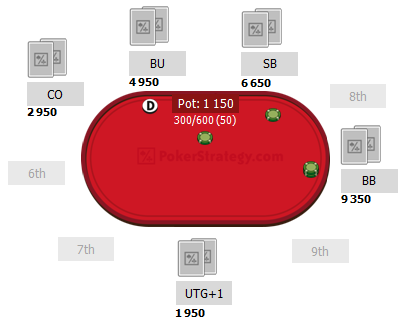
Given that this is quite a standard stack setup, you should be able to recognize what the resulting risk premiums are. Take a look at the table below which shows the risk premium of each player against every other player. Note that the risk premium depends not only on the size of your stack, the payout structure and the number of players left, but also on the particular opponent’s stack size it is calculated against.
| Risk premium of ↓ against → | EP | CO | BU | SB | BB |
|---|---|---|---|---|---|
| EP (2000 chips) | - | 6.8% | 10.0% | 11.6% | 12.8% |
| CO (3000 chips) | 5.4% | - | 14.4% | 16.3% | 17.9% |
| BU (5000 chips) | 4.7% | 8.0% | - | 21.2% | 23.1% |
| SB (7000 chips) | 3.8% | 6.2% | 12.9% | - | 25.9% |
| BB (10000 chips) | 2.9% | 4.6% | 8.7% | 14.6% | - |
In these positions and with blinds at 300/600 ante 50, the equilibrium pushing and calling ranges for the players can be seen below:
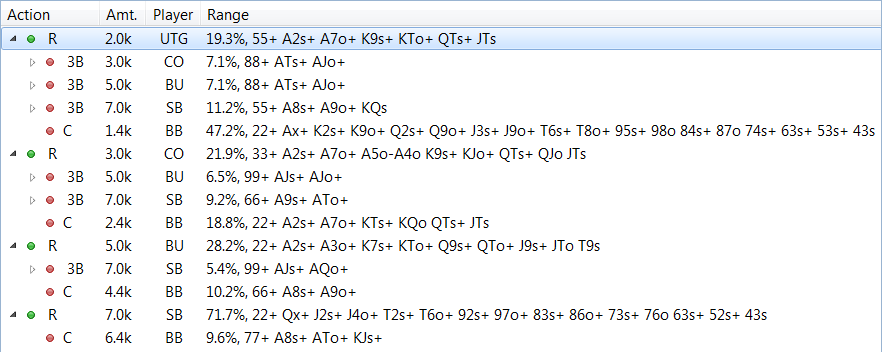
Default Gameplans for Specific Stack Sizes
All the conclusions from the STT considerations still stand and little more can be added - except the fact that as the number of players grows, stacks tend to be more varied, and with short stacks, medium stacks and deep stacks in play, risk premiums are even higher (the lowest, the highest, and the average value of risk premium are all higher than in case of STTs).
That leads to dynamics where big stacks can exploit medium stacks with impunity. Therefore, if big stacks are capable of taking advantage of that, expected ICM values of players’ stacks diverge with each hand – big gets bigger and small gets smaller. To stop this vicious circle, short stacks need to take a stand sooner than under normal circumstances - they need to play looser than the ICM-based ranges.
This idea would be covered by an equity model which is more advanced than the ICM, namely the Future Game Simulation, which is the subject of a separate lesson. If, on the other hand, big stacks don’t take full advantage of the stack setup, the ICM can still be used to come up with correct ranges.
The Bubble Phase in a 27-man SNG
When it Begins
By definition, the bubble phase in a 27-man SNG with the top five spots paid begins with 7 players left. Around 41% of the prize pool is allocated on the exact bubble, as five players secure a payout of just over 8%. This means that the bubble in a 27-man tournament is, once again, a bit more important than in an 18-man, as both in absolute and relative (to the first place money) terms, the share of the prize pool allocated on the bubble is bigger. Consistently with all of the previous examples, the considerations here are limited to the bubble and it is assumed that there are always six players competing for five paid spots.
Typical Risk Premium
Take a look at a typical stack setup at this stage of a tournament:
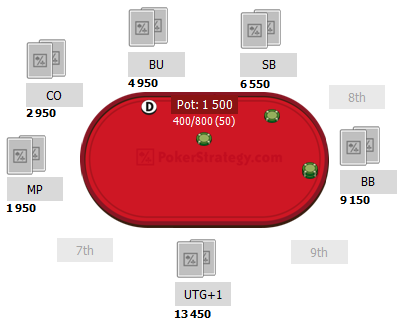
In the table below you can find the resulting risk premiums:
| Risk premium of ↓ against → | EP | MP | CO | BU | SB | BB |
|---|---|---|---|---|---|---|
| EP (13500 chips) | - | 1.9% | 2.7% | 5.3% | 8.1% | 14.2% |
| MP (2000 chips) | 12.7% | - | 6.8% | 10.1% | 11.3% | 12.2% |
| CO (3000 chips) | 17.6% | 5.4% | - | 14.4% | 15.7% | 16.8% |
| BU (5000 chips) | 21.5% | 4.6% | 7.6% | - | 19.0% | 20.5% |
| SB (7000 chips) | 23.5% | 3.6% | 5.4% | 11.0% | - | 22.2% |
| BB (10000 chips) | 25.3% | 2.4% | 4.0% | 7.2% | 11.9% | - |
In the above example, with blinds at 400/800 ante 50, equilibrium ranges are as follows:
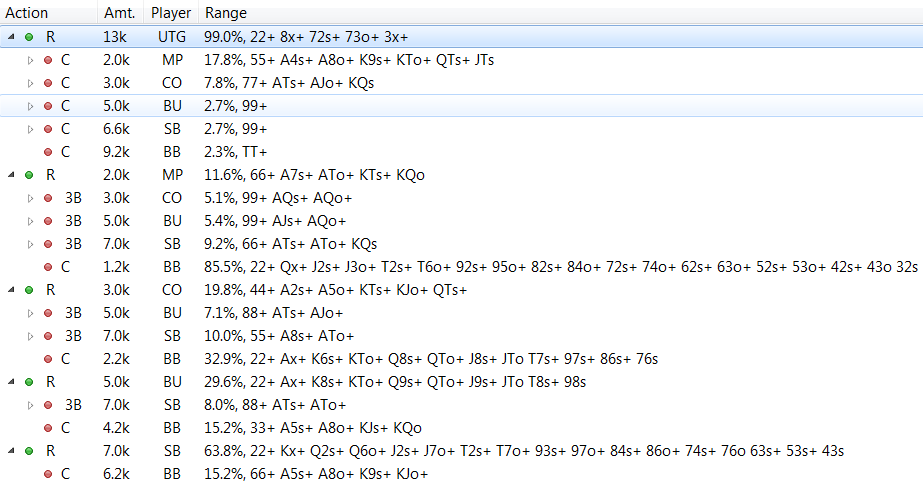
Default Gameplans for Specific Stack Sizes
It becomes even more visible now that the risk premium depends significantly on the stack of your opponent that you consider going all-in against. It is quite obvious that, being a big stack, your risk premium is bigger against medium stacks than against short stacks. But it is also important to remember that as a short stack you would very much prefer to play an all-in pot against another short stack than against a big stack. This is a consequence of the fact that when you double up against another short stack, not only do you gain chips, but also the bubble is much closer to bursting.
As you saw in the ranges shown above, it turns out that a typical example is at the same time an extreme one, as the big stack can push almost any two cards UTG and the others cannot do anything about it.
The Bubble Phase in a 45-man SNG
When it Begins
By definition, the bubble phase in a 45-man SNG with the top seven spots paid begins with 10 players left. Almost 25% of the prize pool is allocated on the exact bubble, as seven players secure a payout of 3.5%. Again, this means that the bubble in a 45-man is less important than in a 27-man, as both in absolute and relative (to first place money) terms, the share of the prize pool allocated on the bubble is smaller. Consistent with all of the previous examples, the considerations here are limited to the bubble and it is assumed that there always are eight players competing for seven paid spots.
Typical Risk Premium
Take a look at a typical stack setup at this stage of a tournament:
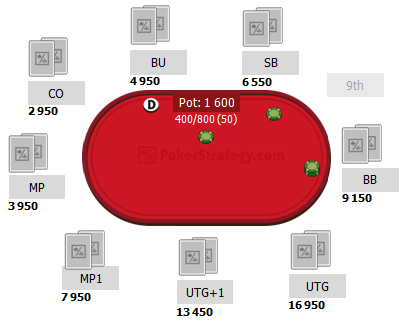
In the table below you can find the resulting risk premiums. You have already seen how the differences between particular stack sizes influence the size of the risk premium, so for simplicity's sake this time we won't show you the entire overview, but just the ranges of each player's risk premium against other players at the table in the above example.
| Risk premium ranging from/to | min | max |
|---|---|---|
| EP1 (17000 chips) | 2.7% | 16.8% |
| EP2 (13500 chips) | 3.3% | 24.7% |
| MP1 (13500 chips) | 5.2% | 21.6% |
| MP2 (13500 chips) | 7.7% | 15.9% |
| CO (13500 chips) | 9.1% | 13.0% |
| BU (13500 chips) | 6.9% | 18.0% |
| SB (7000 chips) | 5.7% | 20.7% |
| BB (10000 chips) | 4.1% | 23.1% |
In the above example, with blinds at 400/800 ante 50, equilibrium ranges are as follows:
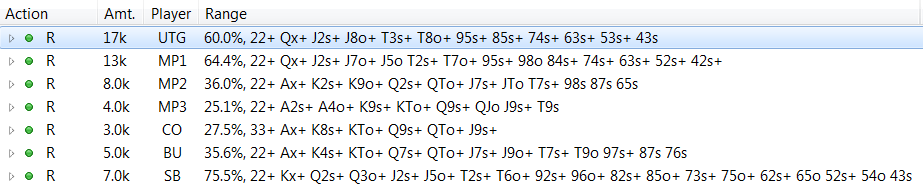
It is interesting to note that in this stack setup, pushing ranges are not as varied as usual between the players.
Default Gameplans for Specific Stack Sizes
The general conclusions are still the same. However, with more players active, it happens more often that someone calls too loose, which is a catastrophe for a pushing player. Therefore, it is advised to push tighter than the equilibrium when you cannot be sure of the skills of the players behind you. Especially as a medium stack; it becomes more plausible to wait out the bubble, whereas being a big stack you can take advantage of the flip side of this coin and push a bit wider - especially with knowledgeable medium stacks behind.
Summary
In this lesson you have learned that:
|
 |
EP (2000 chips) – 6.8% 10.0% 11.6% 12.8%
CO (3000 chips) 5.4% – 14.4% 16.3% 17.9%
BU (5000 chips) 4.7% 8.0% – 21.2% 23.1%
SB (7000 chips) 3.8% 6.2% 12.9% – 25.9%
BB (10000 chips) 2.9% 4.6% 8.7% 14.6% –