


Should we check river to induce bluffs from missed draws?
Barry Carter goes into the Lab to see if we are betting off value betting the river or checking when an obvious draw has missed.
In the self study series Barry Carter shows you how he tried to solve a poker problem then consults a coach or solver to get feedback on his method.
I recently noticed myself doing something out of habit rather than anything else, so I thought I would test whether it was a good habit or not.
When I have bet flop and turn with value and Villain has called both times, if there has been a very obvious draw to chase, I tend to check the river if the draw misses to induce a bet from a missed draw. It sounds like a logical tactic, but I could easily be missing value from made hands that otherwise check back the river.
To explore this further, let's look at a simple hand from GTO Wizard. It is 60BB effective, we raised UTG and get called by the BTN. The flop is T♠9♠2♦, we bet small they call. The river is 4♥, we bet bigger, they call. The river is 3♥. So any flush draw or straight draw on the flop has missed. In this spot, the BTN calls almost all the time on both streets with these hands.
This is our betting range on the river:
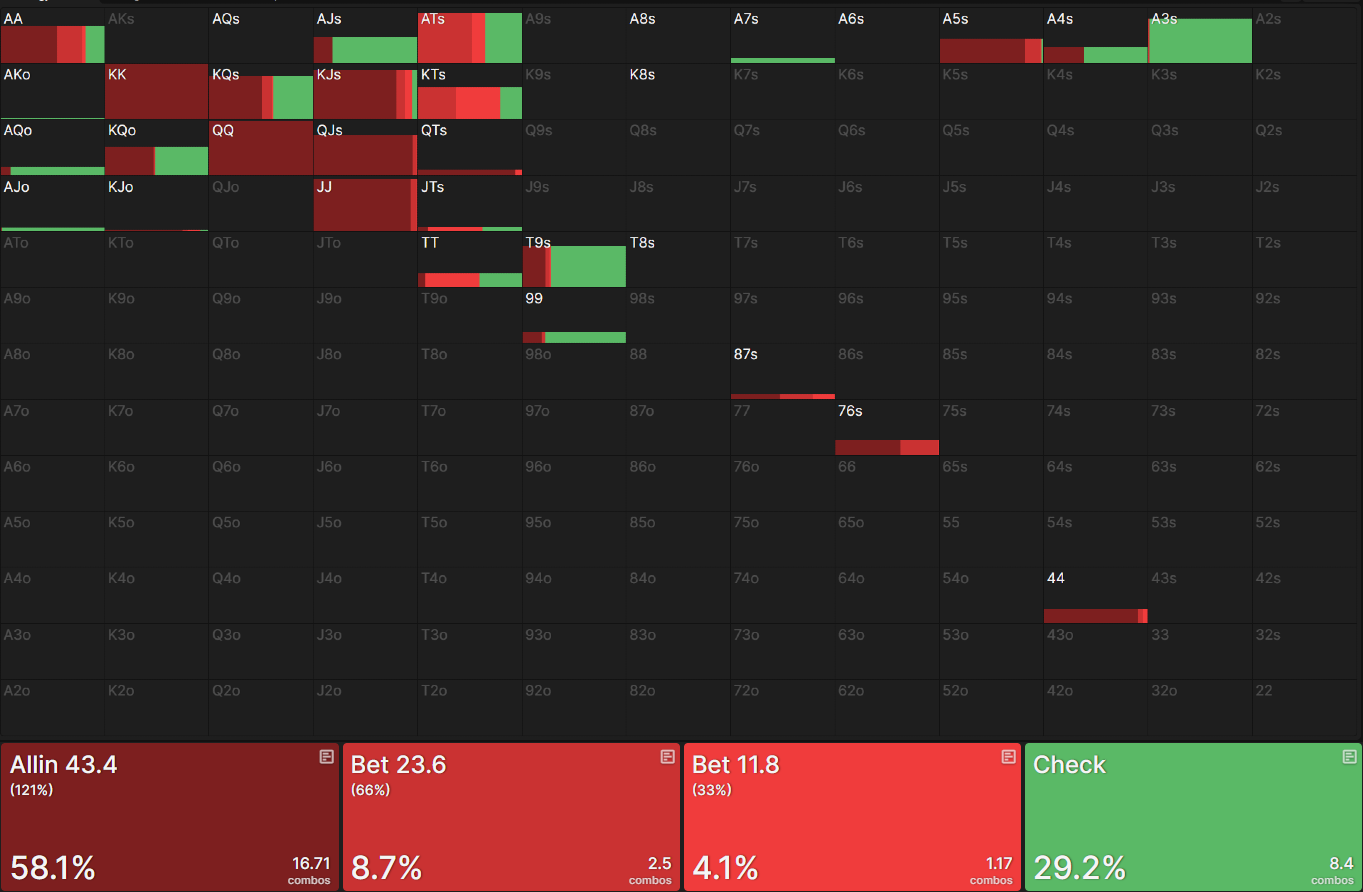
We bet 70% of the time here, so not much checking to induce bluffs. The hands that do check to induce are TT, 99, T9, ATs and KTs. All top pair or better and crucially, they all block the calling range. It's hard for the BTN to have a one pair hand that will call when we have T9s for top two. All the overpairs and a set of 4s bet 100% of the time because they unblock top pair.
When we do check with these hands, this is the response from the BTN:
.png)
The bluffs here are QJs, QJo, J8s (of all suits) and the flush draw misses are 8♠7♠, 8♠6♠, 7♠6♠ and 7♠5♠. So we are targeting missed draws with our check. However, Ax or Kx of spades all check back. They beat some of the bluffs on previous streets so they have some showdown value.
When we shove river, this is the response:
.png)
In GTO World we get called 40% of the time, by hands as weak as bottom pair some of the time. This is why we likely favour betting over checking. However, what if we node lock the hand so the Villain only calls with top pair or better? This is how we act on the river:
.png)
I was surprised at this. I actually thought by having Villain overfold, we would shove more, but we shove less. The hands that check more are the same value hands that block the calling range like T9s and TT. This is a clear tactic to induce a bluff.
Out of curiosity, I wanted to see what would happen if we checked, and then Villain bluffed with the Ax and Kx of spades, as well as the other missed draws they normally bluff. So they overbluffed with missed draws. This is what we do on the river:
.png)
We check slightly more to induce a bluff, but not much. The interesting thing is that the super strong hands like overpairs and 44 all still shove, because they unblock top pair.
One final thing to test, what if Villain is a Nit and they check back with value hands like top pair to third pair? This is what we do:
.png)
Now we shove most of our value hands. If Villain won't bet when they should, we have to do it for them.
The lesson here is clear. Yes, we check to induce bluffs, but less specifically from missed draws and more based on how much we block the calling range. A balanced opponent will find bluffs from somewhere, whether it is a missed draw or a value hand they turn into a bluff. Check when your hand makes it hard for them to have a hand that can call, provided you think they are value betting and bluffing the river at the right frequency.
Previous self study articles
- Playing against disconnected players
- Overbetting with Ace King
- Why do we check back with Range Advantage?
- Why do I turn top pair into a bluff?
- How I use ICMIZER
- How wide can we go with Antes?
- Why can we bluff missed straight draws more than missed flush draws?
- How to play a strong underpair on a wet board
- How to play a 15BB stack
- How often does Villain have an Ace?
- Why do we not check/raise with the nut flush draw?
- Why do we bet small on the turn?
- When do we open shove the flop?
- The difference between SB and BB defends
- Blocker/Unblocker
- How to pick your bluffs
- When NOT to bluff a big draw
- Which hands over realise equity?
How do you study away from the tables? Let us know in the comments:
