


The Average Range


You should already have read:
You are already able to assign your opponents to the five different player types, and you know what to pay attention to when playing them. To get a starting point for your hand reading, you assign your opponents a certain pre-flop range that they typically play: the average range.
 |
An average range is a range that a certain player type plays pre-flop in most cases. |
To determine this, you have to gather relevant information about a player type systematically. In this lesson, you will learn how you can do this.
You will also see what the average ranges of the five player types in NL10 look like. These ranges have been collected by poker experts through database analysis of a couple million hands.
Determining the average range
In order to determine the average range of a certain player type, you proceed position by position. By doing this, you should find answers to the following questions:
- Which hands are open raised by this player type in this position?
- Which hands are called following an open raise before him?
- Which hands are 3-bet against an open raise before him?
It is helpful to divide up the ranges of your player type into the hand categories of suited hands, offsuit hands and pocket pairs.
You can get the necessary information regarding the ranges of a player type as follows:
- By using tracking software
- By exchanging your experiences with other players in the strategy and hand evaluation forums at PokerStrategy.com
- By watching which hands your opponents go to showdown with
Determining the open raise range
To determine the open raise range of a player for a position, you find out the worst hand in each hand category. By doing this, you set a lower limit for the player's open raise range. All hands better than that are also in this range.
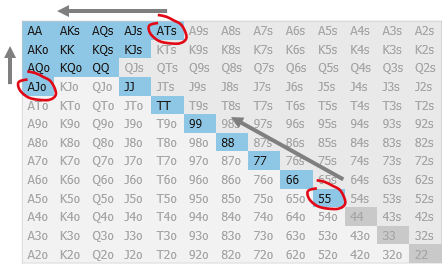
For example, when you have found out that 55, ATs, KJs, AJo and KQo are the lower limits of the different hand categories for an UTG open raise of a nit, then his average range for open raises out of UTG is 55+, ATs+, KJs+, AJo+, KQo.
Determining the 3-bet and the calling range
It is best to determine the calling range and the 3-bet range of a player type simultaneously, since hands that are 3-betted by your opponent cannot be in his calling range, and vice versa.
Again, start with the lower limit and consider what the worst hand in each hand category is that a player type will 3-bet for value from a certain position. All hands better than that are then in his 3-bet range.
If the worst hands in each category that a player type will 3-bet for value are TT, AQo, AQs, then his 3-bet-range is TT+, AQs+, AQo+.
The calling range of this player type then starts with the best hands that are not 3-betted for value by him. So if your opponent is 3-betting TT+ for value, then 99 is the best hand of his calling range.
You can determine the lower limit in a similar way to the lower limit of the open raise range of your opponent, by determining the worst hands in the range of your opponent. His calling range lies in between these two limits.
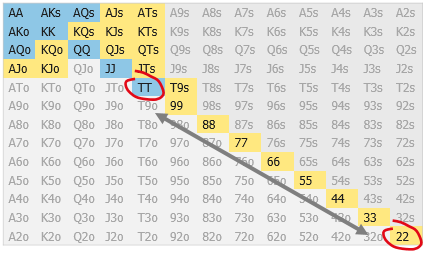
So if your opponent calls 22, AJo, KJo, ATs, KTs, QTs, T9s as worst hands in each category and 3-bets TT+, AQs+, AQo+, his calling range is 99-22, AJs-ATs, KTs+, QTs+, JTs, T9s, AJo, KJo+.
Understanding ranges systematically
In order to systemise this process, you should create tables in which you summarise the average ranges of the most common player types.
These tables could look as follows:
| Player Type | |||
| Position | Open raise | Call | 3-Bet |
| UTG | |||
| MP | |||
| CO | |||
| BU | |||
| SB | |||
| BB | |||