


Game Plan (2): Range Protection
Before this lesson, you should have already read:
Your pre-flop ranges are the foundation for your basis game plan. When setting up your pre-flop ranges, you will notice that your ranges influence one another.
If confronted pre-flop with an open raise, a 3-bet or a 4-bet, you often have a calling and a reraising range. Your calling range often includes your medium strong hands like AJs, 99 or KQ. If your range consists of only these types of hands, it can lead to the following problems:
- Your range misses on specific board textures
- On average the top of your range will be weaker, you won't be able to value bet as profitably and to integrate raising ranges into your game plan
- Often you won't have a value range which means you can hardly bluff with your bottom range
However, if you always play your premium hands passively pre-flop in order to avoid this problem, you will be losing value and won’t be able to bluff pre-flop as well as you would like to.
Instead, you should split certain combinations of hands of your premium hands into calling and raising ranges. This is called range protection.
 |
Range protection is the passive play of certain hand combinations of your premium hands in order to avoid capped ranges. |
When to apply range protection
In order to decide if range protection is necessary, you have to ask the following of your own range, as well as your opponent's range:
- Are the ranges capped or uncapped?
- Are the ranges wide or defined?
Range protection to avoid defined and capped ranges
With a capped range you will often face problems on later streets when your opponent has the stronger top range in bluff catcher situations.
When playing with a defined range you will encounter problems on board textures on which you most probably have missed on completely.
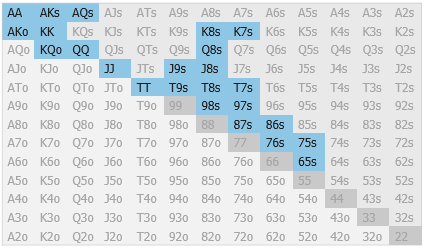
The following example shows both aspects: Your range is capped and defined. You open raise the CO and encounter a 3-bet from an aggressive player on the Button. His 9% 3-bet range is the following:
You are calling, however, with a defined and capped range:
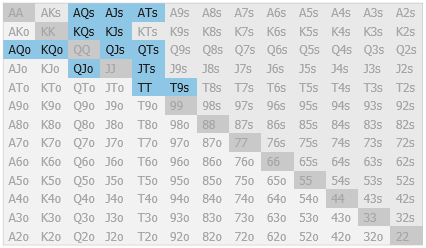
You will face difficulties on the following board textures:
- Boards with all cards below 9: Hardly any hand combinations are in your value range.
- Axx board textures: You are dominated by villain's Ax.
- Qxx board textures: You are rarely able to value bet against your opponent's range.
Under such circumstances you should apply range protection and split up the premium hands KK and AA:
4-bet range: AdAh, AdAs, AhAs, AdAc, AhAc, KhKs, KhKc, KsKc
Call 3-bet range: AsAc, KdKh, KdKs, KdKc
|
Tip: Before your session, determine a suit and split certain combinations in a 1:1 ratio. For example you could call with all KK combinations which contain a diamond and 4-bet the others. |
Wide ranges
When facing wide ranges, range protection becomes less important.
Example:
Heads-up you are defending the 100% minraising range of your opponent with your 42% range passively. On the flop the following ranges are confronting one another:
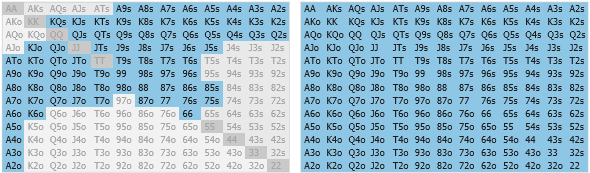
If you flop top pair with your Ax-, Kx- and Qx-hands, the relative strength of your hand will be much stronger considering your opponent is playing his complete range. Situations in which you are dominated will not occur often enough to be an advantage for your opponent.
More than that, the top ranges on most boards will consist of two pair, straights and strong draws. Overpairs will make out only a small part.
|
Range protection is important if you usually play a defined and capped range. But when wide ranges are in play, range protection becomes less important. |
No range protection against certain opponents
You can reraise all premium hands pre-flop if your opponent hardly ever attacks your calling ranges and you make it to showdown with your marginal pairs more often than not.
On the other hand, it might be a more profitable play to just call with your premium hands pre-flop against certain players. This would be the case if your opponent plays super aggressively against your calling range.
Summary

Range protection is the passive play of certain combinations of your premium hands in order to avoid capped ranges.
Range protection is not important when wide ranges come into play.