


Exploits (2): Thin Value Betting
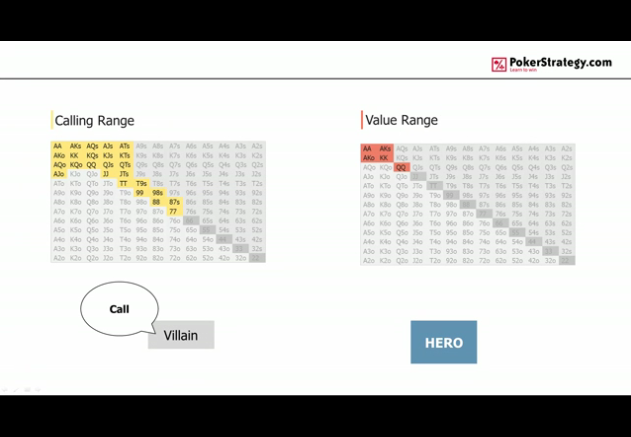
Thin value betting is an exploit that takes advantage of the overly wide calling ranges of your opponents.
In this lesson, you will learn how to identify this mistake in your opponents' play, and with which hands to extend your value range in order to exploit it.
Finding overly wide calling ranges in your opponent's play
In order to recognise situations in which the extension of your value range as an exploit is useful, you need to determine the calling range of your opponent in a particular situation. This can be done in two ways:
- Evaluating showdowns
- Analysing stats
Identifying overly wide calling ranges with the help of showdowns
At the showdown, you need to pay particular attention to the worst hands in your opponent's range and how many streets he calls with these hands. You are looking for deviations from your assumptions about his standard calling range.
Since TAGs and LAGs usually adjust their playing style to the situation, you should pay attention to the specific circumstances and limit your assumptions to them.
The most important factor for your opponent's range is the composition of your perceived range. This means how many bluffs and how many value hands it includes. For example:
- The higher the proportion of bluffs in your perceived range is, the wider your opponent will call.
- The higher the proportion of value bets in your perceived range is, the less your opponent will call.
Have a look at the following example:
$25 NL Hold'em (6 handed) - 100BB stacks
BU - TAG
Pre-flop: Hero is CO with 

2 folds, Hero raises to $0.75, BU calls $0.75, 2 folds
Flop: ($1.85) 

 (2 players)
Hero bets $1.50, BU calls $1.50
Turn: ($5.25)  (2 players)
Hero bets $4.00, BU calls $4.00
River: ($13.25)  (2 players)
Hero bets $11.00, BU calls $11.00
If your opponent calls in this situation with a hand like T8s or 77, it is likely that he calls too much after a couple of draws miss. He estimates the proportion of bluffs in your perceived range to be high.
Therefore you should, in future, value bet thinner against this opponent in situations where your perceived range includes many draws.
Identifying overly wide calling ranges with the help of stats
Stats can also help you estimate your opponent's calling range. Especially relevant are the "fold to c-bet" stats on all streets and the WTS value.
If the "fold to c-bet" value on any street is less than 40%, you should widen your value range. This is also the case when the WTS value is over 35%.
Exploiting overly wide calling ranges with thin value bets
You can exploit the overly wide calling ranges of your opponents with thin value bets. Which hands in particular these are depends on the calling range of your opponent.
Which hands to widen your value range by
You gradually widen your value range in relation to your opponent's calling range; the more your opponent calls, the more hands you can value bet that you would usually check with.
In order to be able to value bet a hand, you need 50% equity against the calling range of your opponent. Against the wider calling range of your opponent, hands that you would usually check have over 50% equity and you can therefore value bet them.
The first hands that you value bet additionally are the best hands that you would normally check. If you normally only value bet TPTK or better and check TPGK, then TPGK is the first hand that you value bet if your opponent calls more.
$25 NL Hold'em (6 handed) - 100BB stacks
BU – TAG
Pre-flop: Hero is CO with
2 folds, Hero raises to $0.75, BU calls $0.75, 2 folds
Flop: ($1.85) (2 players)
Hero bets $1.50, BU calls $1.50
Turn: ($5.25) (2 players)
Hero bets $4.00, BU calls $4.00
River: ($13.25) (2 players)
Hero bets $11.00, BU calls $11.00
You assume that your opponent calls on the river with the following hands: JJ, TT, A9s
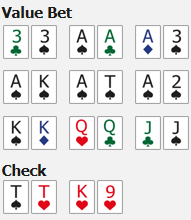
Therefore, the worst hand that you normally value bet is JJ, and the best hand that you would normally check is TT.
 |
||
| Value range: JJ+, 99-88, 33, A9s, A3s, AsKs, AsQs, AsJs, AsTs, As8s, As7s, As6s, As5s, As4s, As2s |
||
| Best hands in the checking range: TT, K9s |
||
If your opponent additionally calls with 89s and 77, you therefore value bet the first hand that you would normally check with, TT. If your opponent also calls with T8s, 87s, 66, you can also value bet K9s. You gradually extend your range in relation to your opponent's calling range.
 |
||
| Standard callin range: JJ-TT, A9s |
||
| Overly wide calling range: 77-66, T8s, 98s, 87s |
||
Summary

If your opponent calls too much, you exploit them by widening your value range, this is called thin value betting.
To find out whether your opponent makes this mistake, you particularly need to pay attention at showdowns to note which hands are the worst ones in his calling range.
The more hands your opponent calls with, the more hands you can thin value bet. You therefore extend your range by the best hands that you would normally check with.