


The Basics: Why Do You Bet?

There are three possible ways to bet in poker. When betting, your goal is always to make money. You can accomplish this in three different ways:
- The value bet: you bet to get paid by worse hands
- The bluff bet: you bet to force better hands to fold
- Collecting dead money: you bet to force your opponent to fold a worse hand with outs against you
In this lesson, you will get to know these different types of bets in detail.
The Value Bet
If you place a value bet, you want a worse hand to call.
So if you want to value bet, two things need to be true: your opponent has a worse hand than you, and he is willing to call.
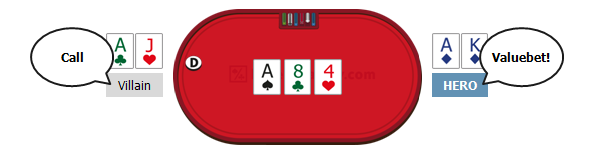
You are on the flop now and you hit top pair. You think that your opponent's range should contain a lot of ace hands, and it is obvious that he will have a hard time folding hands like AT, AJ and AQ. You dominate those hands with AK. You place a value bet to get paid by these hands.
If you bet with K5 against JT on a K43 rainbow flop, that is not a value bet. Your opponent has a worse hand, but he will hardly ever call.
 |
If you place a value bet, you bet with the best hand and you get called by weaker hands. |
The Bluff Bet
If you make a bluff bet, you bet with the weaker hand in order to get a better hand to fold.
If you bet with A3 on 774 rainbow flop, and your opponent folds KT, you did not bluff bet. Your opponent did not fold a better hand.
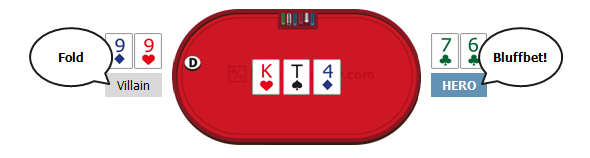
A good example for a bluff bet would be a situation where the flop contains a high card such as an A or K and your opponent cold called your pre-flop open raise. You put your opponent on a range that contains many pocket pairs, and you assume that he will have to fold most of them on this kind of board. You did not hit yourself, but you think that you can get a lot of better hands to give up. You can place a bluff bet in this scenario.
|
Placing a bluff bet means betting with a weaker hand to get a better hand to fold. |
Collecting Dead Money
If you are betting to collect dead money, you just bet to win the pot. You also want your opponent to fold his outs.
Dead money is another term for the money that is already in the pot. At the start of every hand, the blinds are dead money. As the hand goes on, more chips will join the blinds as dead money when players limp, raise, call or 3-bet.
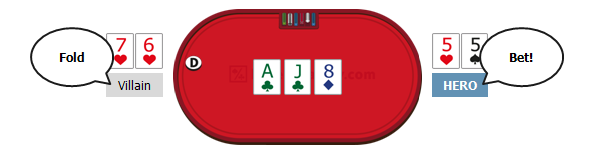
Look at the ace high flop in the graphic above. You raised pre-flop. In addition to the blinds, the pot now also contains the money of your raise and your opponent's call. This is called dead money.
You hold 55. You can't really place a value bet and a bluff bet does not seem wise either. Theoretically, however, both could be possible. Your opponent could continue possible draws that are beat by your 55 and he could also fold better hands like 66 or 77 to a bet.
But none of these outcomes is a primary goal. If you bet and your opponent folds, you won the pot and thus the dead money. Your opponent may have folded a weaker hand with his 76, but he also had 6 outs against you. By betting on the flop, you do not allow him to see a free turn and hit one of his outs. Therefore you force him to give up his outs.
|
When trying to collect dead money, you want to win the pot and get your opponent to fold his outs. |
The Three Types of Bets in Practice
You hold AK and bet the flop:
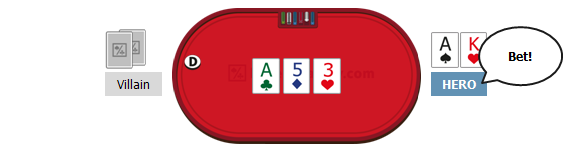
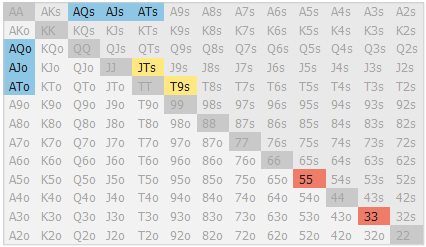
You put your opponent on the following range:
 |
||
| You value bet against AQ-AT. That amounts to 24 combos. |
||
| You do not value bet against JTs-T9s, because those 8 combos will fold to a bet. However, you will collect the dead money. |
||
| You also cannot value bet against 55 and 33. These hands represent six combos that are ahead of you. |
||
As you can see, you can't value bet against every hand. But since you beat 24 of his 38 combos and those combos will also call, your bet is profitable.
Now imagine you want to bluff on this board:
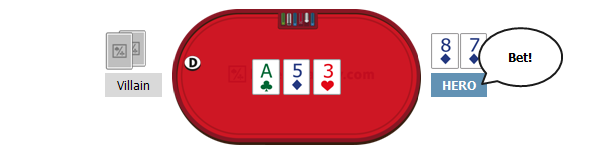
If you give your opponent the same range, you will only get the 8 combos of JTs-T9s to fold. The other 30 combos in his range are not only stronger than your hand, but they will also call a bet. Therefore bluffing will not be profitable in this spot.
What reasons do not justify a bet?
The aforementioned three types of bets contain all possible reasons to place a bet. All other kinds of bets can be explained by a combination of the three. You might first think of bets for "protection" or "information". If you bet for protection, you can achieve two things: your opponent folds his outs and you win the pot immediately. Alternatively, your opponent can also call and pay the price with a second best hand. Then you made a value bet.
Summary
|
There are only three reasons to bet:
You should know which of these goals you want to achieve every time you bet. |
 |