


How to beat the 'Let's Keep It Friendly' bet
What is the best way to exploit a player who leads out of position with medium strength hands? An unfriendly strategy to deal with a friendly bet.

In the self study series Barry Carter shows you how he tried to solve a poker problem then consults a coach or solver to get feedback on his method.
This week I played against an opponent who frequently used what Dara O'Kearney called 'the let's keep it friendly bet'. This is when they lead small, out of position, with a medium strength hand. It's an attempt to control the pot size.
I felt like I knew what to do, but thought it would be fun to test some assumptions. Here is an example hand from GTO Wizard. We are 60bbs effective, it is CO vs BB, single raised pot. The flop is 9♠8♥2♣.
In GTO World, the BB checks 100% of the time, when checked to, this is what the CO does:
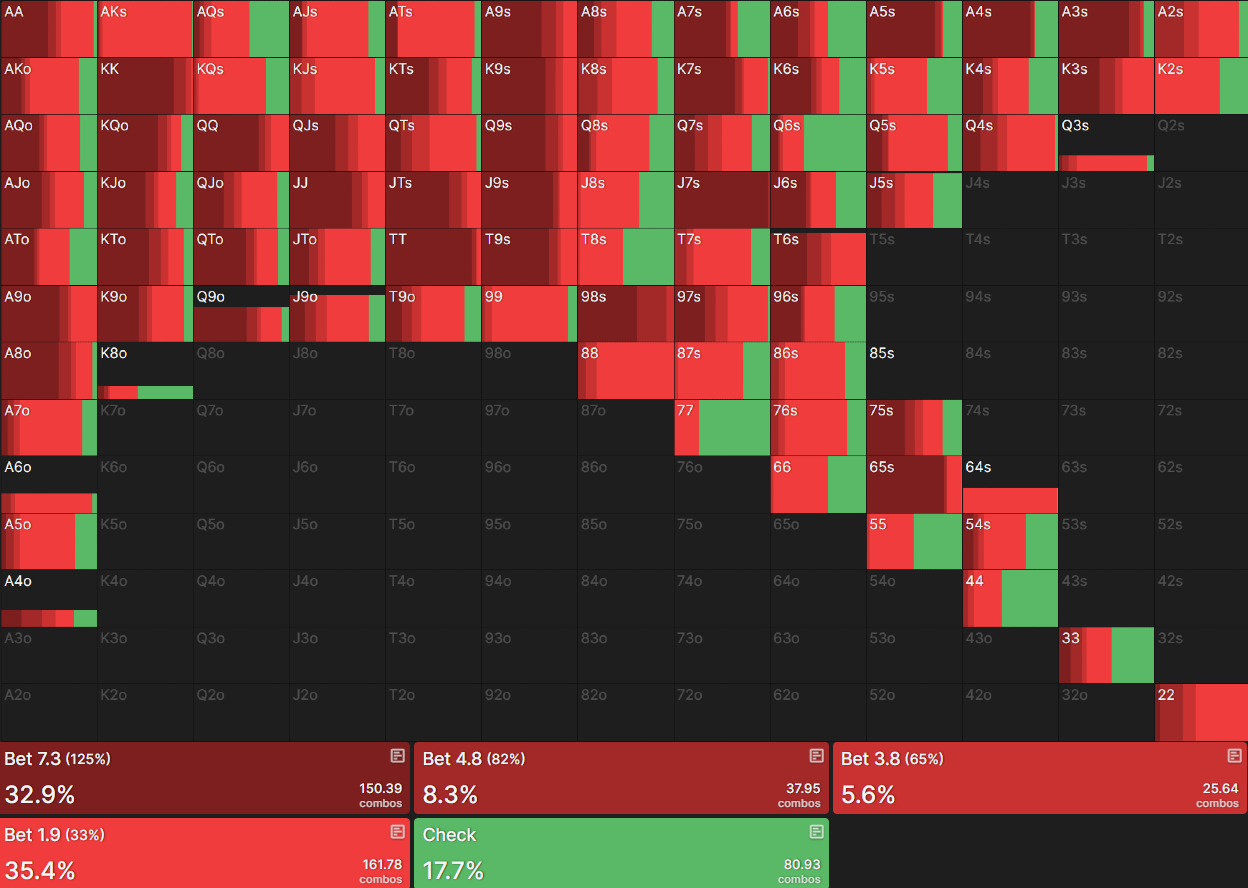
A mixed strategy with some overbetting, medium betting, small betting and checking.
Let's go back to the start of the hand and give the BB a 'let's keep it friendly' bet range:
.png)
Anything pair below top pair leads out 75% of the time and, for some balance, the open ended straight draws lead out half the time. If you haven't seen players play like this, join my games, this might be the most consistent leak I see these days.
First of all, let's see how the CO deals with the lead. Remember, we have nothing to compare it to in GTO World, as there were no leads:
.png)
This is a striking response. We raise with almost everything, only folding out the bottom of the range. This is because the BB has telegraphed they can't have top pair or better, so we put them in a tough spot. Against this raise, the BB is supposed to call 77% of the time. Notice they picked the bigger bet size too. I node locked again so that the BB folded 77 and below to the raise, and this is the new response to the lead from the CO:
.png)
Add some over folds in and our strategy suddenly becomes to raise 100% of hands, mixing the bet sizes. This is a clear cut exploit which reminds me of a quote from Dan Harrington back in the day this leak was known as a 'probe bet' - "when somebody asks a question with a bet, give them an answer they don't want".
This was not quite how I adjusted at the time. I raised my junk and best hands, flatted my OK hands to extract more bets, and called with my draws to then take it away on a later street if I missed. This worked very well for me too, but the solver's response is to raise, raise, raise.
There is another important consideration, which is what we do when this player checks the flop. This means they likely do not have a 2nd pair hand, but could have a top pair or better hand. We mixed in the GTO example, this is what we do in the node locked example:
.png)
A mixed strategy which checks and overbets becomes an almost 100% range bet with a small sizing. This is interesting and fortunately for me, I have recently studied this, because I would have struggled to explain it a month ago.
We have range advantage here, because the BB is missing almost all their pairs. Range advantage determines betting frequency, we have such a big advantage we bet all the time.
Nutted advantage determines bet size. If your opponent has a lot of nutted hands you bet small, because you do not want to overbet into an unbeatable hand. I wouldn't quite call top pair a nutted hand, but it's a very strong hand. The BB is more heavily weighted towards top pair than in the GTO example. So we bet a lot, but we bet small because we could be betting into top pair or better.
The let's keep it friendly bet allows you to be clairvoyant against your opponent. It is a bet made from fear, it is designed to keep the pot small. It stands to reason, therefore, that the adjustment to the bet is to do the opposite. Raise with a wide range and put your opponent under the pressure they were trying to avoid.
Previous self study articles
- Playing against disconnected players
- Overbetting with Ace King
- Why do we check back with Range Advantage?
- Why do I turn top pair into a bluff?
- How I use ICMIZER
- How wide can we go with Antes?
- Why can we bluff missed straight draws more than missed flush draws?
- How to play a strong underpair on a wet board
- How to play a 15BB stack
- How often does Villain have an Ace?
- Why do we not check/raise with the nut flush draw?
- Why do we bet small on the turn?
- When do we open shove the flop?
- The difference between SB and BB defends
- Blocker/Unblocker
- How to pick your bluffs
- When NOT to bluff a big draw
- Which hands over realise equity?
- When to check to induce bluffs on the river?
- What do we do when the check/raise backfires?
How do you study away from the tables? Let us know in the comments:
