


Ranges & Equity (3): Equity Introduction

Ahead of this lesson you should have read:
You already know what a range is and how to write it down. Now it's time to learn more about an application of this concept: Equity.
Equity is a percentage value that indicates how often your hand or range is ahead of your opponent's hand or range at showdown.
Equity is always a number between 0% and 100%. This means that you could have 0% equity and never win against your opponent's range or you could have 100% equity and always win against villain's range. The equities of all players always add up to 100%. If the board runs out in such a way that a split pot becomes a possibility, the likelihood of this case will be added evenly to all players' ranges.
 |
Equity is a percentage that indicates how often your hand or range is ahead of your opponent's hand or range at showdown. |
How to calculate your equity
In order to get your equity right, you have to do a simulation of all community cards that haven't been dealt yet and count all possible results at showdown. The percentage of how often your hand or range wins at showdown is your equity.
When we do a simulation of a pre-flop situation, we look at all possible flop, turn and river cards. In a simulation of a flop spot, you include all possible turn and river cards into your calculation.
There are more than 1.7 million possible combinations for the five community cards, which means that you can't do the simulation by hand. That's why there are special tools such as Equilab which lend you a helping hand to get the job done.
Example: You are all-in pre-flop holding aces with villain holding deuces. Here's a simulation of all possible combinations of community cards:
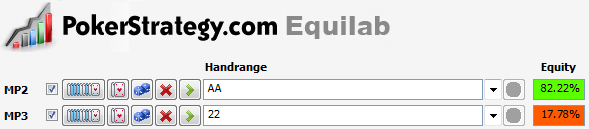
As you can see, you will win 82% of the time. Your equity is 82%. Therefore villain's equity is 18%.
The board changes your equity
If you are all-in pre-flop with AA against 22, there is an 82% chance that you will win the pot at showdown. Now there is a flop of 

 and villain hits a set.
This flop changes the situation and therefore your equity and you now only have 9% equity. If the turn brings one of the two remaining aces, your equity goes back up to 98%.
You can see that equity is not a constant and can change significantly with every community card being dealt onto the board. That's why you have to take every card on the board into account and re-evaluate your equity on every street.
Your equity depends on villain's hand or range
Your equity also largely depends on villain's range. Let's take a look at the following example. You are holding 66 and villain has two possible ranges:

Your absolute hand strength is a pair of sixes, but against the two sample ranges, your equity changes by a significant 35% points. Against range A, you can always get your hand all-in profitably since you win in more than 50% of the cases, but against range B you should fold pre-flop.
Your equity represents your true hand strength, not your absolute hand strength. You always have to define your hand strength in relation to your opponent's hand or range. That's why it's called relative hand strength. All your decisions at the table need to be based on your relative hand strength.
Examples for equity
In the following table there are examples of situations that are common at the table and their equity. Since calculating your equity is somewhat time consuming, getting a feeling for equity in different spots is an essential skill for a poker player to learn.
| Example | Equity | |
| Pair vs lower pair | AA vs 22 | 82% |
| Pair vs two overcards | 66 vs AK | 54% |
| 2 overcards vs 2 undercards | AK vs 76 | 62% |
| 1 overcard vs 1 undercard | A2o vs K3o | 61% |
| Flush draw on the flop vs top pair |   vs vs   on on   |
37% |
| OESD on the flop vs top pair |  vs vs  on on    |
34% |
| 2 overcards on the flop vs top pair |   vs vs  on on  |
24% |
If you want to calculate your equity based on outs, you can do so using the following rule of thumb:
- 1 out - turn to river: ~ 2% equity
- 1 out - flop to river: ~ 4% equity
Keep in mind that these numbers aren't 100% precise and you need to use the Equilab to get exact numbers. However, this rule of thumb allows you to get a rough idea of your equity while you are in the middle of a hand.
Summary
Equity:
|
 |