


Post flop ICM analysis
Barry Carter takes the new post flop ICM feature from GTO Wizard for a spin to highlight its potential.

In the self study series Barry Carter shows you how he tried to solve a poker problem then consults a coach or solver to get feedback on his method.
Given most of my recent books have been about formats where ICM is a factor, you can imagine how excited I was about the new post flop ICM feature at GTO Wizard.
This one is a game changer and today I wanted to review a simple hand to give you an idea why.
As is always the way with ICM analysis we should start with the ChipEV, GTO, way of doing things. This is a 40bb effective pot, UTG vs BB, the flop is 8♣5♠2♦.
In GTO, ChipEV world, the first action is a check from the BB. This makes sense, UTG has a significant range advantage and this is a hard flop for either player to hit:
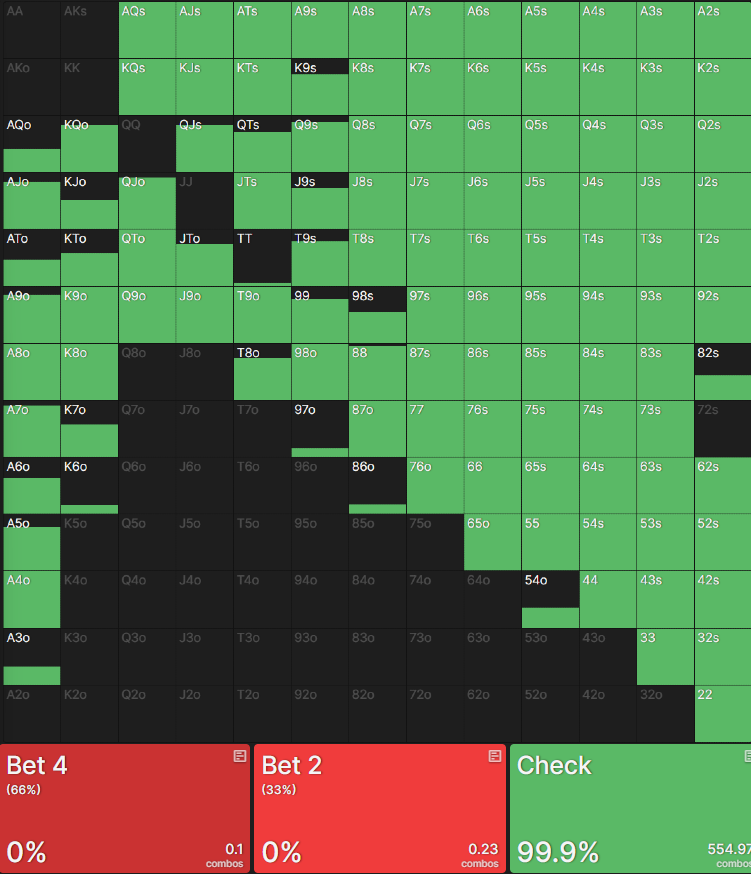
When they do check, this is the UTG response:
.png)
A mixed strategy, with a significant amount of large and overbet sizing. This makes sense, UTG has a polarised range, they tend to have a very strong hand or a miss. The BB does not have many nutted hands either, which dictates bet sizing, so they can go larger.
Let's now make this an ICM spot, with the same ranges and bet sizes, but this is on the final table bubble of the Bigger $109 on PokerStars. Stacks are still 40bbs effective, but we will make the BB have thrice that with 120bbs.
A quick note before we continue, we would not play the same preflop ranges as ChipEV because of ICM, but for the purposes of exploring the differences, we will in this instance.
This is the first action from the BB:
.png)
The BB has gone from checking 100% to leading 24% of the time. This is despite being at a significant range disadvantage. This is a common trend you will see in ICM, being the covering player means you can be more aggressive.
We don't have anything to compare the lead response to in ChipEV world, so let's look at what UTG does when checked to in ICM world.
.png)
At first glance, the response looks similar. A slight increase in checking but the same hands are betting. On further inspection, the bet sizing has come way down. The larger bet sizes were preferred in ChipEV world, but now the 33% pot size is the primary bet size.
This is another commonality in ICM, bet sizings tend to go down. Dara O'Kearney called this 'downward drift'. It's a similar effect to boards with lots of nutted hands like monotone boards. We play poker with the brakes on when there is the threat of elimination.
At this point, we could compare the overbet response in ICM world to ChipEV world, but it happens so rarely it doesn't add much value. The new feature at GTO Wizard, however, includes node locking. So the more interesting thing to do here is see what happens if UTG adopts a ChipEV strategy when they shouldn't.
First of all, this is what happens in GTO ChipEV world when UTG overbets:
.png)
Some raising, some calling but mostly folding, which makes sense for such a big sizing.
This is what happens when we node lock for UTG overbetting the same range as in ChipEV world, on the final table bubble:
.png)
The BB has gone from folding 60% of the time to folding just 22% of the time. They have gone from raising 10% of the time to raising 53% of the time. This is because, under the threat of elimination on the highest equity stage of the tournament, UTG should be folding half the time. They are being put in the 'ICM coffin'. This is a 2 BB/100 mistake from UTG, which magnified during the final table bubble, is worth a lot of real money in equity.
I am going to be playing around with this new feature a lot over the next few weeks, it is a game changer.
Previous self study articles
- Playing against disconnected players
- Overbetting with Ace King
- Why do we check back with Range Advantage?
- Why do I turn top pair into a bluff?
- How I use ICMIZER
- How wide can we go with Antes?
- Why can we bluff missed straight draws more than missed flush draws?
- How to play a strong underpair on a wet board
- How to play a 15BB stack
- How often does Villain have an Ace?
- Why do we not check/raise with the nut flush draw?
- Why do we bet small on the turn?
- When do we open shove the flop?
- The difference between SB and BB defends
- Blocker/Unblocker
- How to pick your bluffs
- When NOT to bluff a big draw
- Which hands over realise equity?
- When to check to induce bluffs on the river?
- What do we do when the check/raise backfires?
- The let's keep it friendly bet
How do you study away from the tables? Let us know in the comments:
